Is Pet Insurance Worth it? A Guide for Pet Parents
Wondering if pet insurance is worth it? Learn how it can save you money on vet bills, what it covers, and how to choose the right plan for your pet.
Do I Need Pet Insurance?
No one can tell you if you need pet insurance. The fact is that if you do NOT have pet insurance then 100% of the time, 100% of that bill will be paid for by you.
Understanding Pet Insurance: Is it Worth it?
As a pet parent, you want the best for your furry family member. But what happens when an unexpected illness or injury leads to a hefty vet bill? That’s where pet insurance comes in.
What is pet insurance & how does it help?
Pet insurance is designed to help cover the cost of veterinary care, so you’re not left facing a tough financial decision when your pet needs medical attention. Pet insurance helps to provide reimbursement for eligible vet expenses, helping pet owners with financial security when unexpected injuries and illnesses strike.
Costs of pet insurance premiums vs. pet insurance benefits
One of the biggest concerns pet parents have is whether the cost of pet insurance is justified. The reality is that veterinary care can be expensive, especially for emergencies, surgeries, or chronic conditions. Without insurance, you might have to pay thousands of dollars out of pocket, but with a policy in place, you can get financial support instead of bearing the brunt of these costs yourself.
The reality of unexpected vet bills
Even the healthiest pets can face sudden health issues—whether it’s an unexpected injury, a sudden illness, or a condition that appears later in life.
Here are some common claims that pet parents have faced and Petsy has helped pay*:
$13,320.00 for gastro-intestinal and digestive system disorders
$6,243.42 for cat bite wound
$5,191.02 for neurological disorders
$6,000 for kidney failure
$4,520 for cruciate ligament rupture
*Based on Petsy settled claims between January 2024-2025.
Pet insurance can help you prepare for the unexpected, so your pet can receive the care they deserve without financial stress.
Cost of Vet Care vs Pet Insurance
One of the biggest questions pet parents ask is: Is pet insurance really worth it? To answer that, let’s look at the cost of veterinary care and how pet insurance can help you manage those expenses.
Common vet costs and what you might pay without pet insurance
Vet bills can add up quickly, especially when unexpected emergencies or chronic conditions arise. We spoke to a range of vet clinics around Australia and collated common treatment costs. Here’s what pet parents can typically expect to pay for common treatments.
*These prices are indicative of average vet costs in Australia for 2025. Your actual expenses may vary based on your vet clinic and your pet’s individual needs.
Treatment
Estimated Cost (Without Insurance)
Emergency vet visit
$250 – $500+
X-rays & diagnostics
$300 – $3,000+
Surgery (e.g., foreign object removal)
$3,000 – $10,000+
Ongoing medication for chronic illness
$500 – $2,000+ per year
Cancer treatment
$5,000 – $15,000+
ACL surgery
$3,500 – $7,000+
Bite wound or laceration repair
$800 – $2,500+
For many pet parents, an unexpected bill of thousands of dollars can be overwhelming, making financial decisions about their pet’s care incredibly stressful. With no Medicare for pets, vet bills are out-of-pocket expenses for pet parents without pet insurance.
Vet costs can vary widely depending on the clinic, location, and type of treatment needed—there’s no set pricing across the board. If you’re worried about affordability, it’s always worth checking with different vet clinics in your area, as prices can differ from one postcode to another. Some clinics also offer payment plans or financial assistance options to help ease the burden of upfront costs.
Typical Vet Expenses With and Without Pet Insurance
Veterinary care has advanced significantly, offering life-saving treatments and specialised care for pets. However, these advancements come at a cost, and unexpected vet bills can quickly add up.
Without Pet Insurance:
When your pet needs medical care, you’re responsible for the full cost of treatment out of pocket. Here are some common expenses based on vet costs in Australia in 2025:
Allergic reaction or skin conditions: $250 – $1,000
Ear infections: $150 – $500
X-rays or imaging (MRI, ultrasound): $300 – $3,000
Emergency surgery (e.g., foreign object removal): $2,000 – $8,000
Cruciate ligament surgery (common in dogs): $3,500 – $7,000 per knee
Cancer treatment (chemotherapy, surgery, radiation): $5,000 – $15,000+
With Pet Insurance:
With pet insurance, you’re reimbursed for eligible expenses based on your coverage. Instead of worrying about how to cover a $5,000 surgery, for example, you might only be responsible for a smaller portion, depending on your policy’s reimbursement rate and deductible amount (called excess).
For instance, if your policy covers 80% of eligible vet bills after a $200 annual excess, a $5,000 surgery on an eligible claim would only cost you $1,160 out of pocket instead of the full amount. This makes pet insurance a valuable tool to help manage unexpected expenses while ensuring your pet receives the best possible care.
Pet insurance helps reduce out-of-pocket costs by reimbursing a percentage of your eligible vet bills, depending on your policy. Here’s more examples on how the difference can look in different scenarios:
Example 1: Emergency surgery for a swallowed object
A playful Labrador swallows a sock, requiring emergency surgery to remove it.
Total Vet Bill: $6,500
Without Pet Insurance: You pay the full $6,500 out of pocket.
With Pet Insurance (80% reimbursement after $200 annual excess): You might pay just $1,460 (assuming a $200 annual excess is applied to this claim).
Example 2: Managing a chronic condition (Diabetes in Cats)
A cat is diagnosed with diabetes and requires lifelong medication and regular vet visits.
Annual Vet Costs: $1,800
Without Pet Insurance: You cover the full $1,800 each year.
With Pet Insurance (80% reimbursement): You may pay only $520 per year (after $200 annual excess).
What Does Pet Insurance Cover?
Coverage overview
Petsy Pet Insurance is an insurance policy that reimburses 80% or 90% of vet costs for the treatment of your pet if they suffer an unexpected injury or illness (provided these occur after any applicable exclusion period has ended symptom free).
Our policy is customisable and you’ll be able to tailor the level of coverage, based on your preferences for the Benefit Percentage, Annual Limit, Annual Excess, whether or not you’d like Optional Extra Benefits (if your pet is less than 3 years old) and whether or not you’d like to include costs of Vet Consultations for your cover.
You get to see a summary of the cover when completing an online quote/application and have the option to select a preferred start date. After making the payment, you’ll receive a confirmation of cover and your policy documents by email.
Our commitment to transparency means that you’re fully informed about your coverage. For added peace of mind, we offer a complimentary Pre-Existing Condition Assessment for all our members. This includes collecting your pet’s vet history upfront which helps to fast-track any future claims and we’ll also let you know whether there are any pre-existing conditions noted in their medical history that might affect your ongoing coverage.
Claims process is quick and easy, and your vet can submit claims on your behalf. Approved claims are paid into your nominated bank account.
What’s Not Covered? Understanding Exclusions in Pet Insurance
Pre-Existing Conditions
If your pet showed signs of an illness or injury before your policy started (or during waiting or exclusion periods), that condition won’t be covered. This is why it could be ideal to get insurance early before any issues arise.
Routine & Preventative Care
Petsy Pet Insurance is designed for unexpected health issues, not everyday care. That means it doesn’t cover:
Regular vet check-ups and annual health exams
Vaccinations
Flea, tick, and worm prevention
Grooming, including ear cleaning
Food, prescription diets, and supplements
Certain Conditions & Treatments
Some treatments and conditions aren’t covered, as explained below :
Brachycephalic Obstructive Airway Syndrome (BOAS) is not covered unless you’ve submitted and had a BOAS application form approved.
Specialised therapies (such as hydrotherapy or acupuncture) are only covered if you’ve added on Optional Extra Benefits to your Petsy Pet Insurance policy.
Experimental treatments, elective procedures, and breeding-related treatments are excluded.
Emergency, Medications & Burials
Emergency vet costs are covered if your pet ran into an unexpected injury or illness after the exclusion periods ended on your policy and it’s not a pre-existing condition. If it wasn’t a true emergency but you visited an emergency clinic, your claim may be adjusted to reflect the cost of treatment at a regular vet during normal hours.
Medications must be approved for use in Australia (or New Zealand if on a trip shorter than 60 days).
Costs after your pet has passed away (such as cremation or burial) are not covered.
General Exclusions
Like most types of insurance, pet insurance won’t cover:
Vet costs due to neglect, mistreatment, or not following vet advice
Vaccinatable diseases if your pet wasn’t up to date on vaccinations
Epidemics, pandemics, or natural disasters
Acts of war, civil unrest, or nuclear events
For a fuller list of exclusions, please refer to “The Summary of Exclusions” in the Product Disclosure Statement.
Importance of reading policy details before purchasing
Before purchasing pet insurance, it’s important to read the policy details carefully so you know exactly what’s covered and what’s not. Every policy has exclusions, waiting or exclusion periods, and limits that can affect your coverage. Understanding these upfront helps you avoid surprises when you need to make a claim, ensuring you choose the right plan for your pet’s needs and your budget and a more seamless pet insurance experience. The policy details are contained in the Product Disclosure Statements.
Why Pet Insurance Matters: Key Benefits for Pet Parents
Pet insurance provides valuable financial protection against unexpected vet bills, helping you manage the cost of emergencies, illnesses, and long-term conditions. Instead of worrying about how to afford treatment, you can focus on getting your pet the best veterinary care without financial stress. Having coverage also gives you peace of mind, knowing you’re prepared for life’s surprises—whether it’s an injury, sudden illness, or other unexpected medical conditions. With pet insurance, you can make decisions based on your pet’s health, not just your budget, ensuring they get the care they need when they need it.
Peace of mind for pet parents
As pet parents, we want to do everything we can to keep our pets safe and healthy. Unexpected illnesses and injuries can happen at any time, and the last thing you want is additional financial stress dictating your pet’s treatment options. Pet insurance provides a financial safety net and instead of worrying how to pay for an emergency vet visit, you can make decisions based on what’s best for your pet. Whether it’s a minor issue or a more serious medical condition, you can have the confidence that you would be more financially prepared.
Setting up a pet insurance policy early can also help to provide coverage for long term and chronic conditions or if you own a breed that’s prone to developing hereditary conditions.
Common Myths about Pet Insurance
“It’s too expensive.”
Some pet parents assume pet insurance is costly, but when compared to unexpected vet bills, it can actually save you money in the long run. Emergency treatments, surgeries, and ongoing care for chronic conditions can add up to thousands of dollars. A pet insurance policy helps manage these expenses, ensuring you’re financially prepared for tomorrow’s unknowns. With the range of policies available, there are also options to adjust the policy to help suit your budget. Petsy Pet Insurance offers a customisable policy without sacrificing the number of conditions covered and without sub-limits attached to the conditions you can claim.
“I don’t need it because my pet is healthy.”
While your pet may be in perfect health today, injuries and illnesses can occur at any time. From sudden injuries like broken bones or allergic reactions all the way to illness conditions that develop over time, medical costs can quickly escalate. Getting pet insurance early helps ensure coverage before issues arise, allowing you to maximise on coverage for the future.
“All policies are the same.”
Not all pet insurance plans offer the same level of coverage. Some may exclude certain conditions, have different reimbursement rates, or limit coverage for chronic illnesses. That’s why it’s important to read the Product Disclosure Statement and compare policies carefully, looking at what’s covered, exclusions, and benefits, so you can choose a plan that best suits your pet’s needs.
How to Choose the Right Pet Insurance Plan
Finding the best pet insurance for your furry friend involves more than just picking the first policy you see. Here’s what to consider when comparing plans:
Key considerations
Coverage – Look at what’s included, such as injuries and illnesses and any specific conditions that you’re concerned about for your pet’s breed. Check if the policy includes sub-limits on the conditions you can claim.
Exclusions – Understand what’s not covered on the policy is just as important as understanding what is, such as pre-existing conditions or specific breed-related health issues, along with any exclusion or waiting periods that apply to the policy.
Benefit percentage and annual limits – Policies vary in how much they cover per claim, common options range from 70% to 90%. The annual limit you choose determines how much you can get reimbursed each policy period (every 12 months).
Excess options – Check the annual excess and any applicable payout limits to ensure they align with your budget and needs. There are different excess types which can range from per condition, per claim or annual excess options. These can determine your overall out of pocket costs.
Waiting or Exclusion Periods – When you start a new policy, there are different exclusion periods that need to pass symptom free before your coverage starts. Check these timelines when starting a new policy.
How to compare different providers
When comparing different pet insurance providers, read through the Product Disclosure Statements or PDSs to review coverage details. Reading customer reviews and testimonials can also help to obtain real world insights, and choose a provider with a straightforward claims process for faster reimbursements. Additionally, you can check if your preferred vet is covered or if there are any network or claim restrictions.
Tips for finding the most suitable policy for your pet include:
Sign up early before health issues arise to maximise coverage.
Choose a policy that works best for your pet’s breed, age, and potential health risks.
Consider add-ons like dental illness, specialised therapies or behavioural conditions.
Make sure the plan offers flexibility and you’re happy with the claims process the provider offers.
By doing your research and comparing policies carefully, you can choose a pet insurance that is most suitable for you and your pet so that your pet can receive the care they need when needed most.
The world of insurance can be difficult to navigate, and pet insurance is no exception. In Australia, we’re fortunate to have a wide range of quality providers and policies to choose from. However, with so many options, it’s important to understand that not all pet insurance policies are created equal. The same claim made under different pet insurance policies may lead to significantly different outcomes. That’s why comparing pet insurance policies is essential to find the right balance among coverage, price, and value for your pet.
Why Would I Want Pet Insurance?
Even if you are a safe driver, you can’t control other drivers on the roads. This is why we get car insurance. You may say that you are a responsible and experienced traveller, but you cannot anticipate everything that happens whilst abroad. This is why we get travel insurance.
You may say that you are a responsible pet parent, but we cannot control what our pets are doing every moment of the day (especially the extra mischievous ones!). Even more so, we cannot have any foresight to know if our pet may develop a chronic condition or illness such as epilepsy or cancer. What is certain though, is that without pet insurance, 100% of the time in a pet emergency, you will have to pay 100% of the vet bill.
What is Pet Insurance?
Pet Insurance is a form of insurance available to pet owners to help cover their pet for accidental injuries and illnesses, by reimbursing a portion of the veterinary costs to treat their pet.
Pet insurance acts as a financial safety net, helping cover unexpected veterinary costs if your pet needs treatment. Some medical expenses can run into the tens of thousands, and having a pet insurance plan can significantly reduce the financial burden and stress during difficult times.
History & Evolution
Insurance for animals began in Sweden in 1890, when Claes Virgin wrote the first policy for horses and livestock. The pet insurance policy for pets like cats and dogs was first sold in Britain in 1947. By 2009, Britain had one of the highest rates of pet insurance, second only to Sweden.
In the U.S., pet insurance started in 1982, with the first policy issued to the famous TV dog, Lassie.
Pet insurance works a bit differently than health insurance for human — it’s more like property insurance. After your pet receives care, you pay the vet and then send a claim to your insurance company to get reimbursed.
One fun fact: Since 2009, the Hambone Award has been given each year to a pet with the most unusual insurance claim. Its name comes from an unnamed dog who reportedly was trapped in a refrigerator and suffered from mild hypothermia, eating an entire holiday ham while waiting for rescue.
Pet insurance policies can have different coverage limits: some have limits per condition, some have limits per condition per year, and others have one overall limit per year. This affects how much you can claim if your pet needs multiple treatments.
Pre-existing symptoms and conditions are often not covered, which is why it’s recommended to insure pets early before any health issues arise.
There’s usually a period of time when you can’t claim for accidents or illnesses right after getting a policy. This ensures coverage is for new injuries or illnesses that show up after you’re insured.
Pet Insurance Today
Today, pet insurance in Australia is becoming increasingly popular as more pet parents seek to protect their furry companions from unexpected vet bills. With a variety of pet insurance policies available, coverage can range from basic accident-only policies to more comprehensive options that include illnesses, routine care, and wellness treatments. Many Australian insurers now offer flexible plans with different benefit limits and extras, giving pet parents the ability to choose coverage that fits their budget and needs.
Understanding Pet Insurance
How Pet insurance Works: A Quick Overview
Pet insurance helps cover the cost of unexpected vet bills. After your pet receives care, you pay the vet, submit a claim, and get reimbursed based on your policy’s coverage. Policies usually cover accidents, illnesses, and sometimes routine care, depending on the plan. There are limits to how much you can claim, and pre-existing symptoms and conditions are generally not covered. Most policies also have a exclusion period before coverage kicks in for certain conditions. Pet insurance gives peace of mind by helping to manage unexpected medical costs for your pet.
In Australia, pet insurance typically offers several types of coverage. These can vary among different providers, but the main types include:
Accident-Only Cover: This only covers costs related to injuries from accidental injuries, such as broken bones or wounds. It doesn’t cover illness-related expenses.
Accident and Illness Cover: This is a more well-rounded coverage option that covers both accidental injuries and illnesses. It can include coverage for a wide range of conditions, from minor issues, like infections and allergies, to more serious diseases like cancer.
Accident and Illness Cover with add-ons: Some plans also cover routine care treatments like vaccinations, desexing, and flea and tick treatments, along with accidental injuries and illnesses.
Routine Care: Can be offered as an optional add-on, which helps to cover some costs for preventative care and wellness treatments, such as vaccinations, microchipping, and desexing. The coverage limits for these treatments are usually lower than for other claimable conditions.
How to compare Pet Insurance Policies
Why Compare Pet Insurance Policies
At Petsy, our mission is to ensure that pet insurance doesn’t end in tears. We’re here to educate you so you know exactly what you’re getting when you sign up. According to Moneysmart, pet insurance premiums typically range from $60 to $120 per month, which means there is a lot of variation of price and coverage in the market. Switching providers can be costly, especially if pre-existing symptoms and conditions are involved, so it’s crucial to find the right policy for you and your pet from the start. We strongly suggest shopping around for pet insurance quotes before you commit to a provider.
How to Compare Pet Insurance Policies
In Australia, there are many quality providers, each offering a range of policies. To make the best choice, it’s important to research and compare coverage options, costs, and how well each policy matches your pet’s health needs.
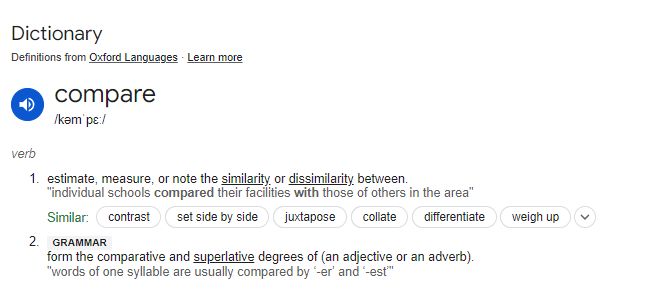
According to Google, the definition of compare is to “estimate, measure, or note the similarity or dissimilarity between”.
When comparing pet insurance policies, typically they have similar key components: inclusions/exclusions, an annual limit, benefit percentage, excess, and optional extra benefits. Your premium is determined, based on the levels of coverage depending on these components, as well as your pet and your address. So, when comparing pet insurance, the key is to understand how each component works differently across providers. This helps you identify the best policy that meets your needs and offers the most value.
Let’s break down these components so you can see where policies are similar and, more importantly, where they differ.
Coverage and inclusions
Most providers offer tiered policies, such as small, medium, or large, or bronze, silver, or gold and will try to bucket you into one of these categories. Generally, the lower-tiered policies offer less coverage and are more affordable, while the higher-tiered options provide broader coverage with fewer restrictions.
At Petsy, we understand that even two pet owners in the same suburb with the same breed of pet may have different financial needs. That’s why we do things differently here and offer one policy that is customisable to suit your coverage and financial requirements.
Annual limit
The annual limit is the maximum amount your pet insurance will pay for all claims in one year. Once this limit is reached, you’ll need to cover any additional costs yourself until the next policy year.
At Petsy, regardless of the annual limit you choose, the list of covered accidental injuries, illnesses, and conditions remains the same. Often with other policies, if you pick a larger annual limit, the list of your inclusions will also increase. At Petsy, no matter which annual limit you choose, the list of covered injuries, illnesses, and conditions remains the same. Whether you opt for a $5,000 or $25,000 annual limit, your coverage remains the same. Plus, unlike many other providers, we don’t impose sub-limits, so there are no restrictions on how much you can claim for specific conditions or claims.
Benefit percentage
This is the percentage of each eligible vet bill your insurance will cover. For instance, if your benefit percentage is 80%, the insurance will pay 80% of the bill, and you’ll pay the remaining 20% (after any excess is applied). This is pretty similar across the industry. Benefit percentage ranges from 70% to 100%.
Excess
This is the amount you have to pay out of pocket before your insurance starts covering costs. It can be a fixed amount per claim, per condition or per policy year.
At Petsy, our excess works a bit differently. Instead of applying an excess per condition or claim, we use a once-off annual excess. For instance, if your annual excess is $300 and your first vet bill is $200, the remaining $100 will be applied to your next approved claim. You only need to meet this excess once per year.
Optional extra benefits
Optional extra benefits are additional coverage options that can be added to the standard coverage. When doing your research, you will find that there are a lot of dissimilarities in the market for optional extra benefits. A lot of providers don’t even offer any optional extra benefits. You will find that some providers offer routine care as ‘add-ons’ and if they do, sometimes only offered as part of plans with the highest level of coverage.
At Petsy, we offer optional extra cover for dental illness, behavioural conditions, and specialised therapies. Plus, we don’t have sub-limits on these. However, it’s important to note that routine care items, like regular teeth cleaning, isn’t covered. Claims need to be related to a dental disease like gingivitis, periodontal disease, or tumours.
We offer optional extra benefits only for pets under the age of three at the time of application. Why only under three? By the age of three, most pets may develop dental diseases, and adding extra benefits later would mean these conditions would be considered pre-existing symptoms and conditions that would not be covered. We want to ensure you’re not paying for coverage that can’t be used.
Vet consultations
Vet consultation fees are what you pay your vet when your pet needs to see the vet for treatment when they’re sick or hurt.
When you receive a vet bill, one of the line items will typically be for the vet consultation. We’re one of the few providers that allows you to exclude vet consultations fees from your coverage. We do this for a few reasons:
Many of our customers are vets, vet nurses, or clinical staff who receive significant discounts or don’t pay for vet consultations at all
Some customers are already on wellness plans which cover vet consultation fees, so we don’t want them doubling up
Pensioners often get discounts on their vet consultation fees
It’s worth noting that the cost of vet consultations can increase significantly during emergency hours. If you don’t fall into one of these categories, it might be worth considering including vet consultations in your coverage.
Customer service and how a provider makes things easier for you
Choosing a pet insurance isn’t just about the coverage—it’s also about how well the provider supports you when you need them most. Here are some things to think about:
Is it easy to file a claim?
How do they handle pre-existing symptoms and conditions?
Can they bill your vet directly?
How easy is it to reach their support team?
What’s their cancellation policy?
Can you add extras later?
An easy way to check out a provider’s service is by looking at reviews on sites like ProductReview.com.au and Google Reviews. These platforms offer real feedback from customers, giving you a sense of how well the provider handles claims and customer support.
What Exactly is a Pet Insurance Quote?
A pet insurance quote is simply just an estimate of what it’ll cost to insure your pet. Similar to quotes for human health, car or home insurance, a pet insurance quote is tailored specifically to your pet. The amount you pay—known as the insurance premium—can vary depending on things like your pet’s breed, age, sex, and where you live. Plus, the level of coverage you pick will impact how much you will pay.
Full definition can be found here. We suggest gathering a few quotes whilst you’re shopping for pet insurance, so you can compare different policies and providers before making your final decision.
What Affects the Cost of your Premium
Different insurance providers have their own way of calculating premiums, but they’re generally based on similar factors. At Petsy, we consider four main factors related to your pet, then adjust the premium based on your preferred coverage options. It’s worth noting that with Petsy your own claims history doesn’t impact your premiums directly, when it comes to renewal time.
Species and Breed: The breed of your pet can significantly impact the cost of your premium. Some breeds are more prone to specific health issues, which can make them a bit pricier to insure. Your pet’s health history prior to taking out pet insurance won’t impact your premiums with Petsy. Just like most other insurers, we don’t cover pre-existing symptoms and conditions and illnesses.
Pet’s Age: Generally, younger pets have lower premiums. As your pet gets older, the chances of health problems increase, which can lead to higher veterinary costs. At Petsy, we like to reward responsible pet ownership and pet parents who start early. So, if you begin your pet’s coverage with us before they’re 6 months old, we’ll automatically increase your annual limit by 20% at no extra cost. If you start before they turn one, we’ll add 10% to your annual limit, also at no extra cost.
Location: Where you live can also affect your premium. Vet costs can vary depending on whether you’re in an urban area or somewhere with a higher cost of living. Certain locations might also have higher risks for specific health issues or accidents, and insurers take this into account.
Sex of your Pet: The sex of your pet can influence behaviour, which might affect the likelihood of certain claims. There are also some statistical differences in health and lifespan between male and female pets, which insurers factor into their risk assessments.
Common Pitfalls when Comparing Pet Insurance Quotes
One common mistake when comparing pet insurance quotes is to have price as the deciding factor and simply pick the lowest premium option. Not all pet insurance policies are created equal, so it’s important to compare policies properly, by comparing “apples with apples”, so you know what’s actually included (or not included) at the price point you are comfortable with.
To offer budget-friendly options, some providers might limit coverage through stricter exclusions or sub-limits, which can limit how much you can claim. These details may not be obvious when obtaining a quote. You may also be met with a hefty price increase when it comes to renewal time.
At Petsy, our focus is on providing high-quality coverage and service that offer long-term value. Our Australian-based team ensures you always speak with a local pet lover. Through our experience, we understand that more extensive coverage tends to align with our customers’ expectations. That’s why we focus on high-quality insurance with no sub-limits. Our customisable policy allows for coverage levels to be adjusted. For example, by increasing the annual excess, you will be able to lower premiums to meet your budget needs.
How can I lower my pet insurance premiums?
There are ways to lower your pet insurance premium by adjusting your coverage options, like the annual limit, benefit percentage, and annual excess. Generally, the more coverage you choose, the higher the premium. Here’s a quick rundown of the main factors:
Annual Limit: The annual limit is the maximum amount your pet insurance will pay for all claims in one year. Once this limit is reached, you’ll need to cover any additional costs yourself until the next policy year. The higher the limit, the higher the premium; the lower the limit, the cheaper or lower the premium. At Petsy, we offer a range of options, including $5k, $10k, and $25k, all with no sub-limits. Our pet insurance covers both accidents and illnesses and has one list of conditions covered under the policy regardless of the annual limit chosen by you. This means, even if you chose an annual benefit limit of $5,000 instead of $25,000, the list of conditions covered is exactly the same. It just means the total amount claimable in the 12-month period is $5k, not $25k.
Benefit Percentage: This is the percentage of each eligible vet bill your insurance will cover. Most options in the market range from 70% to 100%, but be sure to check the fine print for exclusions. At Petsy, we offer two options: 80% and 90%. You can lower your premiums by adjusting your benefit percentage. For example, choosing a plan that covers 80% of each eligible vet bill, rather than 90%, can help reduce your monthly premiums.
Annual Excess: This is the amount you have to pay out of pocket before your insurance starts covering costs. It can be a fixed amount per claim, per condition or per policy year. The lower the excess, the higher the premium; the higher the excess, the cheaper or lower the premium. Different insurers offer different types of excess, such as per claim, per condition, and annual excess. Ours is a once-off, annual excess that you’ll need to meet first. At Petsy, we have several annual excess options: $0, $150, $200, $300, and $500. We recently introduced the $500 annual excess option that can reduce the premium by more than 40% in some cases.
Optional Extra Benefits: Many providers including Petsy, offer add-ons for extra benefits like Dental Illness, Specialised Therapies and Behavioural Conditions. If you decide to include extras, this will increase your premium, as coverage also increases. Petsy is one of the few providers that offer dental illness coverage with no sub-limits.
Vet Consultations: Removing vet consultations fees from your coverage can lower your premium. We are one of the few providers who allows for this, because many of our members are vets and pensioners who receive discounts on vet consultations, or they may already be covered by wellness plans and we don’t want them to double up. However, it’s worth noting that the cost of vet consultations can increase significantly during emergency hours. If you don’t fall into one of these categories, it might be worth considering including vet consultations fees in your coverage.
Benefit Percentage: 80% Annual Excess: $150 Optional Benefits: Excluded Vet Consultation Fees: Included
Annual Limit
$5,000
$10,000
$25,000
Monthly Premium
$41.09
$48.32
$57.87
Quote as at 23 September 2024
5- month old Labrador Retriever
Location: Parramatta, NSW Breed: Labrador Retriever DOB: 12 April 2024 Sex: Boy
Annual Limit: $12,000 ($10,000 plus $2,000 bonus at no extra costs) Benefit Percentage: 80% Optional Benefits: Included Vet Consultation Fees: Included
Annual Excess
$500
$300
$200
$150
$0
Monthly Premium
$45.56
$56.22
$65.42
$71.45
$97.20
Quote as at 23 September 2024
Try out our quote tool to explore coverage options that fit your needs and budget.
The Importance of Pet Insurance Reviews
So, you’ve done your research, compared pet insurance quotes and maybe have one or two providers shortlisted. The policies look great, but how can you be sure you’ll want to stay with one provider for the long haul? Should you just pick a provider and hope for the best? Absolutely not! This is where pet insurance reviews come in handy.
What is a Pet Insurance Review?
In essence, a pet insurance review is a customer’s experience with their insurance provider that is shared online. These reviews offer insights into real experiences, particularly aspects like the claims process, customer service, and overall satisfaction—things you can’t fully judge from the policy details alone.
Reviews can be incredibly helpful for understanding key aspects of a pet insurance provider’s service. When it comes to the claims process, you’ll want to know: Was it easy to submit a claim? How long did it take to process? Were there clear explanations provided if a claim was denied? These details are crucial because they directly affect your experience when you need to rely on your insurance the most.
Similarly, customer service is another critical area to consider. Reviews can tell you how responsive and helpful the support team can be. Do they address concerns promptly? Are they knowledgeable about the policy details and able to guide you through tricky situations? Good customer service can make a huge difference, especially during stressful times when your pet’s health is on the line.
Not every review is going to be spot-on—sometimes, claims are denied for legitimate reasons, like pre-existing symptoms and conditions, but that can lead to unhappy customers. However, if you see the same issues popping up in multiple reviews, it might be a red flag.
Who Can Leave Pet Insurance Reviews?
Customers and the general public can share their experiences on sites like ProductReview.com.au, Trustpilot, or Google Reviews. In addition to customer feedback, financial and pet industry experts also contribute to reviews. Sites like Forbes Advisor offer professional assessments, focusing on coverage options, pricing, and policy details. These expert reviews can be especially helpful when you’re comparing multiple providers and need a deeper understanding of the policies. There is a lot of regulation around online product and service reviews, so that consumers can rely on the reviews they read online from reputable review sites.
What Should I Look for in Pet Insurance Reviews?
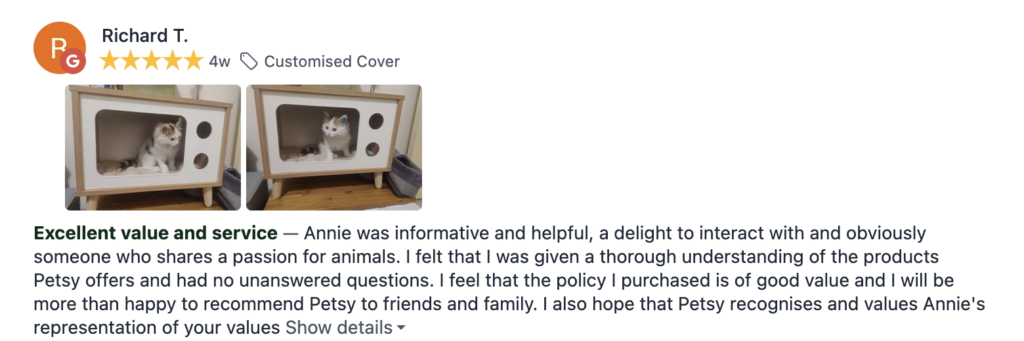
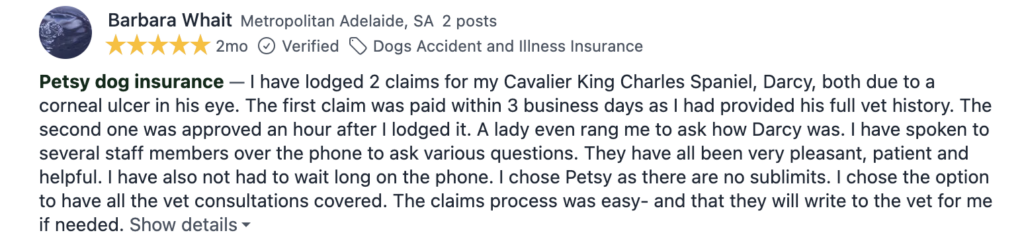
Here are key green and red flags to look out for. Example reviews below have been taken from Productreview.com.au as of 23 September 2024.
Green Flags:
Reviewers who recommend the provider to their family and friends indicate a high level of satisfaction.
Long-term Policyholders: Satisfied customers who have stayed with a provider for years can indicate reliability and trustworthiness.
Helpful Customer Service: Look for reviews praising knowledgeable and supportive service teams. This is particularly helpful when the unexpected happens and you need questions answered.
Happy Switchers: If someone switched providers and loves the new one, that’s a big plus.
Smooth Claims Process: Quick, hassle-free claims are exactly what you want.
Efficient Claims Process: Quick and straightforward claim submission and turnaround are major positives.
Red Flags to look out for in Pet Insurance Reviews
Premium Increases: Bill shock is a real thing and not something you can foresee when you first take out a policy. As your pet ages and veterinary costs rise, it’s normal for insurance premiums to increase over time. Factors like inflation and changes in risk also contribute to these adjustments. When comparing providers, be aware that lower initial premiums are common, but it’s important to understand how premiums might increase over time due to factors like inflation and your pet’s age. Understanding how premiums might change over time will help you make an informed decision and avoid surprises.
Repeated Complaints about Poor Customer Service: We totally get it – no one is perfect! But repeated reviews mentioning poor customer service, or poor communication where customers are left feeling confused is a sign that this could potentially be your experience too.
Claim Denials or Low Payouts: This could mean the provider has restrictive limits like sub-limits on what they cover.
Petsy Pet Insurance
About Petsy Pet Insurance
Established in 2019, Petsy is a leading pet insurance provider in Australia offering extensive coverage and exceptional service to pet owners nationwide. With a deep understanding of the needs and financial circumstances of pet owners, Petsy aims to deliver peace of mind and support during unexpected veterinary emergencies. Petsy is committed to transparency and providing innovative solutions that prioritise the well-being of our beloved pets.
We offer coverage up to $30,000 annually to help cover eligible vet bills for pet owners if their pet runs into an unexpected mishap, with no sub-limits on any of the conditions you can claim.
With Petsy pet insurance, pet owners can rest easy knowing that expenses for costly vet treatments (and more) can be reimbursed, allowing pet parents to focus on their pet’s well-being instead of the financial burden. It also minimises the need to make difficult choices about a pet’s treatments, due to financial constraints.
Why Choose Petsy?
Petsy Pet Insurance is designed with your pet’s care in mind. Unlike many policies that cover only specific conditions, Petsy covers almost every type of accidental injury, illness, or condition, unless it’s specified as not covered under the policy (you can refer to these in the General Exclusions section in the PDS).
We have no sub-limits on the conditions you can claim, meaning you won’t face unexpected restrictions on your coverage, and our excess is an annual excess (per year), not per condition or per claim like some others, which can help to lower unexpected out of pocket expenses.
Plus, if you insure your puppy or kitten with Petsy before their first birthday, you’ll receive an annual limit bonus that will continue after the renewals of the policy.
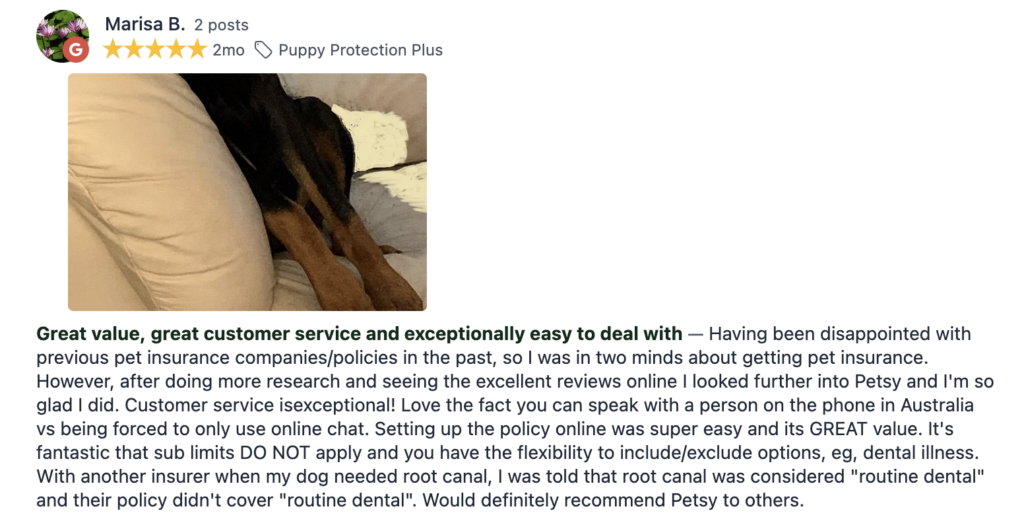
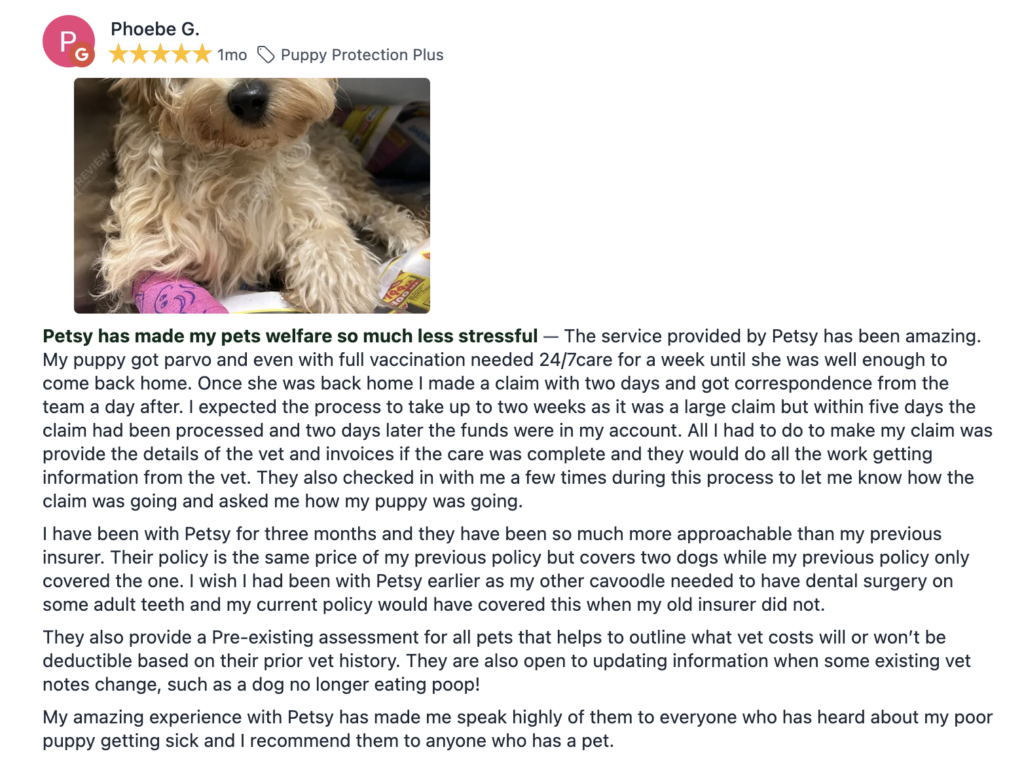
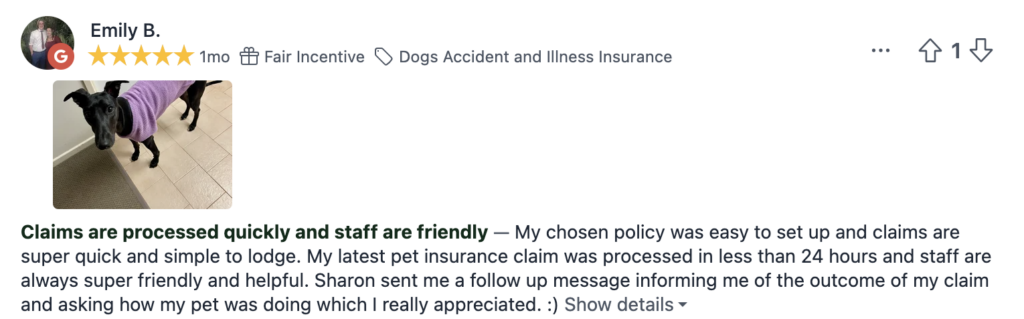
How we take care of you and your pet Pet parents have praised us for providing top-notch coverage with best-in-class customer support.
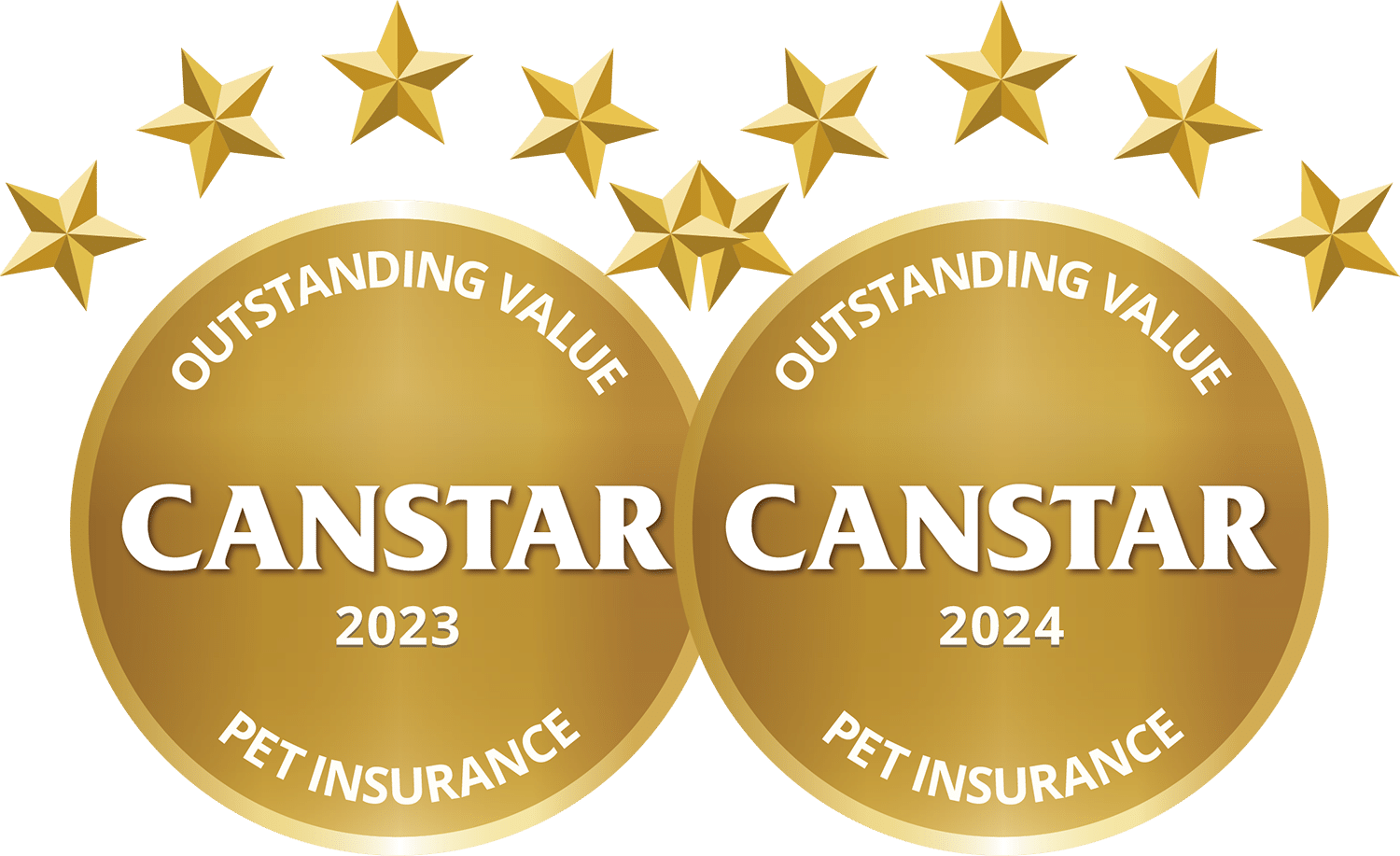
We’ve won Canstar’s Outstanding Value Pet Insurance Award for two consecutive years for 2023 and 2024, and the majority of online reviewers have given us a 5-star rating.
How do we stand above the pack?
We don’t place sub-limits on claims, even as your pet gets older.
Flexible annual excess options, including $0 excess
Forbes Advisor’s pick of the best comprehensive pet insurance policy
Canstar’s 2023 and 2024 Winner for Outstanding Value Pet Insurance
Highly Commended in Finder’s Pet Insurance Awards 2023 for Value and Comprehensive Pet Insurance
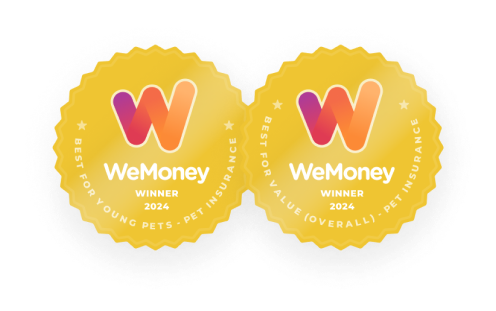
Best for Value Pet Insurance and Best for Young Pets by WeMoney Awards 2024
Finalist for Pet Insurer of the Year by WeMoney Awards 2024
Exclusions for temporary pre-existing symptoms and conditions are reviewable
Optional dental illness coverage for pets younger than 3 years old
Annual limit bonus for pets younger than 1 year old
Discount for veterinary professionals
Shorter exclusion period for illness
How Petsy Stacks Up: A Detailed Comparison
Petsy Pet Insurance
Typical Competitor
Pet insurance specialist
✅
❌
More customisable coverage
✅
❌
Cooling off period
30 days
21 days
Shorter exclusion period for illness conditions
✅ 14 days
❌ 21 days
Pre-existing condition assessment
✅
❌
Annual limit bonus for young pets
✅
❌
Local support team
✅
❌
Pay the vet direct option
✅
❌
Claim via phone
✅
❌
Multipet discount
✅
❌
Cover for vaccine preventable diseases if pet is up to date with vaccinations
✅
✅
Minimum entry age for cover
6 weeks
8 weeks
Payment reminders
✅
❌
Pet Insurance Coverage
Petsy Pet Insurance
Typical Competitor
Min age for entry
6 weeks
8 weeks
Max age for entry
9 years
8 years
Annual excess
✅
❌
Excess type
Per year
Per condition
No sub-limits on inclusions
✅
❌
No sub-limits on after hours emergency vet visits
✅
❌
No sub-limits on hereditary and congenital conditions
✅
❌
$0 excess available
✅
❌
Cover for vaccine preventable diseases if pet is up to date with their vaccinations
✅
❌
Optional coverage available for dental illness for pets younger than 3 years
✅
❌
No sub-limits on dental illness
✅
❌
Optional cover available for specialised therapies for pets younger than 3 years
✅
❌
Optional cover available for behavioural conditions for pets younger than 3 years
✅
❌
Coverage for temporary pre-existing symptoms and conditions, available after a period of time
Can be as short as 2 months depending on the severity of the condition
18 months
Option to exclude vet consultations for veterinary professionals
✅
❌
What’s covered and what’s not: A Clear breakdown
Accidental Injuries
Illnesses
Diagnostics & treatments
✅ Car accidents
✅ Cancer
✅ Hospitalisation
✅ Heatstroke
✅ Diabetes
✅ Emergency care
✅ Broken bones
✅ Ingestion of foreign objects
✅ Surgery
✅ Fractures
✅ Tick paralysis
✅ X-rays
✅ Snake bites
✅ Skin conditions
✅ Medication
✅ Allergic reactions
✅ Ear and eye conditions
✅ Diagnostic tests
✅ Bite and fight wounds
✅ Liver disorders
✅ Blood tests
✅ Soft tissue injury
✅ Gastro intestinal disorders
✅ CT scans
✅ Poisoning
✅ Heart disease
✅ MRIs
✅ Burns
✅ Neurological disorders
And more
And more
And more
Petsy Pet Insurance covers what some other providers charge extra for or don’t cover at all.
Dental illness for pets younger than 3 years old
Overseas Pet Travel Insurance (in New Zealand or Norfolk Islands on trips < 60 days)
Emergency boarding with no sub-limits
See what the experts are saying
“Our Pick of the Best Comprehensive Pet Insurance Policy”
Rated “Excellent” on Trustpilot
Winner “Outstanding Value Pet Insurance”
Rated 4.8 on Product Review
Winner Best for Value Overall and Best for Young Pets – Pet Insurance
Why Petsy?
Pick any vet
No sub limits
Quick and easy claims
We cover treatments that some don’t
Pet ownership can be expensive, but it can be worse if your pets get sick and require emergency treatment. For peace of mind when the unexpected happens, many veterinarians recommend pet owners to consider pet insurance.
Want someone else to help pay for unexpected vet bills? With Petsy, we can help.
Plan Options
Petsy Pet Insurance is an insurance policy that reimburses 80% or 90% of vet costs for the treatment of your pet if they suffer an unexpected injury or illness (provided these occur after any applicable exclusion period has ended symptom free).
We offer coverage up to $30,000 annually with no sub-limits on any of the conditions you can claim.
Our policy is customisable -you’ll be able to tailor your cover by choosing your preferred level of Benefit Percentage, Annual Limit, Annual Excess, and choosing whether you’d like to choose Optional Extra Benefits (if your pet is less than 3 years old) and whether you’d like to include costs of Vet Consultations for your cover.
Benefit Percentage
80% or 90%
Annual Limit
$5,000, $10,000 or $25,000
Annual Excess
$0, $150, $200, $300, $500
Optional Extra Benefits
Include or exclude
Vet Consultations
Include or exclude
Starting early with Petsy Pet Insurance has its perks. For pets starting their protection with us before they’re 6 months old, we’ve topped up your chosen annual limit by 20% and you pay nothing extra.
That’s an extra $1,000 on a $5,000 plan Or an extra $2,000 on a $10,000 plan Or an extra $5,000 on a $25,000 plan
For pets starting their protection with us before they turn one, we’ve topped up your chosen annual limit by 10% and you pay nothing extra.
That’s an extra $500 on a $5,000 plan Or an extra $1,000 on a $10,000 plan Or an extra $2,500 on a $25,000 plan
Petsy offers coverage for puppies and kittens, adult dogs and cats, and senior dogs and cats (if the policy is taken out before they turn 9 years old).
We currently offer Petsy Pet Insurance in every state, territory and city in Australia and work with any licensed vet in the country.
How to Set up a Policy
Getting a quote for your pet insurance is quick and easy and only takes a few minutes. Get a quote online by visiting our website at petsy.com.au. Fill in the details about your pet and follow the prompts. Alternatively, if you prefer to speak with someone, our friendly team is available to assist you over the phone at 1300 952 790.
Our policies are customisable. You can choose the level of coverage that suits your needs, including the benefit percentage, annual limit, and annual excess. Plus, you can decide if you want to include vet consultation costs in your cover. For pets under three years old, you also have the option to add Optional Extra Benefits.
When you complete an online quote, you’ll see a summary of the coverage options. You can select a preferred start date that is within 30 calendar days for your policy to commence. Once you make your payment, you’ll receive a confirmation of your coverage and your policy documents via email, ensuring everything is set for your pet’s protection.
Pre-existing Condition Assessment and Waiver Forms
What is a pre-existing condition assessment? A Pre-existing Condition Assessment is a medical assessment of your pet’s complete vet history by a vet to determine whether your pet has any pre-existing symptoms and conditions that are excluded from the cover. We offer a pre-existing condition assessment to provide transparency on coverage upfront and it also helps to fast-track any future claims process.
Here’s what to expect during the assessment process:
Collecting Medical Histories: We’ll reach out to the vets you’ve listed to gather your pet’s medical records. This step typically takes 5-10 business days, depending on how quickly we can obtain the information from your vets.
Reviewing Records: Once we have all the necessary information, we’ll review your pet’s medical history to identify any pre-existing symptoms and conditions and assess whether they’re temporary or chronic. We’ll determine if these conditions could be eligible for coverage in the future and inform you of how and when you can request a review, including any supporting documentation needed from your vet.
Updating Your Coverage: If our assessment results in changes to the status of any pre-existing symptoms and conditions, we will update your Certificate of Insurance accordingly.
Please note, lifting exclusions for reviewable pre-existing symptoms and conditions isn’t automatic. Exclusions will only be removed with sufficient medical evidence that confirms the condition has been successfully treated, cured or resolved. Conditions deemed non-reviewable will remain permanently excluded from coverage.
We aim to complete a pre-existing condition assessment for every member, but there are rare cases where an assessment might not be possible — for example, if medical records are incomplete, previous vet practices are closed or unreachable, or if shelter records are limited. In such cases, we will evaluate the information available at the time of your first claim.
For pets without any medical history, we recommend scheduling a medical check-up and using a request for waiver form to help establish a medical record for the assessment. Once your policy is set up, you can take a copy of the Waiver Form to your next vet visit and apply to reduce the exclusion period for Specified Conditions by returning the completed form to us (within 14 days of your visit).
Pre-approvals and Vet Payment Options
What is a pre-approval?
A pre-approval refers to an approval of a potential future claim that is assessed before treatment, not after. Pre-approvals are advisable for policyholders anticipating upcoming high-cost treatments
To process to obtain a pre-approval, we need:
An estimate of itemised costs for the procedure
A description of the required procedure
Clinical history related to the procedure (a brief email from a vet is not sufficient)
The minimum requirements to process a pre-approval include:
A completed pre-existing condition assessment
An estimate received from your vet before 2pm AEST Monday to Friday
The exclusion periods on a policy must have ended for the condition
Additional Considerations
To determine if a pre-approval can proceed, we also review the following:
Policy Start Date
Confirm the treatment is not related to a pre-existing condition that existed prior to the policy start date.
Ensure the exclusion periods for the policy have passed for the condition.
Pre-existing Condition Assessment
If no assessment has been completed, a pre-approval cannot be provided.
If an assessment has been completed, check:
Whether the condition is listed as pre-existing.
The timing of the assessment (e.g., before or after the end of exclusion periods).
Current Hospitalisation
If the pet is currently hospitalised, pre-approval may not be possible due to the rapid pace of charges. Delays in treatment while waiting for approval isn’t recommended.
Risk of Euthanasia
If the pet is at risk of euthanasia, we pause the pre-approval process and escalate the case to the head vet for urgent review.
Important Note
Pre-approvals are advisable for planned treatments with significant costs. For emergencies or urgent care, please contact our team to discuss alternative options for claim processing.
The exclusion periods are:
1 Day Exclusion Period for Accidental Injury (except Specified Conditions)
14 days Exclusion Period for Illness (except Specified Conditions)
14 days Exclusion Period for Dental Illness for pets under 1 year old
6 months Exclusion Period for Dental Illness for pets 1 year and older
6 months Exclusion Period for Behavioural Conditions
6 months Exclusion Period for Specified Conditions
Special Considerations by Pet Types
Pet Insurance for Puppies and Kittens
Starting your pet insurance when your pet is young and healthy could minimise the chances of your pet having any pre-existing symptoms and conditions that may not be covered later. Insuring them early can help to ensure they receive extensive coverage without the worry of expensive vet bills.
Starting early with Petsy Pet Insurance has its perks. For pets starting their protection with us before they’re 6 months old, we’ve topped up your chosen annual limit by 20% and you pay nothing extra.
That’s an extra $1,000 on a $5,000 plan Or an extra $2,000 on a $10,000 plan Or an extra $5,000 on a $25,000 plan
For pets starting their protection with us before they turn one, we’ve topped up your chosen annual limit by 10% and you pay nothing extra.
That’s an extra $500 on a $5,000 plan Or an extra $1,000 on a $10,000 plan Or an extra $2,500 on a $25,000 plan
Pet Insurance for Older Pets
If you’ve adopted an older pet, chances are your new friend will have at least one or two existing health issues, even if they’re fairly minor and under control. Older pets need extra love and attention and taking in an older pet means potentially bearing the high cost of caring for them as well. Whilst pet insurance can’t cover pre-existing symptoms and conditions, it can still be a lifeline in avoiding potentially large vet bills and be your ticket to affording the level of care for any new health issues or accidental injuries that arise.
Pet Insurance for Adopted Pets
Pet insurance works in the same way for adopted pets as it does for other pets. However, when you make your first claim, we may ask for a bit of extra documentation, such as your pet’s adoption certificate.
Pre-existing symptoms and conditions and Coverage
What does Petsy Pet Insurance cover?
Petsy Pet Insurance covers almost every type of accidental injury, illness or condition unless it is specifically listed as not covered. This is why it’s important to know what’s not covered by pet insurance.
When reading the Product Disclosure Statement (PDS), the Summary of Benefits section refers to what’s covered, and the Summary of Exclusions section details what’s not covered under the policy.
Petsy Pet Insurance is for unexpected accidental injuries and illnesses after your exclusion periods have ended. Preventative and elective treatments such as vaccinations, desexing or regular health check-ups aren’t covered.
We aim to provide coverage for over a thousand different accidental injuries, illnesses, and conditions as long as they are not pre-existing and you’ve passed the exclusion periods symptom-free.
Your pet insurance policy might come in handy if, for example, your pet accidentally breaks a bone, or gets hurt by a car, or accidentally swallows something they shouldn’t have. Having a pet insurance in place can help you to cover a portion of these unexpected costs, making it easier for you to access veterinary treatments for your pet without money being the sole deciding factor.
What is a Pre-existing Condition?
A pre-existing condition is a health issue (including any sign of symptoms of that health issue) that existed before your pet insurance policy’s exclusion periods end. Most providers don’t cover pre-existing symptoms and conditions, which means if your pet had a health issue before the insurance coverage began, it won’t be covered.
Temporary vs Chronic Pre-existing symptoms and conditions
There are two types of pre-existing symptoms and conditions:
Temporary conditions that can be fully resolved and no longer be relevant to your pet’s ongoing health.
Chronic conditions that require repeat veterinarian visits, ongoing medication and treatment or recurrence of conditions, such as recurrent ear infections.
A temporary Pre-existing Condition is considered to be any condition that has been experienced by a pet for a period of time but is no longer present as a result of treatment. Broken bones, soft tissue injuries, vomiting and diarrhoea all count as potential temporary pre-existing symptoms and conditions. Temporary pre-existing symptoms and conditions are assessed on a case-by-case basis, and you can apply for a review, provided there are no signs or symptoms of the condition during the applicable review period.
A chronic Pre-existing Condition is considered to be any condition which is current before the starting date of the policy (including exclusion periods), ongoing and lifelong condition. Examples of chronic pre-existing symptoms and conditions include cancer, recurrent ear infections, epilepsy, arthritis, heart disease, kidney disease and hip dysplasia. Chronic pre-existing symptoms and conditions are excluded from cover for the life of the policy.
How Does a Pet Insurance Company Identify a Pre-existing Condition?
There are 2 main considerations that determine whether a condition is considered as pre-existing condition:
The dates that signs or symptoms of the condition first appeared – eg. noted down by your vet in your pet’s medical history; and
Whether such dates were before or after the exclusion periods on your policy ended.
A Pre-existing symptom and condition in your pet is identified largely based on their medical history. This includes any signs, symptoms, or diagnoses of an injury or illness that occur before the end of your policy’s exclusion periods.
Pre-existing symptoms and conditions also include conditions that are:
Bilateral – this refers to conditions that can affect both sides of your pet’s body, such as ear infections, cherry eye, cataracts, hip dysplasia, luxating patella’s or cruciate ligament conditions. If one side of the body shows signs of a bilateral condition before your coverage kicks in, your pet won’t be covered if the condition later affects the other side.
Related, secondary to, or occur as a result of, the initial condition – for example, if your pet has diabetes as a Pre-existing Condition, then cataracts wouldn’t be covered because it’s a secondary condition triggered by the first Pre-existing Condition, as pets with diabetes are predisposed to developing cataracts.
Understanding the Impact of Pre-existing symptoms and conditions and Symptoms on Coverage
You can still insure your pet even if they have pre-existing symptoms and conditions or after the diagnosis of an illness, however, you won’t be able to claim for any treatments related to any pre-existing symptoms and conditions. You will still be able to claim for other new and unrelated conditions that are not pre-existing symptoms and conditions, provided your pet has passed the applicable exclusion periods for those conditions.
Switching Providers: What you Need to Consider
You can switch pet insurance providers at any time. However, there are some important things to keep in mind as switching can impact your pet’s coverage.
What can happen to your pet’s coverage if you switch?
If your pet has coverage for certain health conditions under your current policy, these conditions may not be covered by your new provider as they may be considered as pre-existing symptoms and conditions under the new policy.
Pre-existing symptoms and conditions aren’t generally covered under pet insurance, as pet insurance is designed to help to cover new injuries and illnesses that arise after the exclusion periods end on a new policy. It’s important to review your current coverage and compare it with the new provider’s coverage, so that you don’t lose out on coverage.
This can be particularly important if your pet is dealing with a chronic condition as switching coverage could mean losing coverage for that condition.
Tip: Investing your time to learn more about the existing and the new policies, when deciding on the right provider, can help to avoid being stuck later down the track.
How to Make the Most of your Pet Insurance
Claims Process & Submitting Claims
To make the most of your pet insurance, it’s important to understand the claims process with the provider you choose. Generally, after your pet receives treatment, you’ll need to pay the vet, then submit a claim with your insurer.
Common Pitfalls to Avoid
Understanding your pet insurance policy and the claims process can prevent disappointment later on. Common pitfalls include incomplete paperwork when submitting claims and not being aware of exclusions or limitations in your coverage. Being familiar with your policy details can help you avoid surprises and make the most of your insurance. Also, check with your insurance provider if they have options available to help streamline future claims.
If your claim is denied, it’s typically due to these reasons:
Submitting a claim within an exclusion period – Your pet isn’t covered the moment you buy your policy. Your policy has different exclusion periods that need to be passed symptom-free before coverage begins.
Submitting a claim for a pre-existing condition – pre-existing symptoms and conditions aren’t covered if any signs or symptoms of those conditions occurred before the exclusion periods ended.
Submitting a claim for a non-covered item – Pet insurance is designed to help with unexpected vet costs. Preventative, elective or routine treatments including regular health check-ups, vaccinations and desexing aren’t covered.
Renewing Your policy: Key Factors
Pet insurance premiums might change over time and there are some factors that can affect your premiums at renewal.
Your Pet’s Age: Just like humans, as pets age, their healthcare needs can become more complex and frequent. Premiums can be adjusted to account for these anticipated changes in medical expenses.
Rising Veterinary Costs: The cost of veterinary care and treatments increase due to several factors, including general economy wide inflation and increased prices for medical supplies and equipment. As the cost to provide health services for pets increases, insurance premiums may also need to be adjusted to cover these rising expenses.
Advancements in Veterinary Care: New medical treatments and technologies are continually being developed, which can lead to your pet enjoying a higher quality of care. These can include innovative surgeries, new medications, or state-of-the-art imaging technologies. While these advancements can be life-saving, they often come at a higher cost, which can influence the price of insurance coverage.
Industry Trends: The pet insurance industry is always evolving. Changes in the overall market and regulatory compliance costs can affect how premiums are set.
Inflation: Just like in other areas of the economy, inflation impacts veterinary services and pet care costs, which can be reflected in your premium as the costs for vet care and services rise.
Location and Breed Trends: Where you live and the breed of your pet can also impact your insurance costs. Insurance premiums may be adjusted based on the collective health data of pets similar to yours in your area to more accurately reflect the risk and cost of providing care.
Your pet may need different coverage as they age, so reassessing options can help ensure you have the right protection.
Setting Yourself Up for Pet Insurance Success
How to be prepared for emergencies
Emergencies can happen anytime, so it’s important to have a plan in place. Keep your vet’s contact information, a 24-hour emergency clinic contact details, and your pet insurance policy number in an easily accessible location. Ensure your policy covers emergency visits and have an emergency fund to cover upfront costs before your claim is processed.
Navigating vet visits with insurance
When visiting the vet, let them know you have pet insurance. Ask for detailed invoices and make sure you have all the necessary paperwork to submit a claim. Familiarising yourself with your pet insurance claim process so you’re across the information required to avoid delays.
After your pet has received treatment, you can usually ask your vet to submit the claim for you when you’re at the clinic, by providing your policy number or asking the clinic to submit the invoice or history through to your insurance provider.
Getting the most out of your policy
To make the most out of your pet insurance, understand what’s covered and what’s not. Staying organised with medical records and policy details can streamline claims assessment process. Regular vet check-ups can also help identify health issues early, reducing the risk of them becoming serious and avoiding expensive vet bills later on.
FAQs
Coverage FAQs
What does Pet Insurance cover in Australia?
Pet insurance in Australia is designed for the unexpected events, such as accidental injuries and illnesses. Most policies generally do not cover routine care items, like desexing or teeth cleaning. The types of coverage typically include:
Accident-Only Cover: Covers costs related to accidental injuries like fractures and broken bones, but excludes illnesses.
Accident and Illness Cover: A more comprehensive plan covering accidental injuries and illnesses, including hereditary issues, Intervertebral Disc Disease (IVDD), cancer treatment, and chemotherapy.
Add-ons for Routine Care: Some plans allow you to add routine care, covering vaccinations, desexing, and flea treatments.
Petsy Pet Insurance covers almost every type of accidental injury, illness or condition unless it is specifically listed as not covered. This is why it’s important to know what’s not covered by pet insurance.
Can you claim desexing on pet insurance?
At Petsy, we don’t cover the cost of desexing (spaying or neutering) for your pet. However, if your pet needs treatment for complex cryptorchidism (undescended testicles) and it’s not a pre-existing condition, we can help to cover those vet costs.
Costs and Premiums FAQs
What affects the cost of your premium?
The cost of your pet insurance premium is influenced by several factors. Here are the key factors that typically affect your premium:
Pet Specific Factors:
Species and Breed: The breed of your pet can significantly impact the premium. Some breeds are more prone to specific health issues, which can make them more expensive to insure. For example, larger breeds like Labradors and German Shepherds may be more prone to joint issues, while smaller breeds like Pugs and Bulldogs might have respiratory problems
Pet’s Age: Generally, younger pets have lower premiums. As your pet gets older, the chances of developing health issues increase, which can raise the premium cost
Location: Where you live can affect your premium, as vet costs may vary by region. Areas with higher living costs may lead to higher premiums
Sex of Your Pet: The sex of your pet can influence their behaviour and health risks, which may affect the likelihood of claims. This is factored into risk assessments by insurers
Coverage Options:
Coverage Options: The level of coverage you choose directly impacts the premium. A higher annual limit, benefit percentage, and/or lower excess will typically result in higher premiums
Optional Extras: Adding optional benefits, such as coverage for dental illness or specialised therapies, will increase the premium
By adjusting some of these, such as choosing a higher excess or lower annual limit, you can find ways to reduce the cost of your premium.
What is the average cost of pet insurance in Australia?
According to MoneySmart, pet insurance premiums typically range from $60 to $120 per month. This means that there is a lot of variation in the market for the levels of coverage that are offered. It’s important to compare pet insurance policies and understand what coverage is included at a certain price point. Please take this range as a rough guide, as factors specific to your pet such as breed, age, sex and your location will affect your premiums. Factors like breed, age, and location affect your premium, so you should focus on what’s specific to your pet, rather than comparing to the industry average. Sometimes, whether you have made a claim or how many claims you made, can affect your premiums (at Petsy, we don’t consider these, when determining your premium).
How can I lower my pet insurance premiums?
To lower your pet insurance premiums, you can adjust several aspects of your coverage. Petsy offers one customisable policy to allow you to lower your premiums to meet your budget. Here are a few strategies:
Choose a Higher Excess: Increasing the excess (the amount you pay out-of-pocket before your insurance kicks in) can reduce your premium significantly. For example, at Petsy, a $500 annual excess option can reduce premiums by over 40% in some cases
Lower Your Annual Limit: The annual limit is the maximum amount your insurer will pay for claims in one year. Lowering this limit will reduce your premium. For instance, Petsy offers limits like $5,000, $10,000, and $25,000, with the lowest limit having the lowest premium
Adjust the Benefit Percentage: The benefit percentage is the portion of eligible vet bill your insurance will cover (e.g., 80% or 90%). Opting for a lower benefit percentage can help lower your premium
Remove Optional Extra Benefits: Optional benefits like coverage for dental illness, specialised therapies, and behavioural conditions can increase your premium. Removing these extras, especially if your pet doesn’t need them, can reduce your premium
Exclude Vet Consultations from Your Coverage: Petsy allows you to exclude vet consultation fees from your coverage, which can lower your premium. This may be a good option if you already receive discounted vet consultations or if you’re on a wellness plan which covers vet consultation fees
By adjusting these variables, you can customise your pet insurance to balance your budget with the level of coverage you need.
Is it better to have a higher excess pet insurance?
A higher excess can lower your premiums, but it means you’ll need to pay more out-of-pocket expenses, before insurance covers eligible expenses. A lower excess reduces the amount you need to pay but comes with higher premiums.
What is the cheapest and best pet insurance?
Accident-only cover is usually the most affordable pet insurance option, with premiums starting from $20-$30 per month for dogs and even lower for cats. However, this cover may not include situations you normally expect to be covered, like when a pet swallows a foreign object, which is often classified as an illness, not an accident.
Petsy no longer offers accident-only policies because such policies provide limited coverage that can be confusing and insufficient during emergencies. Instead, we provide customisable accident and illness plans that allow you to adjust coverage options like the annual excess to reduce your premiums. By increasing the annual excess, you can lower your premium—our $500 excess option can reduce premiums by over 40% in some cases.
Choosing the Right Insurance FAQs
How do I know which pet insurance is best for me?
Choosing the right pet insurance depends on your pet’s health needs and your budget. Not all policies are created equal and it’s important to understand what each policy covers and how that compares with the price. The cheapest option may not necessarily provide the most value. Here’s a breakdown of key components.
Coverage Type: Accident-only policy covers accidental injuries, while accident and illness policy covers both injuries and illnesses. Add-ons for routine care are also available.
Annual Limit: This is the max amount your insurance will pay each year—higher limits offer more coverage but come with higher premiums.
Benefit Percentage: This is how much of each eligible vet bill your insurance will cover (e.g., 80%).
Excess (Deductible): The out-of-pocket amount you pay before insurance will start to cover costs. Some plans have an annual excess, while others have per claim or per condition excess.
Add-Ons or Optional Extra Benefits: Additional coverage for dental illness or specialised therapies may be worth considering.
Which level of pet insurance is the best?
The coverage level of pet insurance that is best for you and your pet, is really dependent on your needs and what fits your budget. Higher coverage comes at a cost of higher premiums.
Pet insurance is very specific to your pet. So, consider factors like your pet’s age and breed. For example, different breeds have varying risks and predispositions to certain health conditions. Some breeds are more prone to certain illnesses or genetic conditions. For example, larger breeds like Labradors and German Shepherds are more susceptible to joint issues like hip dysplasia, while smaller breeds such as Pugs or Bulldogs can have breathing problems. These breed-specific risks can increase the likelihood of needing costly treatments. Some breeds are more expensive to treat due to the type of care they may require. For instance, surgery for large breeds can be more expensive because they require larger doses of anaesthesia, more medication, and longer recovery times.
How do I know which pet insurance is the best for me?
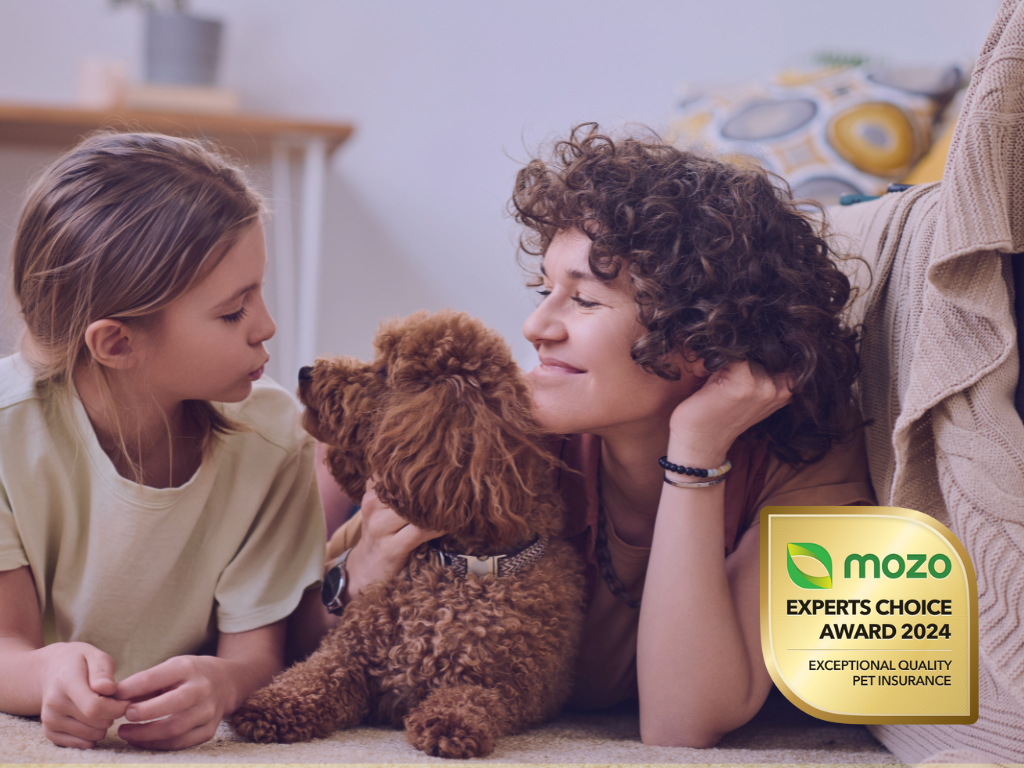
The best pet insurance will be the insurance that meets your financial and coverage needs and provides support to you when you need it. You can check out third-party sources like Forbes Advisor, Canstar, and Mozo, that offer expert reviews and awards. Customer reviews from platforms like ProductReview.com.au and TrustPilot can also give you real insight into how different providers handle claims and customer service.
Is it worth shopping around for pet insurance?
Yes, shopping around for pet insurance quotes is definitely worthwhile. Providers offer different coverage levels at various price points, so comparing policies helps you make an informed decision. Most policies have key components like annual limits, benefit percentages, excess, and optional extras. Understanding how these components differ across providers will help you find the best value and coverage for your pet’s needs. Remember, pet insurance policies are not created equal. This helps you identify the best policy that meets your coverage needs and offers the most value. We walk you through how to compare pet insurance policies, “apples with apples”, in this guide.
Pet-Specific FAQs
What age is best to get pet insurance?
The best time to get pet insurance can be as early as possible, to reduce the chance of your pet developing pre-existing symptoms and conditions and symptoms, which are excluded from coverage. Pet insurance is designed for the unexpected, so early coverage can save you on future vet expenses.
What factors should I consider about my pet’s breed and age?
You should consider your pet’s breed and age when deciding the type of coverage you need and the potential cost. Here are the factors to consider about your pet’s breed and age:
Breed-Related Factors:
Breed-Specific Health Risks:
Certain breeds are more prone to specific health conditions, which can affect the likelihood of needing certain expensive treatments.
Large breeds like Labradors and German Shepherds are more prone to joint issues like hip dysplasia, which can lead to costly surgeries
Small breeds such as Pugs and Bulldogs may face respiratory problems due to their flat faces (brachycephalic syndrome). Please note Petsy Pet Insurance does not cover vet costs related to brachycephalic syndrome until the Petsy Brachycephalic Obstructive Airways Syndrome (BOAS) Application form is submitted and accepted by us.
Genetic predispositions: Some breeds are more prone to hereditary conditions like Intervertebral Disc Disease (IVDD), heart disease, or luxating patella
Cost of Different Treatment by Breed:
Some breeds are more costly to treat due to the complexity of the care they require. For example, surgery for larger breeds may involve higher doses of anaesthesia, more medication, and longer recovery times
Smaller breeds might need specialised treatments for conditions like dental issues or breathing problems
Age-Related Factors:
Young Pets (Puppies and Kittens):
Early Coverage: Starting coverage when your pet is young helps avoid exclusions for pre-existing symptoms and conditions, as younger pets are less likely to have developed serious health issues
Bonus for Early Sign-Up: At Petsy, pets that are insured before their first birthday receive an annual limit bonus at no extra cost, making early coverage even more beneficial
Older Pets:
Increased Health Risks: As pets age, they are more likely to develop chronic conditions such as arthritis, diabetes, or heart disease, which can lead to higher premiums
Insurance Limitations: Some insurers have age limits for entry. For example, Petsy Pet Insurance covers pets up to 9 years old for new policies, but once a policy is active, it can continue as long as you renew your policy
Adopted Pets:
For adopted pets, especially older ones, it’s important to consider whether they may already have pre-existing symptoms and conditions that could affect coverage
By taking into account your pet’s breed and age, you can select the best insurance plan that matches their specific health risks and needs, helping you avoid or reduce unexpected costs down the line.
Pet Insurance Value and Usage FAQs
How do I get the most out of my pet insurance?
To maximise your pet insurance coverage, start early to avoid pre-existing symptoms and conditions being excluded. Petsy policies can start for pets aged between 6 weeks and 9 years, and coverage continues as long as you renew. Avoid switching providers, if previous claims related conditions can be considered pre-existing symptoms and conditions by a new insurer. At Petsy, we like to reward responsible pet ownership by giving puppies and kittens an annual limit bonus of up to 20% at no extra cost, if you sign up before your pet’s first birthday.
Is Pet Insurance a waste of money?
Pet insurance isn’t a waste of money for most pet owners, especially if you want someone else to help pay for your unexpected vet bills. Vet care can be expensive, and without insurance, you’re responsible for 100% of the costs, 100% of the time. For example, emergency treatments, surgeries, or long-term care for chronic conditions can easily add up. Pet insurance can ease the financial burden, allowing you to focus on your pet’s well-being rather than costs.
If you’re able to cover high vet bills out of your own pocket, you might question its value, and there are alternatives to pet insurance. Ultimately, it depends on your financial situation, your pet’s health, and your risk tolerance for unexpected medical expenses.
How does pet insurance work with pre-existing symptoms and conditions?
Pet insurance generally does not cover pre-existing symptoms and conditions, which are health issues that your pet had before the policy’s waiting or exclusion periods ended.
Definition of Pre-existing symptoms and conditions:
A pre-existing condition is any injury, illness, or symptom that your pet experienced before your pet insurance policy became active or before the waiting/exclusion periods ended.
Types of Pre-existing symptoms and conditions:
Temporary Pre-existing symptoms and conditions:
These are conditions that can be fully resolved and may no longer affect your pet’s health after treatment. Examples include broken bones, soft tissue injuries, or short-term vomiting and diarrhoea.
Many insurance providers, including Petsy, allow for temporary pre-existing symptoms and conditions to be reassessed after a certain period without symptoms. If a condition remains symptom-free during the applicable review period, you may be able to get coverage for it in the future.
Chronic Pre-existing symptoms and conditions:
These are ongoing or lifelong conditions, such as cancer, arthritis, heart disease, or diabetes. Chronic conditions typically require continuous treatment and care, and they are usually excluded from coverage for the life of the policy.
How Pre-existing symptoms and conditions are Identified:
Pre-existing symptoms and conditions are identified based on your pet’s medical history and the timing of any symptoms. Insurers look at whether any signs of illness or injury occurred before the end of the policy’s waiting/exclusion periods.
Bilateral conditions may also be excluded. If a condition affects one side of the body before the waiting/exclusion period ended, the insurer may exclude coverage if it later affects the other side (eg. hip dysplasia, cruciate ligament issues, cataracts).
Impact on Coverage:
If your pet has a pre-existing condition, pet insurance will not typically cover any treatments related to that condition. However, you can still get coverage for new and unrelated conditions that arise after your policy becomes active and the waiting/exclusion periods have passed.
Assessing Pre-existing symptoms and conditions:
Some insurance providers, including Petsy, offer pre-existing condition assessments to determine which conditions may be excluded from coverage. This assessment is based on review of your pet’s vet treatments history.
In summary, while pre-existing symptoms and conditions are typically not covered, some conditions can be reassessed and may become eligible for coverage if they are resolved over time. However, chronic or ongoing pre-existing symptoms and conditions will remain excluded from your policy.
When faced with a pet emergency, knowing what to do can make all the difference. Here are some first aid basics for common pet emergencies, along with steps to take to ensure your pet gets the care they need.
Seizures
Witnessing your pet having a seizure can be distressing, but staying calm is crucial. To keep your pet safe, clear the area of any hard or sharp objects that could cause injury. Pay close attention to their head, as they may inadvertently strike it against furniture or walls. Avoid trying to restrain your pet, as this could cause them to react unpredictably. Instead, focus on timing the seizure, as your vet will need this information to determine the severity of the situation.
Once the seizure stops, keep your pet warm and in a quiet, safe space. Monitor their behaviour closely, as post-seizure disorientation is common. Contact your vet immediately to discuss what happened and receive further instructions. If your pet experiences multiple seizures in a short time or has a seizure lasting longer than five minutes, it’s a medical emergency—take them to a vet or animal hospital without delay.
Key action: Keep your pet safe by clearing the area of any hard or sharp objects, especially their head. Do not try to restrain them. Time the seizure, and once it stops, keep your pet warm and quiet. Contact your vet for further instructions.
Poisoning
If you suspect your pet has ingested something toxic, act quickly. Remove any remaining substance from their mouth, if possible, and try to identify what they ingested. Common household toxins include chocolate, rat bait, medications, Xylitol (commonly found in chewing gum), certain houseplants, and foods like onions, pits of stone fruits or grapes. Call your vet or the Animal Poisons Helpline (1300 869 738) for advice specific to the toxin.
Do not induce vomiting unless instructed by a professional, as some substances can cause more harm when vomited. For example, certain cleaning chemicals or oils can cause severe burns to the oesophagus if regurgitated. In some cases, your vet may advise bringing your pet in for treatment to administer activated charcoal or other antidotes. Keep the packaging of the suspected poison handy, as it can provide critical information for treatment.
Key action: If you think your pet has swallowed something toxic, try to remove it from their mouth and call your vet or the Animal Poisons helpline (1300 869 738) immediately. Don’t make your pet vomit unless explicitly instructed.
Cuts and Scrapes
Minor cuts and scrapes can often be treated at home with basic first aid, but it’s essential to know when professional care is needed. Start by cleaning the wound with pet-safe antiseptic wipes or saline solution to remove dirt and debris. Avoid using hydrogen peroxide or alcohol, as these can irritate or delay healing.
Once the wound is clean, cover it with a sterile gauze pad and secure it gently with adhesive tape. If the cut is bleeding heavily, apply firm but gentle pressure with a clean cloth or gauze until the bleeding stops. If the wound is deep, won’t stop bleeding, or shows signs of infection (such as swelling, redness, or discharge), seek immediate veterinary care.
Key point: Clean the wound with antiseptic wipes and cover it with a clean gauze pad secured with tape. For heavy bleeding, apply direct pressure and seek vet care right away.
Car Accidents
Even if your pet seems unharmed after being hit by a car, they may have internal injuries or fractures that aren’t immediately visible. Ensure your own safety first by securing the area and moving your pet out of the roadway. Use a blanket or towel to carefully lift them, supporting their head and body to minimise movement.
Contact your vet or an emergency animal hospital right away, explaining what happened and describing your pet’s condition. Keep your pet as calm and still as possible during transport. Remember, adrenaline may temporarily mask pain in your pet, so don’t assume they’re okay just because they’re not visibly distressed.
Key action: Car accidents can cause severe injuries like broken bones and internal damage, even if your pet seems fine. If your pet is hit by a car, ensure your safety first, secure the area, and get them to an emergency vet right away.
Heatstroke
Heatstroke is a life-threatening condition that occurs when your pet’s body overheats and can’t cool itself down. Breeds with flat faces, such as Bulldogs and Pugs, are particularly susceptible, as are pets left in hot environments or exercising in high temperatures.
If you suspect heatstroke, act immediately. Move your pet to a shaded or air-conditioned area and begin cooling them down. Use lukewarm water (never ice-cold) to wet their body, avoiding the face, and use a fan to increase air circulation. Offer small amounts of cool water to drink but don’t force them to drink too much too quickly, as this can lead to vomiting.
Even if your pet starts to recover, heatstroke can cause internal damage, so a vet visit is essential.
Key action: Heat stroke is a serious condition needing immediate vet care. If you suspect heat stroke, move your pet to a cooler place, cool them with water (avoid their face), use a fan, and offer water.
Pet Insurance is a form of insurance available to pet owners to help cover their pet for accidental injuries and illnesses, by reimbursing a portion of the veterinary costs to treat their pet.
Pet insurance acts as a financial safety net, helping cover unexpected veterinary costs if your pet needs treatment. Some medical expenses can run into the tens of thousands, and having a pet insurance plan can significantly reduce the financial burden and stress during difficult times.
History & evolution
Insurance for animals began in Sweden in 1890, when Claes Virgin wrote the first policy for horses and livestock. The pet insurance policy for pets like cats and dogs was first sold in Britain in 1947. By 2009, Britain had one of the highest rates of pet insurance, second only to Sweden.
In the U.S., pet insurance started in 1982, with the first policy issued to the famous TV dog, Lassie.
Pet insurance works a bit differently than health insurance for human — it’s more like property insurance. After your pet receives care, you pay the vet and then send a claim to your insurance company to get reimbursed.
One fun fact: Since 2009, the Hambone Award has been given each year to a pet with the most unusual insurance claim. Its name comes from an unnamed dog who reportedly was trapped in a refrigerator and suffered from mild hypothermia, eating an entire holiday ham while waiting for rescue.
Pet insurance policies can have different coverage limits: some have limits per condition, some have limits per condition per year, and others have one overall limit per year. This affects how much you can claim if your pet needs multiple treatments.
Pre-existing symptoms and conditions are often not covered, which is why it’s recommended to insure pets early before any health issues arise.
There’s usually a period of time when you can’t claim for accidents or illnesses right after getting a policy. This ensures coverage is for new injuries or illnesses that show up after you’re insured.
Pet insurance today
Today, pet insurance in Australia is becoming increasingly popular as more pet parents seek to protect their furry companions from unexpected vet bills. With a variety of pet insurance policies available, coverage can range from basic accident-only policies to more comprehensive options that include illnesses, routine care, and wellness treatments. Many Australian insurers now offer flexible plans with different benefit limits and extras, giving pet parents the ability to choose coverage that fits their budget and needs.
Understanding Pet Insurance
How pet insurance works: A quick overview
Pet insurance helps cover the cost of unexpected vet bills. After your pet receives care, you pay the vet, submit a claim, and get reimbursed based on your policy’s coverage. Policies usually cover accidents, illnesses, and sometimes routine care, depending on the plan. There are limits to how much you can claim, and pre-existing symptoms and conditions are generally not covered. Most policies also have a exclusion period before coverage kicks in for certain conditions. Pet insurance gives peace of mind by helping to manage unexpected medical costs for your pet.
In Australia, pet insurance typically offers several types of coverage. These can vary among different providers, but the main types include:
Accident-Only Cover: This only covers costs related to injuries from accidental injuries, such as broken bones or wounds. It doesn’t cover illness-related expenses.
Accident and Illness Cover: This is a more well-rounded coverage option that covers both accidental injuries and illnesses. It can include coverage for a wide range of conditions, from minor issues, like infections and allergies, to more serious diseases like cancer.
Accident and Illness Cover with add-ons: Some plans also cover routine care treatments like vaccinations, desexing, and flea and tick treatments, along with accidental injuries and illnesses.
Routine Care: Can be offered as an optional add-on, which helps to cover some costs for preventative care and wellness treatments, such as vaccinations, microchipping, and desexing. The coverage limits for these treatments are usually lower than for other claimable conditions.
Key insurance terms you need to know
Common insurance terms you’ll come across when comparing different providers.
Annual Limit: The maximum amount your pet insurance will pay for all claims in one year. Once this limit is reached, you’ll need to cover any additional costs yourself until the next policy year.
Benefit Percentage: The percentage of each eligible vet bill your insurance will cover. For instance, if your benefit percentage is 80%, the insurance will pay 80% of the bill, and you’ll pay the remaining 20% (after any excess is applied).
Excess: The amount you have to pay out of pocket before your insurance starts covering costs. It can be a fixed amount per claim, per condition or per policy year.
Sub-limits: Specific limits under your policy for certain types of treatments or conditions. For example, there might be a sub-limit placed on high cost treatments.
Exclusion Periods: The period of time after you start your policy during which you can’t make a claim for treatments. If your pet gets sick or injured during this period, the costs won’t be covered by the insurance.
Pre Existing Conditions: Any signs or symptoms of conditions your pet had before your insurance policy started, including during any exclusion periods. Pre-existing symptoms and conditions are generally not covered by pet insurance policies.
Differences between pet insurance and human health insurance
While both health insurance and pet insurance help cover medical costs, they work a bit differently. Health insurance for humans usually pays the doctor directly, while pet insurance typically requires you to pay the vet upfront, then submit a claim for reimbursement. Pet insurance is more like property insurance, focusing on accidents, illnesses, and sometimes routine care, but it usually doesn’t cover pre-existing symptoms and conditions or preventative care the same way human health insurance might. Additionally, pet insurance policies often have annual or per-condition limits on how much can be claimed.
Unlike humans in Australia, who are covered by Medicare for many healthcare costs, pets do not have a government healthcare system. Pet insurance works more like property insurance, requiring you to pay the vet upfront and then submit a claim for reimbursement. While health insurance for humans often covers a broad range of care through Medicare, pet insurance focuses on accidents, illnesses, and sometimes routine treatments. However, it typically doesn’t cover pre-existing symptoms and conditions or offer the same level of comprehensive care that Medicare does for people, making pet insurance an important option to manage unexpected vet bills for pet owners.
Key considerations when choosing pet insurance
When choosing pet insurance, consider several key factors. First, think about your pet’s specific coverage needs and whether the policy allows customisation, such as adjusting the excess, annual limit, and benefit percentage. Next, evaluate the claims process: great customer service and a straightforward, quick claims experience can make a big difference in your overall pet insurance experience. Also, consider the costs —lower premiums could mean less coverage, and check for any payout limits on specific conditions. Finally, decide on the type of excess that works best for your budget.
Importance of pet insurance
Pet insurance plays an important part of responsible pet ownership. Caring for pets can be expensive and vet bills can quickly add up, especially in emergencies.
Pet insurance acts as a financial safety net, helping cover unexpected veterinary costs if your pet needs treatment. Some medical expenses can run into the tens of thousands, and having a pet insurance plan can significantly reduce the financial burden and stress during difficult times.
Pet Insurance for puppies and kittens
Starting your pet insurance when your pet is young and healthy could minimise the chances of your pet having any Pre-existing symptoms and conditions that may not be covered later. Insuring them early can help to ensure they receive extensive coverage without the worry of expensive vet bills.
Pet Insurance for older pets
If you’ve adopted an older pet, chances are your new friend will have at least one or two existing health issues, even if they’re fairly minor and under control. Older pets need extra love and attention and taking in an older pet means potentially bearing the high cost of caring for them as well. Whilst pet insurance can’t cover Pre-existing symptoms and conditions, it can still be a lifeline in avoiding potentially large vet bills and be your ticket to affording the level of care for any new health issues or accidental injuries that arise.
Setting Yourself Up for Pet Insurance Success
How to be prepared for emergencies
Emergencies can happen anytime, so it’s important to have a plan in place. Keep your vet’s contact information, a 24-hour emergency clinic contact details, and your pet insurance policy number in an easily accessible location. Ensure your policy covers emergency visits and have an emergency fund to cover upfront costs before your claim is processed.
Navigating vet visits with insurance
When visiting the vet, let them know you have pet insurance. Ask for detailed invoices and make sure you have all the necessary paperwork to submit a claim. Familiarising yourself with your pet insurance claim process so you’re across the information required to avoid delays.
After your pet has received treatment, you can usually ask your vet to submit the claim for you when you’re at the clinic, by providing your policy number or asking the clinic to submit the invoice or history through to your insurance provider.
Getting the most out of your policy
To make the most out of your pet insurance, understand what’s covered and what’s not. Staying organised with medical records and policy details can streamline claims assessment process. Regular vet check-ups can also help identify health issues early, reducing the risk of them becoming serious and avoiding expensive vet bills later on.
Petsy Pet Insurance
Established in 2019, Petsy is a leading pet insurance provider in Australia offering extensive coverage and exceptional service to pet owners nationwide. With a deep understanding of the needs and financial circumstances of pet owners, Petsy aims to deliver peace of mind and support during unexpected veterinary emergencies. Petsy is committed to transparency and providing innovative solutions that prioritise the well-being of our beloved pets.
We offer coverage up to $30,000 annually to help cover eligible vet bills for pet owners if their pet runs into an unexpected mishap, with no sub-limits on any of the conditions you can claim.
With Petsy pet insurance, pet owners can rest easy knowing that expenses for costly vet treatments (and more) can be reimbursed, allowing pet parents to focus on their pet’s well-being instead of the financial burden. It also minimises the need to make difficult choices about a pet’s treatments, due to financial constraints.
Petsy wins Mozo Experts Choice Award 2024 for Exceptional Quality Pet Insurance
We’re thrilled to announce some exciting news – Petsy has been awarded the Mozo Experts Choice 2024 for Exceptional Quality Pet Insurance! This recognition highlights our ongoing commitment to help offer innovative pet insurance solutions that prioritise the well-being of our beloved pets.
At Petsy, pets are more than just animals—they’re family. Petsy Pet Insurance helps pet parents prepare for the unexpected, providing support when it’s needed most and helping to ease the financial stress of expensive vet bills.
Why Petsy Stood Out to Mozo Experts:
Customisable Plans: We offer flexible options to suit different budgets and needs, including adjustable benefit percentages, annual limits, and annual excess options.
Transparent Policies: With no sub-limits and a complimentary pre-existing condition assessment when you join, we help to provide transparency upfront in our coverage, which means less surprises at claim time.
Optional Extras: From optional coverage for dental illnesses to behavioural conditions and specialised therapies, our optional extra benefits offer extra things you can add to your pet insurance to help cover conditions and treatments that aren’t included as standard.
How we take care of you and your pet: Pet parents have praised us for providing top-notch coverage with best-in-class customer support.
This award reflects our commitment to delivering value, quality, and care to Australian pet parents.
About Mozo
Mozo is one of Australia’s most trusted financial comparison platforms, dedicated to helping consumers make informed decisions about their finances. Established in 2008, Mozo has grown into a household name by offering easy-to-use tools and unbiased comparisons for a wide range of products, including banking, insurance, loans, and energy plans.
What sets Mozo apart is its commitment to transparency and accuracy. Their team of experts rigorously analyses products across the market, assessing value, quality, and customer benefits. This ensures that the information they provide is not only comprehensive but also fact-checked and reliable.
Each year, Mozo recognises outstanding products and services through its Mozo Experts Choice Awards. These awards are based on detailed, independent analysis and are a mark of excellence for companies that consistently deliver top-tier services to their customers. Mozo’s platform is designed with the consumer in mind, featuring interactive tools, real-time comparisons, and educational content to guide Australians in making financial choices that suit their unique needs. By leveraging Mozo, millions of Australians have found better deals and saved money on essential services.
A Message of Thanks
To our members and their pets – Thank you. Your trust in Petsy inspires us to continually improve and find new ways to better support you. This award is as much yours as it is ours, and we’re honoured to be part of your pet’s journey, especially when we can help a furry friend get back on their paws.
Discover the Petsy Difference:
We understand the special bond between pet parents and their furry family members. That’s why we’re committed to providing pet insurance that puts your pet’s well-being first—so you can focus on what truly matters: caring for your best mate.
If you’re not already part of the Petsy family, now’s the perfect time to see why we’ve been recognised as one of Australia’s top pet insurance providers by Mozo and more.
Protect your pet with insurance that’s designed with pet parents in mind—plus, no sub-limits on claimable conditions.
Coronaviruses/COVID-19 and your pets – what you need to know
Our vets provide their expertise on what you need to know about the Coronavirus/COVID-19
Table of contents
What is a Coronavirus?
Coronaviruses are a large family of viruses which can cause illness in animals or humans. In humans, several coronaviruses are known to cause respiratory infections ranging from the common cold to more severe diseases such as Severe Acute Respiratory Syndrome (SARS) and the recently identified COVID-19.
What is COVID-19 and can it infect pets?
COVID-19 is the disease caused by the recently identified coronavirus SARS-CoV-2. COVID-19 was unknown before the recent outbreak identified late last year.
Currently there is no evidence suggesting that dogs and cats can be a source of infection for COVID-19, or that they can become sick from the COVID-19 virus. COVID-19 is currently spreading through human to human transmission. However, it is always a good idea to wash your hands with soap and water after contact with pets. This helps protect against various common bacteria, such as E. coli and Salmonella, that can pass between pets and humans.
There is a single dog in Hong Kong which tested a weak positive to the COVID-19 virus, however it is still being investigated whether this positive test result was due to environmental contamination or if the dog was truly infected. It is important to note the dog was not showing any signs of disease. This is an evolving situation and information will be updated as it becomes available from the relevant human health and veterinary bodies.
Do dogs and cats suffer illness from any coronaviruses?
Feline infectious peritonitis virus (FIP) and canine coronavirus (CCV) are two coronaviruses which have been unfortunately present and causing disease in dog and cat populations for a long time. It is important to note that FIP and CCV are distinctly different and separate to the COVID-19 virus causing the current disease outbreak with humans. CCV generally causes mild gastroenteritis in dogs, and FIP is a progressive and invariably fatal systemic disease of domestic cats. Both cannot cause illness in people.
Does Petsy Pet Insurance provide cover for COVID-19 or other coronaviruses?
Feline infectious peritonitis (FIP) and canine coronavirus (CCV) are assessed as Illness conditions under a Petsy Pet Insurance policy and are generally eligible for cover under Illness subject to the exclusion periods and provided the condition is not pre-existing.
It is important to remember, the World Health Organisation (WHO) and veterinary bodies have advised currently there is no evidence dogs and cats can become sick from COVID-19. If there are any developments in relation to COVID 19 impacting dogs and cats, we will do our best to keep our customers informed.
Rest assured if your pet is currently displaying symptoms of coughing, respiratory issues or a fever/elevated temperature, you should seek veterinary advice, and know these conditions are generally coverable under your policy provided there were no signs or symptoms that occurred prior to the start of cover or during any applicable exclusion periods (and therefore considered a pre existing condition under the policy and excluded from cover).
What are vaccine preventable diseases?
Vaccine preventable diseases relate to known infectious diseases caused by either bacteria and/or viruses where the risk can be reduced by the use of vaccines.
These diseases include in dogs;
Canine distemper virus (CDV)
Canine adenovirus (CAV)
Canine parvovirus (CPV-2)
Parainfluenza virus (PI)
Bordetella bronchiseptica (Bb) and
Leptospira interrogans
In cats these diseases are:
Feline Parvovirus (FPV)
Feline calicivirus (FCV)
Feline herpesvirus (FHV-1)
Feline leukaemia virus (FeLV)
Feline immunodeficiency virus (FIV), and
Chlamydia felis
Does Petsy Pet Insurance cover vaccine preventable diseases?
With a Petsy Pet Insurance policy, we over coverage for a list of vaccine preventable diseases if you can provide sufficient evidence that your pet is up to date with their vaccinations. Vaccinatable diseases are not covered if the pet is not up to date with vaccinations at the time of first occurrence of and at the time of treatment of a vaccinatable disease and/or related illness.
If I am quarantined or hospitalised due to COVID-19 and can’t take care of my pet, can I seek assistance for emergency boarding?
If during the Period of Insurance, You are unexpectedly hospitalised for four (4) or more consecutive days, and it is not reasonable for someone who lives with You to look after Your Pet and is therefore necessary for Your Pet to board at a licensed kennel or cattery, We will reimburse a portion of Your incurred boarding costs for a period of up to thirty (30) days up to the Benefit Percentage, subject to the Annual Excess and Annual Limit as shown in Your Certificate of Insurance.
If you are not hospitalised and are simply quarantined at home due to COVID-19, emergency boarding for your pet will not be covered.
Additional resources
Further information relating to the Coronavirus can be sourced from the World Health Organisation (WHO) or Australian Veterinary Association (AVA) websites:
Petsy Pty Ltd (ABN 54 633 343 058, AR 1277359) (‘Petsy’) distributes and promotes Petsy Pet Insurance as an authorised representative of Knose Financial Services Pty Ltd (ABN 38 620 795 735, AFSL 536651) (‘Knose’). Knose is an underwriting agency acting under a binding authority as an agent for the insurer; (a) Pacific International Insurance Pty Limited (ABN 83 169 311 193) (’Pacific) in relation to policies from 01 March 2023 or have an anniversary renewal date from 18 March 2023, and (b) the Australia branch of Allied World Assurance Company, Ltd (ABN 54 163 304 907) (‘Allied World’) in relation to policies purchased between 17 February 2022 and 28 February 2023 (inclusive) or renewed between 01 March 2023 and 17 March 2023 (inclusive).In all aspects of arranging this product, Petsy and Knose act as an agent of Pacific/Allied World (as the case may be) and not as your agent. Any advice contained on this website is general advice only and has been prepared without taking into account individual objectives, financial situation or needs and you should consider the appropriateness of any such advice, the Product Disclosure Statement (‘PDS’’)(Allied World PDS) and the Target Market Determination (‘TMD’’)(Allied World TMD) available via www.petsy.com.au or by calling 1300 952 790 before making a decision to acquire, or to continue to hold, the product.
Terms, conditions, limits and exclusions apply. Please refer to the PDS.
Spending time outdoors is a natural part of being a dog and having access to fresh air, exercise and mental stimulation is vital to a dog’s happiness and well-being. While regular time outside is great for your dog, it also means they have to share the same space as insects, bees and other critters who live outside. Dogs are curious creatures and they investigate the outside world using their noses and paws, which also happen to be the two prime targets of insect stings. Dogs also love to run and chase things including insects which in some cases, protect themselves by stinging the dog.
How to identify if your dog’s been stung
If your dog has been stung, it’s important be aware of the signs so you can get them to the vet as soon as possible. The most common signs to look for are excessive licking or pawing of a particular spot. Other tell-tale signs include swelling, drooling, crying out or running in circles. If you notice your dog exploring a flower, plant or native bush and yelps in pain, they may have experienced a sting. The most common spots for bee stings on dogs include the pads of the feet, the mouth, and the face area.
Mild signs include swelling, scratching rubbing, licking or chewing at the sting. Severe signs include profound swilling, hives, vomiting and difficulty breathing.
If in doubt, take your dog to the vet immediately.
Multiple stings are dangerous. Dogs who have been stung by multiple bees at once are more likely to have a reaction and may experience anaphylactic shock. If you suspect your dog has encountered multiple stings or has been stung inside the mouth or throat, take them to the veterinarian.
Bee and wasp stings are poisons. The two most common types of stinging insects are bees and wasps. The main cause of pain for the dog is the poison that is injected by the bee or wasp, not the small puncture wound created
Most of the time dogs get stung on their faces from getting too close to a stinging insect. They are also more likely to get bee stings than people as they tend to chase or play with things that move. A sting on your dog’s sensitive nose is particularly painful and they can get stung by several kinds of insects including bees, wasps and hornets. Some dogs may even get stung on the tongue or inside their mouth or throat if they try to bite or catch an insect. These stings can be dangerous as the subsequent swelling can close your dog’s throat and block his airway.
It’s important to note that not all stings are the same. Bees have a barbed stinger that detaches from the bee and will remain in your dog’s skin. For several minutes after the sting, the venom sack on the stinger will continue to pulsate and inject more venom into the area. Wasps and hornets on the other hand don’t have barbed stingers, instead they retain their and can sting multiple times.
Watch out for allergic reactions
Signs of allergic reactions include:
Redness
A flurry of yelping
Pawing at the muzzle or affected areas
Drooling
Vomiting
General weakness
Difficulty breathing
A large amount of swelling extending away from the sting site
A pained yelp or limp
If you notice your dog experiencing any kind of reaction, take your dog to the vet immediately.
What you can do to help
Stay calm
While seeing your pup being in pain may make you anxious and nervous, it will help your pup if try to remain calm while you make your way to the vet. Bee stings, though uncomfortable are rarely fatal with the proper precautions.
Keep an eye on your pup
Keep a close eye on your pup to see if the problem worsens. Signs could include significant swelling, hives, increased pain or signs of anaphylactic shock, like having trouble breathing. You should take your dog to the vet if you notice any of these signs. Once you arrive at the veterinary clinic, if the pet has symptoms consistent with a worsening allergic reaction, injectable therapy such as antihistamines, steroids and/or epinephrine may be administered. Do not give your dog any medication without consulting your veterinarian first.
Do your best to remain calm and give them all the love and support they need until they feel better.
These pups learnt their lesson and know they need to bee more careful next time!
Please note that any advice is general. For further advice and information, you should consult your veterinarian.
If you’re bringing home a puppy, it’s crucial to understand the 6 essential canine development deadlines in a puppy’s life to help ensure you have a well-behaved companion for life.
Table of contents
Puppyhood is a critical time and the success of your dog-human relationship is based on your teaching your puppy the rules and regulations of domestic living. Understanding this development period will have a profound and everlasting effect that will enrich your dog-human relationship for many years to come. An adult dog’s temperament and behaviour habits (both good and bad) are shaped during puppyhood – very early puppyhood.
Understanding these natural stages of learning and development will help ensure your pup has the best possible start to life and will help avoid many of the behavioural pitfalls that many dog-owners face.
The stages in a nutshell
Before you bring your puppy home
Stage 1: Educate yourself on dogs
Stage 2: Learn how to evaluate a puppy’s development
Stage 3: Learn how to house-train your puppy
After you bring your puppy home
Stage 4: Socialise your puppy with other people and dogs (by 12 weeks)
Your pup’s first month in your home is the most crucial developmental period of his life. This is a short, make-or-break period which pretty much determines whether your puppy will develop into a well-mannered and good-natured companion that will bring joy to your life for many years to come, or whether your puppy will develop numerous, predictable behaviour problems and grow up to be fearful and unfriendly.
Before bringing home a puppy, understand that you will be faced with a crossroad with the course of your puppy’s development in your hands. The clock is ticking and there are only three months to get a lot of things done. Early socialisation and training will help to prevent the list of predictable behaviour and temperament problems.
Appropriate socialization and training are the biggest factors in determining how closely the dog will approach your view of perfection in adulthood. Any puppy can be a fantastic companion if properly trained and any puppy (regardless of breed and breeding) can also be difficult to live with if not properly trained and socialised. No matter which puppy you choose, success or failure is entirely in your hands and your puppy’s behaviour and temperament largely depends on good care and training.
Environmental influences (socialisation and training) exert a far greater impact on desired domestic behaviour and temperament than genetic heredity. For example, the temperamental differences between a good (educated) Malamute and a bad (uneducated) Malamute or between a good Golden Retriever and a bad Golden Retriever are much greater than the temperamental differences between a Golden and a Malamute with an equivalent experiential and educational history.
Why is it important?
Misbehaviour can be one of the most prevalent reasons for re-homing dogs and for them being sent off to shelters. Minor house soiling and chewing mistakes sometimes leads to banishment to the backyard, where the dog may develop severe socialisation problems and learn bad habits.
Some of these predictable habits and problems can be prevented with responsible owner and puppy education.
Before you bring your puppy home
Development stage 1: Educate yourself on dogs and puppies
If you have decided that you would like to raise and train a puppy, before you go looking for puppies, you should complete your education about puppies. This includes understanding what puppies need and how they behave, deciding what kind of puppy you want and how to search for and select a suitable puppy.
Owners will need to learn how to teach the pup to go to the toilet, what to chew, when to bark, where to dog, to sit when greeting people, to walk calmly on the leash, to settle down and hush when requested, to inhibit his otherwise quite normal biting behaviour and to thoroughly enjoy the company of other dogs as well as people.
You’ll need to decide what breed you like, what breed matches your lifestyle, whether you want a pure-breed or mix-breed, when and where to get your puppy as well as whether you’d like to get a puppy or adopt an adult dog.
Remember, you are selecting a puppy to live with you for a long time. Choosing a puppy to share your life is a very personal choice – your choice. You will save yourself lots of unnecessary problems and heartbreak if your choice is informed and educated.
Ask yourself the following questions:
What breed or type of dog are you looking for and why?
How many dogs do you want in the household?
Do you want a male or female dog?
What age would you like the dog to be when you bring him into your family?
What type of dog would suit your lifestyle?
What size dog are you able to keep?
Do you want a mix-breed or pure-bred dog?
Will you look for a breeder or adopt from a shelter?
How much time can you allocate to grooming, exercise and training?
Evaluate the following:
Sensitivity to sounds and the puppy’s response to a variety of different noises like people talking, laughing, crying and shouting, a whistle, a hiss or a single hand clap.
Household etiquette and where they are choosing to eliminate in the house (comparing how many piles and puddles are in the toilet area versus on the floor will offer a good indication on where the puppy will eliminate when they arrive at your home).
You are choosing a pup to come and live in your home with you and adapt to your lifestyle so make sure the pup has been prepared as best they can for domestic life in general and suitable for your lifestyle.
Development stage 3: Learn how to house-train your puppy
Have a toilet training and chew toy training program ready to be implemented from the very first day your puppy comes home. Your puppy wants to please but needs to learn how. You will need to be the person who teaches the puppy the rules around the house. You can start by teaching your pup good habits from the first day she comes home. Good habits are just as hard to break as bad habits.
Your puppy will feel the need to bark, chew and eliminate during the day so they must be left somewhere where they can satisfy their needs without causing any damage or annoyance. House-soiling is a spatial problem and involves normal, natural and necessary canine behaviours (peeing and pooping) performed in inappropriate places.
Simple behaviour problems are so easily preventable, yet they are one of the most common reasons for people’s dissatisfaction with their dogs a. Teaching household manners should be your number one priority the first day your puppy comes home.
Toilet training can be accomplished by praising your puppy and offering treats when they go to the toilet in an appropriate area. Usually puppies urinate within half a minute of waking up from a nap and usually defecate within a couple of minutes of that.
Puppies have a 45-minute bladder capacity at three weeks of age, 75-minute capacity at eight weeks, 90-minute capacity at twelve weeks and two-hour capacity at 18 weeks. Releasing your puppy every hour offers you an hourly opportunity to reward your dog for using a designated toilet area. You do not have to do this precisely each hour, but it is much easier to remember to do so each hour on the hour.
Short-term confinement as a method of toilet training offers a convenient means to accurately predict when your puppy needs to relieve herself. Confining a pup to a small area strongly inhibits her from urinating or defecating, since she doesn’t want to soil her sleeping area. Hence, the puppy is highly likely to want to eliminate immediately after being released from confinement.
Toilet-training
Short-term confinement, whether to a crate or tie-down, is a temporary training measure to help you teach your puppy where to eliminate and what to chew. A dog crate is the best housetraining tool to help you accurately predict when your dog wishes to relieve herself and is the best training tool to help you to teach your puppy to become a chewtoyaholic. Once your puppy has learned to eliminate only in appropriate areas and to chew only appropriate objects, she may be given free run of the house and garden for the rest of her life.
Short-term close confinement allows you to predict when your puppy wants to go so that you may be there to direct him to the appropriate spot and reward him for doing the right thing in the right place at the right time. During the hour-long periods of close confinement, as your puppy lies doggo in dreamy repose, his bladder and bowels are slowly but surely filling up. Whenever the big hand reaches twelve and you dutifully release the pup to run to his indoor toilet or backyard doggy toilet to relieve himself, your puppy is likely to eliminate pronto. Knowing when your puppy wants to go allows you to choose the spot and most importantly to reward your puppy handsomely for using it. Rewarding your puppy for using his toilet is the secret to successful toilet training. If on the other hand the puppy were left in his playroom, he would most likely use his indoor toilet but would not be rewarded for doing so.
Teaching your dog to chew toys instead of the furniture
Sadly, the maddening pace of present-day domestic dogdom necessitates teaching your puppy how to enjoy spending time at home alone—not only to ensure your pup adheres to established household etiquette when unsupervised, but more importantly to prevent your puppy from becoming anxious in your absence.
A chew toy is an object for the dog to chew that is neither destructible nor consumable. If your dog destroys an object, you will have to replace it, and that costs money. If your dog consumes the object, you may have to replace your dog. Eating non-food items is extremely hazardous to your dog’s health.
In the wild, dogs spend a good 90% of their waking hours searching for food and the regular bowl feeding deprives them of this principal activity – searching for food.
In a sense, each bowl-fed meal steals the puppy’s raison d’etre, its very reason for being. Within seconds of gulping his meal, the poor pup now faces a mental void for the rest of his day with nothing but long, lonely hours to worry and fret, or work himself into a frenzy.
As the puppy adapts to fill the void, normal behaviours such as chewing, barking, strolling, grooming, and playing become stereotypical, repetitive, and maladaptive. Specific behaviours increase in frequency until they no longer serve any useful function except to pass the time.
Stereotyped behaviours cause the release of endorphins, perpetuating their repetition, and in a sense, the dog becomes drugged and hooked on mindless, repetitive activity. Stereotyped behaviours are like behavioural cancers; as they progressively increase in frequency and squeeze most useful and adaptive responses from the dog’s behaviour repertoire until eventually the “brain-dead” dog spends hours on end barking, pacing, chewing himself, or simply staring into space.
A vital facet of your puppy’s early education is to teach him how to peacefully pass the time of day. Feeding your puppy’s kibble only from hollow chew toys—Kong’s, Biscuit Balls, and sterilized bones—keeps your puppy happily occupied and content for hours on end. It allows the puppy to focus on an enjoyable activity so that he doesn’t dwell on his loneliness.
Each piece of extracted kibble also rewards your puppy for settling down calmly, for chewing an appropriate chew toy, and for not barking.
Teaching your dog to enjoy his own company while you are gone
Teach your puppy how to settle down calmly and quietly when you are absent by teaching him how to settle down with chew toy at time when you are present. Right from the outset, make frequent quiet moments part of the puppy’s daily routine.
When playing with your pup, have him settle down for frequent short interludes every one or two minutes. Initially, have the pup lie still for a few seconds before letting him play again. After a minute, interrupt the play session once more with a three-second settle-down. Then try for four seconds, then five, eight, ten, and so on.
Although being yo-yoed between the commands “Settle down” and “Let’s play” is difficult at first, the puppy soon learns to settle down quickly and happily. Your puppy will learn that being asked to settle down is not the end of the world, nor is it necessarily the end of the play session, but instead that “settle down” signals a short timeout and reward break before he is allowed to resume playing. If you teach your puppy to be calm and controlled when told, you will have years of fun and excitement ahead.
Once your puppy has learned to settle down and shush on cue, there is so much more your dog can enjoy with you as this well trained dog will be invited to many adventures like trips in the car, picnics, visits to the pub and dog-friendly activities.
On the other hand, if you allow your puppy to run amok when he is a puppy, there is no doubt that he will want to run amok when he is an adult. Try your best to teach your puppy to enjoy his own company, to develop self-confidence, and to stand on his own four paws.
When you are at home (short-term confinement)
It is important to supervise your puppy. When the two of you are not play-training, confine your pup for an hour at a time to her doggy den (short-term confinement area), such as a portable dog crate.
The purpose of short-term confinement is threefold:
To prevent mistakes around the house
To teach your puppy to become a chewtoyaholic (since chew toys stuffed with food are the only chewables available), so that she learns to settle down quickly, quietly, and calmly
To be able to predict when your puppy needs to eliminate
When you’re not at home (long-term confinement)
An example of long-term confinement is containing your puppy in a small puppy playroom like the kitchen, bathroom, utility room, or section of the room cordoned off by an exercise pen. Include a comfortable bed, a bowl of clean fresh water, plenty of hollow chew toys (Kong products and sterilized bones stuffed with dog food), and a doggy toilet in the farthest corner from her bed.
The purpose of a long-term confinement area is twofold:
To prevent mistakes around the house
To maximize the likelihood that your puppy will learn to use the provided toilet, to chew only chew toys (the only chewables available), and to settle down calmly and quietly (without barking)
Housetraining recap
When you are away from home, keep your puppy confined to her puppy playroom, where she has a suitable doggy toilet.
Otherwise, when you are at home:
Keep your puppy closely confined to her doggy den, or on-leash by her bed.
Every hour on the hour, release your pup from confinement and quickly run her (on-leash if necessary) to the toilet area. Instruct your pup to eliminate and give her three minutes to do so.
Enthusiastically praise your puppy, offer her three freeze-dried liver treats, and then play/train indoors or in the yard. (Once your puppy is over three months old, take her for a walk as a reward for eliminating in her toilet area.)
After you bring your puppy home
Development stage 4: Socialise your puppy with other people and dogs (by 12 weeks)
A dog’s temperament, especially his feelings toward people and other dogs, is primarily the result of his level of socialisation during puppyhood—the most important time in a dog’s life.
Your puppy should be socialised with people before he is twelve weeks old. As a rule of thumb your puppy needs to meet at least one hundred different people during his first month at home. To capitalize on the time your pup needs to be confined indoors, you can invite people over.
Puppies that enjoy the company of people grow up into adult dogs that enjoy the company of people. And dogs that enjoy the company of people are less likely to be frightened or bite.
Many puppy training techniques focus on teaching your puppy to enjoy the company and actions of people. Well-socialised dogs are confident and friendly, rather than fearful and aggressive. For under socialised dogs, life is unbearably stressful.
Socialising your puppy to enjoy people is vital—second only in importance to your pup learning to inhibit the force of his bite and develop a soft mouth. Socialisation must never end. Remember, your adolescent dog will begin to de-socialise unless he continues to meet unfamiliar people every day. Walk your dog or expand your own social life at home if this becomes the case.
There are 3 goals of socialisation:
Goal 1: Teach your puppy to enjoy the presence, actions, and antics of all people—first the family, and then friends and then strangers, especially children and men. Adult dogs tend to feel most uneasy around children and men, especially little boys. A dog’s antipathy toward children and men is more likely to develop if the puppy grows up with few or none around, and if the puppy’s social contacts with children and men have been unpleasant or scary.
Goal 2: Teach your puppy to enjoy being hugged and handled (restrained and examined) by people, especially by children, veterinarians, and groomers. Specifically, teach your puppy to enjoy being touched and handled in a variety of “hot spots,” namely, around his collar, muzzle, ears, paws, tail, and rear end.
Goal 3: Teach your puppy to enjoy giving up valued objects when requested, especially her food bowl, bones, balls, chew toys, garbage, and paper tissues.
Development stage 5: Learn bite inhibition (by 18 weeks)
Bite inhibition is the single most important quality a dog must learn. The narrow time window for developing a “soft mouth” begins to close at four and a half months of age.
Puppy biting is a normal, natural and necessary puppy behaviour. Puppy play-biting is the means by which dogs develop bite inhibition and a soft mouth. The developing puppy should learn that his bites can hurt long before he develops jaws strong enough to inflict injury. A puppy must learn his limits and can only learn his limits by exceeding them during development and receiving the appropriate feedback.
The greater the pup’s opportunity to play bite with people, other dogs and other animals, the better his bite inhibition will be as an adult.
Good bite inhibition does not mean that your dog will never snap, lunge, nip, or bite. Good bite inhibition means that should the dog snap and lunge, his teeth will seldom make skin contact, and should the dog’s teeth ever make skin contact, the inhibited “bite” will cause little, if any, damage.
Bite inhibition is of crucial importance, by far the single most important quality of any dog, or any animal. Living with a dog that does not have reliable bite inhibition is unpleasant and dangerous. Bite inhibition must be acquired during puppyhood.
Bite inhibition training comprises first teaching the puppy to progressively inhibit the force of his bites until painful puppy play-biting is toned down and transformed into gentle puppy mouthing, and then, and only then, teaching him to progressively inhibit the incidence of his mouthing. Thus, the puppy learns that mouthing is by and large inappropriate and that any pressured bite is unacceptable.
Teaching bite inhibition
The first step is to stop your puppy from hurting people: to teach him to inhibit the force of his play-bites. It is not necessary to reprimand the pup, and certainly physical punishments are not called for. But it is essential to let your puppy know that bites can hurt. A simple “Ouch!” is usually enough. When the puppy backs off, take a short time out to “lick your wounds,” instruct your pup to come, sit, and lie down to apologise and make up. Then resume playing.
If your puppy does not respond to your yelp by easing up or backing off, an effective technique is to call the puppy a “Bully!” and then leave the room and shut the door. Allow the pup a minute or two time-outs to reflect on the association between his painful bite and the immediate departure of his favourite human playmate. Then return to make up.
It is important to show that you still love your puppy, only that his painful bites are objectionable. Have your pup come and sit and then resume playing once more. It is much better for you to walk away from the pup than to physically restrain him or remove him to his confinement area at a time when he is biting too hard. So, make a habit of playing with your puppy in his long-term confinement area.
This technique is remarkably effective as it is precisely the way puppies learn to inhibit the force of their bites when playing with each other. If one puppy bites another too hard, the bite yelps and playing is postponed while he licks his wounds. The biter soon learns that hard bites interrupt an otherwise enjoyable play session. He learns to bite more softly once play resumes.
Development stage 6: Preventing adolescent problems (by 5 months of age)
Behaviour is always changing, sometimes for the better, sometimes for the worse. Things will continue to improve if you continue working with your adolescent dog, but they will get worse if you don’t. Both behaviour and temperament will tend to stabilise, for better or worse, as your dog matures around his second birthday for small dogs or third birthday for large dogs. Even when your dog reaches maturity, you should always be on the alert for the emergence of unwanted behaviours or traits, which you must quickly nip in the bud before they become hard-to-break habits.
To ensure that your well-schooled puppy remains well socialised and friendly towards people, during adolescence and adulthood, he needs to meet different and unfamiliar people (especially children) every day.
Socialisation often heads downhill during adolescence, sometimes surprisingly precipitously. As they get older, dogs have fewer opportunities to meet unfamiliar people and dogs. Puppy classes and parties are often a thing of the past and most owners have established a set routine by the time their dog is five or six months old. At home, the dog interacts with the same familiar friends and family, and is walked, if at all, on the same route to the same dog park, where they encounter the same old people and the same old dogs. Consequently, many adolescent dogs become progressively de-socialised toward unfamiliar people and dogs until eventually they become intolerant of all but a small inner circle of friends.
Remember, your dog will only remain sociable if he continues meeting and greeting unfamiliar people and unfamiliar dogs every day. Meeting the same people and dogs over and over is not enough. You want your dog to practice the art of meeting and getting along with strangers, not simply getting along with old friends.
As soon as it safe for your puppy to go out, take him on walks – lots of them. There is no better overall socialisation exercise and no better overall training exercise. Dog walks are also good for your health, heart and soul. The secret to a well-socialised adult dog is at least one walk a day and a couple of trips a week to the dog park. Try to find different walking routes and different dog parks so that your dog can meet a variety of dogs and people.
This article was written by
Before taking out a pet insurance policy, your pet Bella has a case of Gastroenteritis (a tummy upset). The condition is treated and Bella recovers. Following the surprise episode, you decide to purchase a pet insurance policy for Bella to help with future, unexpected Vet visits.
Treasure every moment with your special pooch and do some fun things with them to keep life interesting. Doing activities together will help to strengthen your bond, not to mention add sparkle and interest to their lives. Create memories you’ll always treasure; these fun activities will be sure to get your four-legged friend’s tail wagging. Life is an adventure, enjoy the ride together.
Table of contents
1. Take a road trip and visit a new place together
2. Throw your dog a pawty with all their closest pals. For the ultimate cute patrol, make them dress up in funny costumes
3. Take a break from technology, get off-grid and stay in a dog-friendly Tiny House
6. Head to a dog-friendly beach like Greenhills and enjoy an early morning walk or leisurely sunset stroll looking out to the ocean (dogs are allowed on the beach before 10am and after 4pm)
7. Have a doggy playdate with a friend’s dog
8. There are a small handful of National parks and reserves with dog walking areas. Discover nature together on a scenic hike at one of these regional parks
9. Pack a hamper full of delicious goodies, bring a blanket and have a picnic together at the park
10. Chill out at home, put on some jazz and enjoy each other’s company
11. Watch a movie together at an outdoor cinema at Centennial Park
12. Practice your coordination with a game of frisbee
13. Take your dog on a boat ride and don’t forget to bring a doggie life jacket
14. Hold your dog while you dance
15. Watch the sun come up at the top of Mark’s Park in Bondi
16. Teach your dog a new trick
17. Stop off at Manly Lagoon Park for a doggy dip in the water
18. Go bike riding and give your dog a workout (or have him relax in a basket)
19. Visit Sydney park – they are allowed in the spacious parks and open spaces with the exception of the children playgrounds
20. Explore a dog friendly hideaway like Sirius Cove reserve in Mosman
21. Socialize and meet new friends at Hawthorne Canal Reserve
22. Head down to Leichardt’s Café Bones to share a cappuccino and a puppacino with your furry friend
23. Take your dog paddle boarding
24. Treat your dog with a gourmet meal
25. Have a steak dinner together
26. Take a trip to the spa and get a
27. Go shopping together at a dog-friendly store
28. Get a dog calendar made with all your dog’s photos
29. Take an obedience class
30. Do doga (dog yoga) yes, it exists
31. Go on a scenic wilderness hike
32. Test your dog’s intelligence with a Pooch IQ kit
33. Create a social media fan page for your furry friend
34. Take a splash in the rain with an
35. Get squeaky clean and have a bubble bath
36. Enjoy the sunshine at the dog-friendly Marrickville local, The Vic on the Park
37. Enjoy a Sunday roast together at The London hotel
38. Enjoy some pub grub at The Henson
39. Bake your dog a dog-friendly cake
Practice balancing treats on your pet’s nose
41. Enjoy million-dollar views at the Observatory Hill Park (it’s off-leash for dogs too)
42. Take a sunshine walk along Beare Park, a small but lovely enclosed playground
43. Have a good ol’ Aussie BBQ with your crew (and their pups of course)
45. Have a photoshoot and make your dog a superstar
46. Draw or paint a portrait of your dog
47. Get sandy at the dog friendly beach, Rosebay Foreshore
48. Kayak with your dog, make sure they’re wearing a safety vest
49. Take a scenic hike through the heritage Narrabeen Lagoon trail (8.4km) and appreciate the fresh air and beautiful scenery
50. Take your dog to a dog-friendly farmer’s market
This article was written by
Before taking out a pet insurance policy, your pet Bella has a case of Gastroenteritis (a tummy upset). The condition is treated and Bella recovers. Following the surprise episode, you decide to purchase a pet insurance policy for Bella to help with future, unexpected Vet visits.
Knowing which canine companion will suit you best may be a challenge. Different dog breeds have their own personalities and they can either complement you perfectly or you might drive each other crazy.
We’ve created an illustrated guide to help distinguish the differences between different dog breeds so you can make the right decision.
Table of contents
Shiba Inu
The Shiba Inu dog breed was originally bred to flush birds and small game and was occasionally used to hunt wild boar. They are one of Japan’s six native breeds: Akita (large), Kishu, Hokkaido, Kai, Shikoku (medium), and Shiba (small). He is known for his spirited personality, small upright ears and cat-like agility. Today he serves primarily as a companion dog.
Temperament and personality traits: Shiba Inus are alert dogs with fiery personalities. They are dominant dogs who like to be in charge and will make you work for your position as leader. Owning a Shiba Inu means committing to plenty of exercise and lots of intensive training and socialization. These three ingredients are essential to raising a well-adjusted Shiba with good manners. They prefer the company older kids who understand how to behave around dogs.
Shiba Inus require a lot of vigorous activity to maintain health and even temperament. They are sometimes known to be dog-aggressive and a bored Shiba can also become a destructive Shiba. Their minds are just as active as their bodies so they will require lots of exercise, interactive games and early socialization. The Japanese have three words to describe the essence of a Shiba. Kan-i refers to the breed’s alertness and bravery; this awareness and confidence makes the Shiba a perfect watchdog. Ryosei means being good-natured, loyal, and obedient. Finally, soboku describes their easy, natural good looks.
Fun fact: One of the most unique characteristics about Shiba Inu puppies is the infamous “Shiba scream.” They have this odd and high pitched scream that’s incredibly loud. It’s usually produced when they’re mistreated, unhappy, provoked or just plain old happy! It can be a bit off-putting, scary, and funny at times, depending on the situation.
Golden retriever
Originally bred as gun dogs, the Golden Retriever is a smart, trainable and friendly companion. Because of their intelligence, they make great working dogs and can be seen performing a number of different roles including seeing-eye dogs, hearing dogs, hunting & detection dogs, and search and rescue dogs.
Temperament and personality traits: One of the world’s friendliest family dogs, the Golden Retriever is cheerful, demonstrative, trustworthy with everyone, and forgiving of any mistakes made by inexperienced owners. They are friendly with everyone (strangers, children, dogs, cats, smaller pets), his bark is welcoming rather than protective. A Golden Retriever remains enthusiastically puppy-like for many years, so early obedience training is required to instill calmness and good manners.
Doberman
A German named Louis Dobermann is credited with developing the Doberman pinscher breed in the late 1800s. The Doberman pinscher has a long head and a sleek, muscular body. The ears are often cropped to stand erect, and the tail is usually docked short. The Doberman pinscher has a short, sleek and shiny coat that is black, dark red, blue or fawn with rust-colored markings on the face, body and tail.
Temperament and personality traits: Dobermans are extremely intelligent with active minds and bodies with a strong desire to please. They must be properly trained as a bored dog will develop behaviour problems and a big, strong dog, of any breed, must know where it belongs in the pack hierarchy. Socialised early with other dogs, pets and children, the Dobermann can make a lovely family pet. It is loyal and affectionate and will certainly protect the home. They are known to be a one-man dog and will not tolerate teasing so children must be taught how to behave around the dog.
Fun fact: They were first bred by a tax collector. Herr Karl Louis Dobermann was a man with many jobs: He was a tax collector, who would sometimes work as a police officer, night guard, and dog catcher. Because of his career, Dobermann often found himself traveling with bags of money through dangerous parts of town at late hours; it left him feeling uneasy. With his access to the pound, breeding a canine bodyguard to keep him—and his money—safe seemed like a natural decision. He wanted a medium sized dog that was refined but intimidating. The resulting dog is lean and muscular with dark fur and brown markings.
Pug
The pug possesses physically distinctive features of a wrinkly, short-muzzled face, and curled tail. The breed has a fine, glossy coat that comes in a variety of colours, most often fawn or black, and a compact square body with well-developed muscles.
Temperament and personality traits: Pugs are known to be sociable and gentle companion dogs. They are very childlike and have sweet, comical and charming personalities. Though stubborn, Pugs seldom get into real mischief. Adults spend much of the day sleeping.
Fun fact: The perfect pug tail has two curls: pugs are known for their curly tails that curve up towards their bodies and according to the AKC, “the double curl is perfection”
Chihuahua
The Chihuahua is the smallest breed of dog and is named after the state of Chihuahua in Mexico. They come in a wide variety of colours and two coat lengths.
Temperament and personality traits: Chihuahuas are loyal, friendly and good family pets when treated respectfully. They can get all the exercise needed in the house or apartment.
Fun fact: They’re little geniuses. Relative to their bodies, Chihuahuas have the biggest brain in the dog world. They’re quick-witted and easy to train. They’re not, however, easy to housebreak as a result of a tiny bladder and a willful personality. As desert dogs, they’re also not too keen on the rain or cold.
Poodle
The poodle is skillful is many dog sports and activities, including agility, obedience, tracking to herding, circus performers and assistance dogs. The poodle has been bred in at least three sizes, including Standard, Miniature, and Toy and they exist in many coat colours. The poodle is an active, intelligent and elegant dog, squarely built, and well proportioned.
Temperament and personality traits: Elegant, proud and clever, poodles are impressive dogs as many best-in-show winners from this dog breed can attest. The Poodle is also known for what their fans call “an air of distinction”, a dignified attitude that’s hard to describe, but easy to spot in the dog. An outstanding trait of the Poodle is his intelligence. He is often said to have human-like intelligence, an amazing cleverness that astounds his owners. Of course, smart dogs can be difficult to live with. They learn fast — good habits and bad — and they remember everything.
Fun fact: Despite their French reputation, poodles hail from Germany, where they were called pudel, which is German for “puddle.”
Scottish Terrier
The Scottish terrier is one of five breeds of terrier that originated in Scotland, the other four being the modern Skye, Cairn, Dandie Dinmont, and West Highland White Terriers. The Scottish Terrier is a small, compact, short-legged, sturdily-built terrier of good bone and substance. They have a hard, wiry, weather-resistant coat and a thick-set, cobby body which is hung between short, heavy legs. They are territorial, alert, quick moving and feisty and is known to be independent and self-assured, playful and intelligent.
Temperament and personality traits: Scottish terriers are often described as a big dog in a little dog’s body and are informally and fondly known as “Scotties”. They are feisty, independent, and sometimes excitable. As adults, their behavior can become moody. Some Scotties take to only one person. Scotties can be aggressive with other pets and stubborn about training.
Fun fact: They get cramps when they’re too excited. When Scotties get too excited, they might experience something known as the Scottie Cramp. This neurological disorder causes the muscles to tense up, making it difficult to walk. Dogs experiencing this cramp exhibit “a goose-stepping gait” and might somersault or fall over. Luckily, these episodes don’t last long and do not appear to be painful for the dogs.
Miniature Pinscher
The Miniature Pinscher dog breed was originally bred in Germany to hunt vermin, primarily rats, in homes and stables. It is a small domesticated dog, muscular and full of energy.
Active, curious and entertaining, the Miniature Pinscher is not for the peaceful household. Full of bounding energy for a dog their size, the Miniature Pinscher needs a great deal of exercise. A small to medium-sized backyard is the best place for this breed as they love to explore and run. Known to be talented escape artists, it’s essential that any outdoor area be secure. Miniature Pinschers will dig under fences if given the opportunity. The breed requires a great deal of exercise and human attention to remain happy and healthy.
Temperament and personality traits: Known as the “King of Toys” for his stately appearance and self-assured attitude, the Miniature Pinscher is a fearless, energetic, and alert companion dog who enjoys the company of his family and has a love of toys.
Fun fact: They make good guard dogs – Miniature Pinschers are eager to sound the alarm and love the sound of their own voice, regardless of whether or not anyone else does. Their bark is predictably shrill and sharp, and belted out with gusto. A Miniature Pinscher’s bark reflects their confidence and natural suspicions, but could indicate anxiety or stress-related behaviors. Since they are highly sensitive to separation anxiety, they shouldn’t be left alone if managing their barking is a high priority.
American Eskimo
The American Eskimo dog or “Eskie” is a striking fellow with a white coat, sweet expression and black eyes and comes in three sizes – standard, miniature and toy. Distinctive features include a dense, sparkling white coat with a lion-like ruff around the chest and shoulders; a smiling face, black nose, lips and eye rims that convey a keen, intelligent expression and plumed tail carried over the back.
He’s a Nordic dog breed and are lively, active companion dogs who love to entertain and join the action on family activities.
Temperament and personality traits: They are very loyal and need to be around their owners. They are highly intelligent but can be stubborn at times and are sometimes prone to excessive barking if not properly socialized with people. They are an intelligent breed and are capable of escapes if not adequately confined.
Fun fact: They became circus dogs and an eskie was the first dog known to walk a tightrope. Today, they are still known for the wide variety of tricks they can perform.
Beagle
Beagles are scenthounds and will follow a trail with unbroken determination. They’ve got about 220 million scent receptors in their noses, compared to about 5 million in humans
Temperament and personality traits: Beagles are smart, affectionate, curious, friendly and playful. They are ideal family pets because of their size, groomability, and easy going nature with children. Couch potatoes will want to steer clear of beagles; this breed loves constant activity and the outdoors.
Fun fact: Snoopy is a beagle – The “Peanuts” character Snoopy is arguably the most famous fictitious Beagle. Snoopy was silent for the first few years of the comic strip, but later was given an active imagination and inner monologue.
Bull terrier
The Bull Terrier was originally developed in the 19th century as a fighting dog and, later, a All puppies should be checked for deafness, which occurs in 20.4% of pure white Bull Terriers and 1.3% of colored Bull Terriers and is difficult to notice, especially in a relatively young puppy.fashionable companion for gentlemen, but these days he’s a family companion and show dog.
Bull Terrier’s most recognizable feature is its head, described as ‘shark-head-shaped’ (sometimes confused with egg-shaped) when viewed from the front; the top of the skull is almost flat.
Temperament and personality traits: They are a goofy, lovable breed whose personality is as unique as it looks. They have the tenacious spirit and agility of the terrier mixed with the brute force of a bulldog (this was originally bred to create the ultimate fighting pit dog) although the personality of today’s bull terrier is clown-like, active and silly.
Fun fact: You can get a small one. Although technically a different breed, miniature bull terriers exist – they only grow to be about 14 inches tall, while their larger cousins can be up to 21 inches. They are hypoallergenic and shed much less than their larger counterparts.
Dalmatian
The Dalmatian is a medium size dog noted for its unique black, liver spotted coat. Over the years Dalmatians have been used as dogs of war, border patrols, cart pullers, sheep herders, dogs of the hunt, circus performers and, of course, coaching dogs. Their outline is square, showing them to be well-balanced, strong, muscular dogs. They have wonderful freedom of movement taking long strides, showing smooth, powerful and rhythmic action. Due to the publication in 1956 of the book 101 Dalmations, have become very popular pets and show dogs.
Temperament and personality traits: Dals are outgoing and friendly, free from nervousness and aggression although puppies can become hyper if not carefully reared or disciplined as puppies. They are mild-mannered, affectionate dogs who enjoy company and clowning about. They are dedicated and loyal and always want to please but because of their determined natures will easily form bad habits. Because of their hunting instincts they love to run, jump and climb so caution should be taken at all times to ensure their safety.
Fun fact: Dalmatians are born white. Despite being covered in spots in adulthood, puppies are born snow white. Pups generally don’t grow their trademark spots until about four weeks.
Boston Terrier
A playful, fun breed, the Boston is a great choice for people who are looking for a cheerful and energetic companion. They can move very fast and should never be let outside unless they are in a secure, fenced-in yard or on a leash. They are compact, well-proportioned, handsome little dogs. They have broad chests. Their heads are square and rather flat on top; the muzzle is short, square and broad. The Boston’s appealing eyes are round, large and dark.
Temperament and personality traits: Bostons are good-natured, playful dogs and make cheerful companions. Bostons are considered intelligent and can be well trained, but they can be stubborn. In other words, they may know “sit” and “stay,” but they may not always obey when you want them to. They generally get along well with other pets especially if they are raised together.
Fun fact: They were originally bred to be fighters. Coachmen crossbred their wealthy employers’ dogs to create this pooch. They combined the English Bulldog with the (now-extinct) white English terrier. Originally, they were considerably larger and used as fighting dogs. After dog fighting became illegal, the breed shrunk in size.
Russell Terrier
The Russell Terrier is a predominantly white working terrier with an instinct to hunt prey underground. They originated in England but the country of development was Australia.
Temperament and personality traits: They are spirited terriers, fearless and sassy with minds of their own and aren’t above causing mischief to get a laugh. They are highly trainable and are famous for their high jumping antics.
Fun fact: They have expressive faces perfect for television. There were more than 100 candidates for the role of Wishbone, a time-traveling canine literature expert on a children’s show of the same name. Despite the stiff competition, Soccer, a Jack Russell terrier, got the job. The little dog got his name thanks to the small dots on his ear resembling a soccer ball. He went on to star in more than 50 episodes of Wishbone and even a movie called Wishbone’s Dog Days of the West.
Pembroke Corgi
Known for their quick intelligence and forceful will, Pembroke Welsh corgis are active, hardy and want to be part of the family. Regular exercise is a must. They are identifiable by their short stature, prick ears and foxy face. Corgis have weatherproof coats — double but short. The color ranges from a rich red or fawn to black or sable with white markings. The blacks usually have white and tan to make them tri-colored with heads varying from red to black. Occasionally a fluffy corgi will appear in a litter. These puppies have a longer, softer, fluffier coat than is typical.
Temperament and personality traits: Pembroke Welsh corgis are known for their quick intelligence and forceful will. They are active, animated dogs and do not ever want to be left out of the action. Corgis can be prone to excessive alarm barking and to digging or chewing if left alone too much or not exercised enough. Most corgis are fine with other pets and children if they have been raised with them. Beware that they will sometimes chase and nip at the heels of small running children because of their herding instincts.
Fun fact: There is a massive corgi meet-up in Southern California. SoCal Corgi Beach Day started as a humble meet-up event at Huntington Beach in 2012. The first event attracted just 15 dogs; the last one had more than 1100 corgis in attendance. The event happens three times a year.
This article was written by Petsy Pet Insurance
Specified Conditions includes:
Cruciate ligament damage
Intervertebral disc disease
Hip dysplasia
Patella luxation
Elbow dysplasia
Cherry eye
Entropion
Ectropion,
Osteochondritis dissecans (‘OCD’)
Lumps
Lumps means the protuberance or localised area of swelling or unusual growth that can occur anywhere on or in the body including tumours, warts, cysts, growths, mucoceles, haematomas and abscesses.
You can apply to reduce the 6-month exclusion period for Specified Conditions by using our request for Waiver Form. Simply take this form to your next vet visit and submit the completed form back to [email protected] within 14 days of the visit.
During the application process You will be provided with the option to include Optional Extra Benefits that cover certain conditions and Treatments which are not otherwise covered under the Policy.
The Optional Extra Benefits are:
Alternative Therapies, Behavioural Problems, and Dental Illness.
Examples of Alternative Therapies: Acupuncture, physiotherapy, hydrotherapy.
Examples of Behavioural Problems: Excessive licking, fur pulling, pacing and destructive chewing.
Examples of Dental Illnesses: Dental diseases, gingivitis, periodontal disease.