

Blog
Pet Insurance Pre-existing conditions: How we used to deal with them vs now
What is a pre-existing condition or symptom in pet insurance?
A pre-existing condition or symptom is one that exists or occurs before your pet’s insurance policy begins (and during the exclusion period). It is rare for pet insurance providers to cover any pre-existing conditions. If they do, it will usually require some time for that condition to no longer exist. before they do.
There is a common misconception where people assume pet insurance is similar to human health insurance. If anything, it’s closer to car insurance. Here is an example to help explain:
Let’s say you buy a car with a damaged rear bumper, but you don’t currently have car insurance. Then one day you finally decide to get car insurance, and several months later, you are involved in a car accident where someone T-bones the front of your car. Your insurance provider will pay for damages sustained in the front T-boned accident but will not reimburse you to fix the rear damaged bumper as it was there before you got the car insurance.
How we used to deal with pre-existing conditions and how most insurers still do:
You could sign up and become a policy holder, not knowing whether a condition is considered pre-existing condition and therefore not covered.
It could be years, until it comes time for your first claim – this would only end up in tears, if you are told “sorry this is not covered as it is a pre-existing condition”.
Most pet insurers don’t ask for a copy of the veterinary history until the first claim, so there is no clarity on coverage until then.
Pet insurance doesn’t cover everything, so it’s important to find out what it does and doesn’t cover.
What we do now in our efforts to manage the expectations and make this fairer for all of our customers.
We offer a free pre-existing condition assessment when you first start your policy.
This will give you more clarity when you start your cover on whether your pet has any conditions that could be considered pre-existing conditions.
We aim to complete this within the first 30 days, within your cooling-off period, so that you can decide whether you want to continue with us, but the timing depends on how quickly you can supply your vet details to us and how quickly your vet clinic can get back to us with your pet’s history. -Therefore, doing it as soon as you can is to your benefit.
| Some other pet insurance providers | Petsy Pet Insurance |
|---|---|
 Lack of opportunity to find out what pre-existing condition may apply Lack of opportunity to find out what pre-existing condition may apply |  Free pre-existing assessment offered, as soon as you start your policy Free pre-existing assessment offered, as soon as you start your policy |
| Veterinary history often not assessed until the first claim | Transparency on coverage |
| Could be paying your premium for years not knowing if your pet has any pre-existing conditions that are not covered | We can ask your pet’s veterinary history within the first 30-days that you start the policy |
| Less clarity on any pre-existing condition exclusions | Gives you time to make changes and amend your policy |
| More clarity upfront on whether your pet has any pre-existing conditions that aren’t covered | |
| Friendly Australian customer care team will guide you through your pre-existing condition assessment journey |
As pre-existing condition assessments are carried out based on your pet’s veterinary history. If we consider something as a pre-existing condition, it’s highly likely that most other pet insurance providers will do the same.
The biggest difference with us is that we offer to conduct a pre-existing assessment at no cost to you, as early as possible to help you manage expectations.
We believe that not doing this can lead to tears, especially if you make your first claim months or years into your policy period without knowing what constitutes a pre-existing condition.”
Again, if a condition is considered to be a pre-existing condition by us, then, generally speaking, it is likely that it won’t be covered by another provider either.
Why is it important to understand pre-existing conditions?
When you decide to purchase pet insurance for your pet, one of the most important things for you to think about is what conditions, injuries or illnesses they have had before the start of cover under the policy and what conditions occur during an applicable waiting period.
The reason it is important for you to think about this is because Petsy Pet Insurance, like most pet insurance policies, has an exclusion for pre-existing conditions, which means there is no cover for vet costs associated with the treatment of a pre-existing condition. And unlike private health insurance for humans, conditions that arose while being covered by one pet insurance provider are generally not covered by another provider if you switch your pet insurance provider.
Benefits of completing a Pre-existing Condition Assessment
(Also known as a PECA)
- Claims are assessed based on your pet’s veterinary history.
- A pre-existing condition assessment will give you more clarity on your coverage.
- We aim to be transparent, so you can be clear and upfront on whether anything isn’t covered.
- Some other pet insurance providers don’t ask this question upfront, which means you won’t find out what’s considered to be pre-existing conditions (and not covered by the policy) until it comes time for your first claim. This could be a few years down the track.
- Completing this process upfront gives you time to change or amend your policy.
- It helps you avoid unpleasant surprises at claim time – insuring your pet for years and then find out at a claim time that a condition was considered pre-existing conditions, all along.
What is a pre-existing condition?
Anything that your pet has shown signs or symptoms of before the policy’s waiting periods end (including prior to the start of the policy) is considered a pre-existing condition. We don’t cover pre-existing conditions, but we’ll help cover any new accidental injuries and illnesses as part of your policy.
Why complete a PECA?
A pet insurance policy is designed to help cover the unexpected, so any illness, health condition or injury that have occurred in the past, or are in the process of happening, or shown signs or symptoms of in the past, are not covered under the policy. These are pre-existing conditions that are not covered by your policy.
Most pet insurance providers won’t ask to check if your pet has any pre-existing conditions until your pet runs into a mishap and it comes time to make a claim.
At Petsy, we value transparency. It is very important to us that we are as clear and upfront as possible about the cover available under the policy, so we offer an opportunity for you to do a Pre-existing Condition Assessment (PECA) that can be completed as soon as you purchase a policy for your pet, to help you understand what the policy does and does not cover.
If a pre-existing condition isn’t covered by us, it’s likely it’s not going to be covered by any other pet insurer either.
You can fast-track your future claims process by providing your vet details upfront. Completing a Pre-existing Condition Assessment will also mean your claims process will be quicker, smoother and any approved claims get reimbursed faster.
Another Relatable example
You wouldn’t be able to buy car insurance after your car was in an accident and expect insurance to help cover the costs of the damage to your car. Similarly, pet insurance is not designed to protect your pet from something that has already happened or is in the process of happening to your pet.
How do I find out whether my pet has any pre-existing conditions?
To find out whether your pet has any pre-existing conditions, you can apply for a Pre-existing Condition Assessment (PECA) by sending us an email with a list of your pet’s vets. We offer this service so you can find out as soon as you start your policy whether your pet has any pre-existing conditions that aren’t covered.
What happens during a Pre-existing Condition Assessment?
Once a list of your pet’s vets has been provided to us, we will contact the vets for your pet’s veterinary history to complete the assessment and an updated Certificate of Insurance will be issued confirming the outcome.
If your pet has any pre-existing conditions, we’ll also advise whether these can be reviewed at a future date, the earliest future date you may request a review and any supporting information we will require at that time. Please note that exclusions are not automatically removed at the exclusion review date, and they’ll only be removed if the medical evidence confirms the pre-existing condition has been successfully treated or resolved. If a pre-existing condition is not reviewable, it means that it’s permanently excluded from your cover.
All PECAs are completed largely based on the veterinary history we receive from your vets.
How long does a PECA take?
The process of completing a Pre-existing Condition Assessment usually takes between 2-10 business days, depending on the age of your pet and how many vet clinics we have to contact for veterinary histories and how fast they’re able to send these histories to us, so that we can assess them.
Helpful Tips
- Be mindful of the Waiting Periods that apply to your policy. These Waiting Periods have to be served symptom free before your coverage kicks in.
The waiting periods are:
Injury (except Specified Conditions): 1 day
Illness (except Specified Conditions): 14 days
Optional Dental Illness
For pets under 1-year-old: 14 days
For pets of 1-year-old and over: 6 months
Optional Behavioural Conditions: 6 months
Specified Conditions: 6 months
- As any future claims and insurance related assessments are completed largely based on your pet’s veterinary histories, you can always ask your vet if there’s anything written in the clinical notes during your visit for extra transparency. Whilst a veterinarian or vet nurse might say your pet is generally healthy, asking the question can help you understand if there’s anything you should be mindful of later down the track when it comes to making a claim.
- Supply your vet details to us as quickly as possible so we can complete your Pre-existing Condition Assessment during your cooling off period. The timeframe to complete this will depend on how quickly you can supply your vets’ details to us and how quickly your vet clinic can get back to us with your pet’s history. Doing this as soon as you can is for your benefit.
If your pet does have pre-existing conditions
Whilst they won’t be covered for the specific illness or injury considered as a pre-existing condition, they’ll still have coverage for a large number of other unrelated injuries or illnesses. Petsy Pet Insurance covers an extensive list of different health emergencies and illnesses, ranging from broken bones, accidentally swallowing things, all the way through to diabetes and cancer treatment. Here is a list of hundreds of conditions covered under the Petsy Pet Insurance Policy
Whilst our pet insurance doesn’t cover pre-existing conditions, it can still be a lifeline in avoiding potentially large vet bills and be your ticket to affording the level of care for any new health issues or accidental injuries that arise in the future.
Pet Insurance Quote: What You Need to Know Before You Buy in 2026

What Exactly is a Pet Insurance Quote?
A Pet Insurance Quote is simply just an estimate of what it’ll cost to insure your pet. Similar to quotes for human health, car or home insurance, a pet insurance quote is tailored specifically to your pet. The amount you pay, known as the insurance premium, can vary depending on things like your pet’s breed, age, sex, and where you live. Plus, the level of coverage you pick will impact how much you will pay.
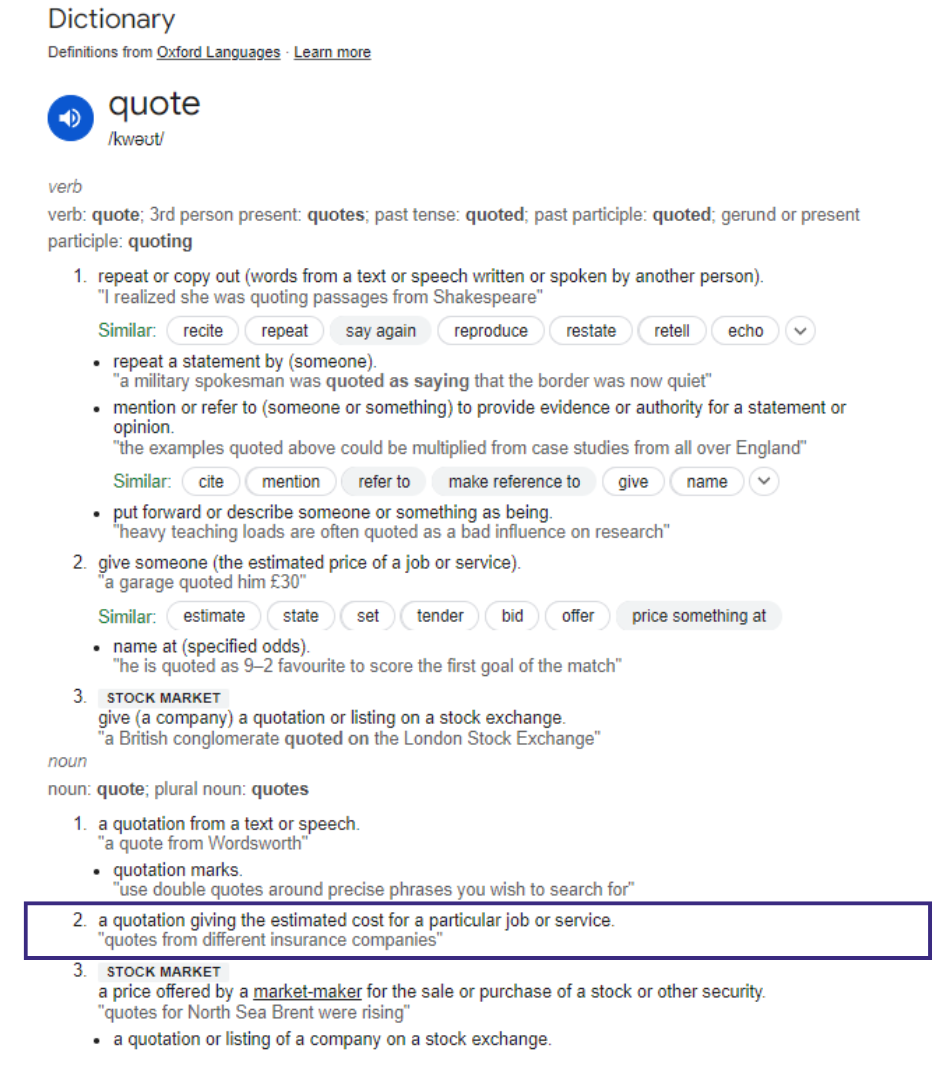
The full definition can be found here.
Why Comparing Pet Insurance Quote Matters?
According to CHOICE, Australia’s leading consumer advocacy group, comparing pet insurance policies is crucial because coverage, exclusions, and premiums can vary significantly between providers. They offer a comprehensive comparison of 78 policies from 28 insurers, featuring a big and versatile catalogue of different pet insurance providers in Australia. Importantly, CHOICE does not receive payments from the insurers it reviews, ensuring unbiased evaluations.
Similarly, Moneysmart, an initiative by the Australian Securities and Investments Commission (ASIC), advises consumers to compare the cover across different insurers. They emphasise checking aspects such as premiums, cover limits, policy excesses, and exclusions to ensure the policy meets your pet’s needs and your financial situation.
When shopping for pet insurance, we suggest gathering a few quotes while you’re shopping for pet insurance, so you can compare different policies and providers before making your final decision.
Independent sources like CHOICE and Moneysmart recommend this approach to ensure you find coverage that suits both your pet’s needs and your budget. By evaluating various options, you can make an informed decision and select the best policy for your furry friend.
What Affects the Cost of Your Premium?
Different insurance providers have their own way of calculating premiums, but they’re generally based on similar factors. At Petsy, we consider four main factors related to your pet, then adjust the premium based on your preferred coverage options. It’s worth noting that with Petsy, your own claims history doesn’t impact your premiums directly when it comes to renewal time.
Species and Breed
The breed of your pet can significantly impact the cost of your premium. Some breeds are more prone to specific health issues, which can make them a bit pricier to insure. Your pet’s health history prior to taking out pet insurance won’t impact your premiums with Petsy. Just like most other insurers, we don’t cover pre-existing symptoms and conditions and illnesses. You can read more about how we handle pre-existing symptoms and conditions differently at Petsy.
Pet’s Age
Generally, younger pets have lower premiums. As your pet gets older, the chances of health problems increase, which can lead to higher veterinary costs. At Petsy, we like to reward responsible pet ownership and pet parents who start early. So, if you begin your pet’s coverage with us before they’re 6 months old, we’ll automatically increase your annual limit by 20% at no extra cost. If you start before they turn one, we’ll add 10% to your annual limit, also at no extra cost.
Location
Where you live can also affect your premium. Vet costs can vary depending on whether you’re in an urban area or somewhere with a higher cost of living. Certain locations might also have higher risks for specific health issues or accidents, and insurers take this into account.
Sex of your Pet
The sex of your pet can influence behaviour, which might affect the likelihood of certain claims. There are also some statistical differences in health and lifespan between male and female pets, which insurers factor into their risk assessments.
Common Pitfalls When Comparing Pet Insurance Quotes
One common mistake when comparing pet insurance quotes is to base the decision solely on price and choose the option with the lowest premium. Not all pet insurance policies are created equal, so it’s important to compare policies properly, by comparing “apples with apples”, so you know what’s actually included (or not included) at the price point you are comfortable with. We can guide you on how to compare pet insurance policies.
Another mistake people tend to overlook is not reading the Pet insurance reviews of your pet insurance provider. Understanding other customers’ experiences can give you a good idea of how responsive an insurer is when it comes to claims, customer service quality, and whether the policy delivers on its promises.
To offer budget-friendly options, some providers might limit coverage through stricter exclusions or sub-limits, which can limit how much you can claim. These details may not be obvious when obtaining a quote. You may also be met with a hefty price increase when it comes to renewal time.
At Petsy, our focus is on providing high-quality coverage and service that offers long-term value. Our Australian-based team ensures you always speak with a local pet lover. Through our experience, we understand that more extensive coverage tends to align with our customers’ expectations. That’s why we focus on high-quality insurance with no sub-limits. Our customisable policy allows for coverage levels to be adjusted. For example, by increasing the annual excess, you will be able to lower premiums to meet your budget needs.
How Can I Lower My Pet Insurance Premium?
There are ways to lower your pet insurance premium by adjusting your coverage options, like the annual limit, benefit percentage, and annual excess. Generally, the more coverage you choose, the higher the premium. Here’s a quick rundown of the main factors:
Annual Limit
The annual limit is the maximum amount your pet insurance will pay for all claims in one year. Once this limit is reached, you’ll need to cover any additional costs yourself until the next policy year. The higher the limit, the higher the premium; the lower the limit, the cheaper or lower the premium. At Petsy, we offer a range of options, including $5k, $10k, and $25k, all with no sub-limits. Our pet insurance covers both accidents and illnesses and has one list of conditions covered under the policy regardless of the annual limit chosen by you. This means, even if you chose an annual benefit limit of $5,000 instead of $25,000, the list of conditions covered is exactly the same. It just means the total amount claimable in the 12-month period is $5k, not $25k.
Benefit Percentage
This is the percentage of each eligible vet bill your insurance will cover. Most options in the market range from 70% to 100%, but be sure to check the fine print for exclusions. At Petsy, we offer two options: 80% and 90%. You can lower your premiums by adjusting your benefit percentage. For example, choosing a plan that covers 80% of each eligible vet bill, rather than 90%, can help reduce your monthly premiums.
Annual Excess
This is the amount you have to pay out of pocket before your insurance starts covering costs. It can be a fixed amount per claim, per condition or per policy year. The lower the excess, the higher the premium; the higher the excess, the cheaper or lower the premium. Different insurers offer different types of excess, such as per claim, per condition, and annual excess. Ours is a once-off, annual excess that you’ll need to meet first. At Petsy, we have several annual excess options: $0, $150, $200, $300, and $500. We recently introduced the $500 annual excess option that can reduce the premium by more than 40% in some cases.
Optional Extra Benefits
Many providers, including Petsy, offer add-ons for extra benefits like Dental Illness, Specialised Therapies and Behavioural Conditions. If you decide to include extras, this will increase your premium, as coverage also increases. Petsy is one of the few providers that offer dental illness coverage with no sub-limits.
Vet Consultations
Removing vet consultation fees from your coverage can lower your premium. We are one of the few providers who allow for this, because many of our members are vets and pensioners who receive discounts on vet consultations, or they may already be covered by wellness plans and we don’t want them to double up. However, it’s worth noting that the cost of vet consultations can increase significantly during emergency hours. If you don’t fall into one of these categories, it might be worth considering including vet consultation fees in your coverage.
Examples of Pet Insurance Quotes with Petsy
When exploring pet insurance options with Petsy, you’ll find a range of pet insurance quotes based on your pet’s age, breed and current location. Below are a few examples of quotes to give you a good idea of what to expect when getting a pet insurance quote with Petsy.
Please note: these pet insurance quotes are taken on the 13th of April 2026, and are subject to change. For the most updated pet insurance quote price for your pet, please visit our quote tool. You can get a custom quote for your pet in less than 10 seconds.
Example 1
Pet Type: Dog
Location: BARANGAROO, NSW, 2000
Breed: Cavoodle
Sex: Male
Age: 1 year
Pet Desexed: Yes
Reimbursement: 80%
Vet Consultation Fees: No
Optional Extra Benefits: No
Annual Excess: $500
Quote as of 13th April 2026
| Annual Limit | $5,000 | $10,000 | $25,000 |
|---|---|---|---|
| Monthly Premium | $28.27 | $33.93 | $41.41 |
Example 2
Pet Type: Dog
Location: BARANGAROO, NSW, 2000
Breed: Golden Retriever
Sex: Male
Age: 1 year
Pet Desexed: Yes
Reimbursement: 80%
Vet Consultation Fees: No
Optional Extra Benefits: No
Annual Excess: $500
Quote as of 13th April 2026
| Annual Limit | $5,000 | $10,000 | $25,000 |
|---|---|---|---|
| Monthly Premium | $48.59 | $58.07 | $69.77 |
Example 3
Pet Type: Dog
Location: BARANGAROO, NSW, 2000
Breed: Miniature Dachshund
Sex: Male
Age: 1 year
Pet Desexed: Yes
Reimbursement: 80%
Vet Consultation Fees: No
Optional Extra Benefits: No
Annual Excess: $500
Quote as of 13th April 2026
| Annual Limit | $5,000 | $10,000 | $25,000 |
|---|---|---|---|
| Monthly Premium | $35.33 | $42.41 | $51.76 |
Example 4
Pet Type: Dog
Location: BARANGAROO, NSW, 2000
Breed: Labrador Retriever
Sex: Male
Age: 1 year
Pet Desexed: Yes
Reimbursement: 80%
Vet Consultation Fees: No
Optional Extra Benefits: No
Annual Excess: $500
Quote as of 13th April 2026
| Annual Limit | $5,000 | $10,000 | $25,000 |
|---|---|---|---|
| Monthly Premium | $48.20 | $57.63 | $69.24 |
Petsy Multi-pet Discount
Insuring multiple pets with Petsy has its perks! For every additional pet you add, you’ll get a 5% lifetime discount. This discount applies automatically when you insure more than one pet at the same time. If you’re an existing member and would like to add an additional pet to an existing policy or want to know about our latest promotions, feel free to give us a call at 1300 952 790.
So! Ready for Your Pet Insurance Quote?
Getting and understanding a pet insurance quote is a key step in finding the best coverage for your pet and peace of mind for you.
Comparing quotes across different providers ensures you’ll find a policy that balances affordability with the coverage your pet needs. Just be sure to watch out for potential pitfalls, like what’s included in the fine print or being guided purely on price. By carefully reviewing each quote and matching it with your pet’s specific needs and your budget, you can choose a policy that offers both great protection and value. Whilst you’re here, get a quote from Petsy and Happy shopping!
Get a free QuoteCompare Pet Insurance: Choose the right pet insurance policy for your pet in 2026

Why do you need pet insurance?
“When it comes to your pet’s health, a little preparation goes a long way.”
Let’s be honest—we can’t tell you if you need pet insurance. That’s financial advice, and you’ll need to speak to a professional for that.
But what we can tell you is this: without pet insurance, 100% of the vet bill, 100% of the time, will come out of your pocket. Unlike humans, pets don’t have Medicare. It costs just as much to run a blood test on a dog or cat as it does on a human, but in Australia, taxpayers cover the cost for people.
Pet insurance isn’t mandatory, but it’s quickly becoming a must-have for many Aussie pet parents. It’s there to help when the unexpected happens—like if your pet eats something they shouldn’t or has an unfortunate run-in with a car.
As pet parents, we know that a trip to the vet emergency hospital brings two kinds of stress.
First, there’s the emotional stress.
Your pet can’t tell you or the vet what’s wrong, and it’s tough not knowing how to help. You just have to trust the vets to care for your pet as you would.
Then, there’s the financial stress.
While you’re relieved that your pet has received the care they need, you’re often left with a hefty vet bill.
At Petsy, we started with a mission to ease that financial burden so you can focus on your pet’s well-being and your family during tough times.
Types of available pet insurance
In Australia, pet insurance generally comes in a few different types of coverage, that can vary by provider. To help you understand how different type of pet insurance policies coverages relate to affordability you can check out our guide on Cheap Pet Insurance, meanwhile lets look at the table below to get a brief idea on what do they typically cover and what they are best suited for.
|
Insurance Type |
Covers Accidents |
Covers Illnesses |
Covers Routine Care |
Best For |
|---|---|---|---|---|
|
Accident-Only |
|
|
|
Budget-conscious pet owners |
|
Accident & Illness |
|
|
|
Broad medical coverage without extras |
|
Accident & Illness + Routine Add-ons |
|
|
|
Comprehensive care with wellness included |
|
Routine Care (Add-on Only) |
|
|
|
Preventative care support |
Comparing pet Insurance and understanding these options is just the first step. Lets look in detail on how you can compare different pet insurance policies for your pet so that you don’t just get the best value for your money but best protection as well.
Accident-Only Cover: This only covers costs related to injuries from accidents, such as broken bones or wounds. It doesn’t cover illness-related expenses.
Accident and Illness Cover: A more comprehensive option that covers both accidental injuries and illnesses. It can include coverage for a wide range of conditions, from minor issues, like infections and allergies, to more serious diseases like cancer.
Accident and Illness Cover with add-ons: Some plans also cover routine care treatments like vaccinations, desexing, and flea and tick treatments, along with accidental injuries and illnesses.
Routine Care: Can be offered as an optional add-on, which helps to cover some costs for preventative care and wellness treatments, such as vaccinations, microchipping, and desexing. The coverage limits for these treatments are usually lower than for other claimable conditions.
At Petsy, we offer accident and illness cover with add-ons only. We believe that in an emergency, people shouldn’t have to worry about whether they selected the right level of coverage when they bought their policy. We want our policyholders to have peace of mind.
Why compare pet insurance?
At Petsy, our mission is to ensure that pet insurance doesn’t end in tears. We’re here to educate you so you know exactly what you’re getting when you sign up. According to Moneysmart, pet insurance premiums typically range from $60 to $120 per month, which means there is a lot of variation of price and coverage in the market. Switching providers can be costly, especially if pre-existing symptoms and conditions are involved, so it’s crucial to find the right policy for you and your pet from the start. We strongly suggest shopping for pet insurance quotes before you commit to a provider. We explain what goes into a pet insurance quote in this article and explain how you can reduce your pet insurance premium.
How you can compare pet insurance policies
In Australia, there are many quality providers, each offering a range of policies. To make the best choice, it’s important to research and compare coverage options, costs, and how well each policy matches your pet’s health needs. We’re here to guide you through this process so you can make an informed decision.
According to Google, the definition of compare is to “estimate, measure, or note the similarity or dissimilarity between”.
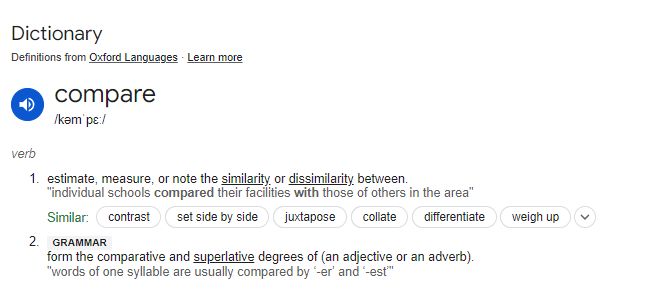
Full definition here
When comparing pet insurance policies, typically they have similar key components: inclusions/exclusions, an annual limit, benefit percentage, excess, and optional extra benefits. Your premium is determined, based on the levels of coverage depending on these components, as well as your pet and your address. So, when comparing pet insurance, the key is to understand how each component works differently across providers. This helps you identify the best policy that meets your needs and offers the most value.
Let’s break down these components so you can see where policies are similar and, more importantly, where they differ.
Coverage and inclusions
Most providers offer tiered policies, such as small, medium, or large, or bronze, silver, or gold and will try to bucket you into one of these categories. Generally, the lower-tiered policies offer less coverage and are more affordable, while the higher-tiered options provide broader coverage with fewer restrictions.
At Petsy, we understand that even two pet owners in the same suburb with the same breed of pet may have different financial needs. That’s why we do things differently here and offer one policy that is customisable to suit your coverage and financial requirements.
Annual limit
The annual limit is the maximum amount your pet insurance will pay for all claims in one year. Once this limit is reached, you’ll need to cover any additional costs yourself until the next policy year.
At Petsy, regardless of the annual limit you choose, the list of covered accidental injuries, illnesses, and conditions remains the same. Often with other policies, if you pick a larger annual limit, the list of your inclusions will also increase. At Petsy, no matter which annual limit you choose, the list of covered injuries, illnesses, and conditions remains the same. Whether you opt for a $5,000 or $25,000 annual limit, your coverage remains the same. Plus, unlike many other providers, we don’t impose sub-limits, so there are no restrictions on how much you can claim for specific conditions or claims.
Benefit percentage
This is the percentage of each eligible vet bill your insurance will cover. For instance, if your benefit percentage is 80%, the insurance will pay 80% of the bill, and you’ll pay the remaining 20% (after any excess is applied). This is pretty similar across the industry. Benefit percentage ranges from 70% to 100%.
Excess
This is the amount you have to pay out of pocket before your insurance starts covering costs. It can be a fixed amount per claim, per condition or per policy year.
At Petsy, our excess works a bit differently. Instead of applying an excess per condition or claim, we use a once-off annual excess. For instance, if your annual excess is $300 and your first vet bill is $200, the remaining $100 will be applied to your next approved claim. You only need to meet this excess once per year.
Optional extra benefits
Optional extra benefits are additional coverage options that can be added to the standard coverage. When doing your research, you will find that there are a lot of dissimilarities in the market for optional extra benefits. A lot of providers don’t even offer any optional extra benefits. You will find that some providers offer routine care as ‘add-ons’ and if they do, sometimes only offered as part of plans with the highest level of coverage.
At Petsy, we offer optional extra cover for dental illness, behavioural conditions, and specialised therapies. Plus, we don’t have sub-limits on these. However, it’s important to note that routine care items, like regular teeth cleaning, isn’t covered. Claims need to be related to a dental disease like gingivitis, periodontal disease, or tumours.
We offer optional extra benefits only for pets under the age of three at the time of application. Why only under three? By the age of three, most pets may develop dental diseases, and adding extra benefits later would mean these conditions would be considered pre-existing symptoms and conditions that would not be covered. We want to ensure you’re not paying for coverage that can’t be used.
Vet Consultations
Vet consultation fees are what you pay your vet when your pet needs to see the vet for treatment when they’re sick or hurt.
When you receive a vet bill, one of the line items will typically be for the vet consultation. We’re one of the few providers that allows you to exclude vet consultations fees from your coverage. We do this for a few reasons:
- Many of our customers are vets, vet nurses, or clinical staff who receive significant discounts or don’t pay for vet consultations at all
- Some customers are already on wellness plans which cover vet consultation fees, so we don’t want them doubling up
- Pensioners often get discounts on their vet consultation fees
It’s worth noting that the cost of vet consultations can increase significantly during emergency hours. If you don’t fall into one of these categories, it might be worth considering including vet consultations in your coverage.
Compare the Customer Service and how a provider makes things easier for you
Choosing a pet insurance isn’t just about the coverage—it’s also about how well the provider supports you when you need them most. Here are some things to think about:
- Is it easy to file a claim?
- How do they handle pre-existing symptoms and conditions?
- Can they bill your vet directly?
- How easy is it to reach their support team?
- What’s their cancellation policy?
- Can you add extras later?
An easy way to check out a provider’s service is by looking at reviews on sites like ProductReview.com.au and Google Reviews. These platforms offer real feedback from customers, giving you a sense of how well the provider handles claims and customer support.
We walk you through what to look for in pet insurance reviews in this article here.
Petsy is Australia’s highest rated pet insurance provider*
At Petsy, we’re proud of our top ratings on ProductReview.com.au, TrustPilot, and Google, which reflect our commitment to looking after you and your pets. We’ve also been recognised with Canstar’s Outstanding Value Pet Insurance Award for two consecutive years in 2023 and 2024.
We’re the Pet People, and we understand pets because we’re pet parents too. When you call us, you’ll speak to someone right here in Australia who gets how things work with vets in this country. For extra peace of mind, we offer a complimentary pre-existing symptoms and conditions assessment. This way, you’ll know exactly what’s covered and what’s not before anything unexpected happens. Plus, it means faster claim payments when you need them most.
*Highest rated on Product Review, Finder, Choice and Furbaby Pet Insurance as of April 2026
Pet Insurance Reviews: What to Know Before You Choose a pet insurance policy in 2026

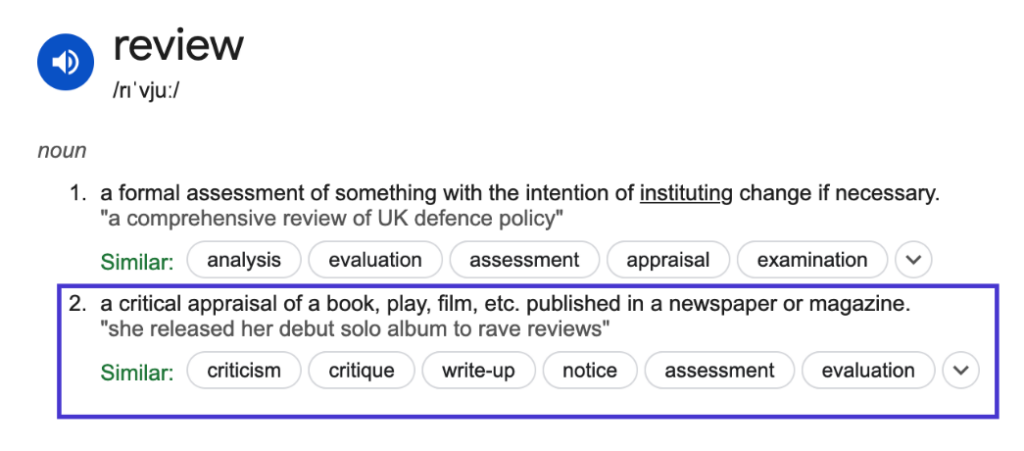
To begin, what is a pet insurance review?
In essence, a pet insurance review is a customer’s experience with their insurance provider that is shared online. These reviews offer insights into real experiences, particularly aspects like the claims process, customer service, and overall satisfaction—things you can’t fully judge from the policy details alone.
See full definition here.
What can pet insurance reviews tell me?
Reviews can be incredibly helpful for understanding key aspects of a pet insurance provider’s service. When it comes to the claims process, you’ll want to know:
- Was it easy to submit a claim?
- How long did it take to process?
- Were there clear explanations provided if a claim was denied?
These details are crucial because they directly affect your experience when you need to rely on your insurance the most.
Similarly, customer service is another critical area to consider. Reviews can tell you how responsive and helpful the support team can be.
- Do they address concerns promptly?
- Are they knowledgeable about the policy details and able to guide you through tricky situations?
Good customer service can make a huge difference, especially during stressful times when your pet’s health is on the line.
Not every review is going to be spot-on; sometimes, claims are denied for legitimate reasons, like pre-existing conditions, but that can lead to unhappy customers. However, if you see the same issues popping up in multiple reviews, it might be a red flag.
Who Can Leave Pet Insurance Reviews?
Customers and the general public can share their experiences on sites like ProductReview.com.au, Trustpilot, or Google Reviews. In addition to customer feedback, financial and pet industry experts also contribute to reviews. Sites like Forbes Advisor offer professional assessments, focusing on coverage options, pricing, and policy details.
These expert reviews can be especially helpful when you’re comparing multiple providers and need a deeper understanding of the policies. There is a lot of regulation around online product and service reviews, so that consumers can rely on the reviews they read online from reputable review sites.
What should I look for in pet insurance reviews?
Here are key green and red flags to look out for. Example reviews below have been taken from Productreview.com.au as of 23 September 2024.
Green flags
Reviewers who recommend the provider to their family and friends indicate a high level of satisfaction.
R
Richard T.
4w
Customised cover
Excellent value and service — Annie was informative and helpful, a delight to interact with and obviously someone who shares a passion for animals. I felt that I was given a thorough understanding of the products Petsy offers and had no unanswered questions. I feel that the policy I purchased is of good value and I will be more than happy to recommend Petsy to friends and family. I also hope that Petsy recognises and values Annie’s representation of your values.
Long-term Policyholders: Satisfied customers who have stayed with a provider for years can indicate reliability and trustworthiness.
A
Adam M
2mo
Top cover
A very Happy Customer — I have been with Petsy Pet Insurance since we got our puppy 2 years ago and they have been amazing, really easy to deal with and a simple process to lodge your claims through. They respond quickly to both claims and general enquiries.
Helpful Customer Service: Look for reviews praising knowledgeable and supportive service teams. This is particularly helpful when the unexpected happens and you need questions answered.
B
Barbara Whait
2mo
Dogs accident and illness insurance
Petsy dog insurance — I have lodged 2 claims for my Cavalier King Charles Spaniel, Darcy, both due to a corneal ulcer in his eye. The first claim was paid within 3 business days as I had provided his full vet history. The second one was approved an hour after I lodged it. A lady even rang me to ask how Darcy was. I have spoken to several staff members over the phone to ask various questions. They have all been very pleasant, patient and helpful. I have also not had to wait long on the phone. I chose Petsy as there are no sublimits. I chose the option to have all the vet consultations covered. The claims process was easy- and that they will write to the vet for me if needed.
Happy Switchers: If someone switched providers and loves the new one, that’s a big plus.
M
Marisa B.
2mo
Puppy protection plus
Excellent value and service — Annie was informative and helpful, a delight to interact with and obviously someone who shares a passion for animals. I felt that I was given a thorough understanding of the products Petsy offers and had no unanswered questions. I feel that the policy I purchased is of good value and I will be more than happy to recommend Petsy to friends and family. I also hope that Petsy recognises and values Annie’s representation of your values.
Smooth Claims Process: Quick, hassle-free claims are exactly what you want.
P
Phoebe G.
1mo
Puppy protection plus
Petsy has made my pets welfare so much less stressful — The service provided by Petsy has been amazing. My puppy got parvo and even with full vaccination needed 24/7care for a week until she was well enough to come back home. Once she was back home I made a claim with two days and got correspondence from the team a day after. I expected the process to take up to two weeks as it was a large claim but within five days the claim had been processed and two days later the funds were in my account. All I had to do to make my claim was provide the details of the vet and invoices if the care was complete and they would do all the work getting information from the vet. They also checked in with me a few times during this process to let me know how the claim was going and asked me how my puppy was going.
I have been with Petsy for three months and they have been so much more approachable than my previous insurer. Their policy is the same price of my previous policy but covers two dogs while my previous policy only covered the one. I wish I had been with Petsy earlier as my other cavoodle needed to have dental surgery on some adult teeth and my current policy would have covered this when my old insurer did not.
They also provide a Pre-existing assessment for all pets that helps to outline what vet costs will or won’t be deductible based on their prior vet history. They are also open to updating information when some existing vet notes change, such as a dog no longer eating poop!
My amazing experience with Petsy has made me speak highly of them to everyone who has heard about my puppy getting sick and I recommend them to anyone who has a pet.
Efficient Claims Process: Quick and straightforward claim submission and turnaround are major positives.
E
Emily B.
1mo
Dogs accident and illness insurance
Claims are processed quickly and staff are friendly x — My chosen policy was easy to set up and claims are super quick and simple to lodge. My latest pet insurance claim was processed in less than 24 hours and staff are always super friendly and helpful. Sharon sent me a follow up message informing me of the outcome of my claim and asking how my pet was doing which I really appreciated.
Red flags to look out for in pet insurance reviews:
Premium Increases: Bill shock is a real thing and not something you can foresee when you first take out a policy. As your pet ages and veterinary costs rise, it’s normal for insurance premiums to increase over time. Factors like inflation and changes in risk also contribute to these adjustments. When comparing providers, be aware that lower initial premiums are common, but it’s important to understand how premiums might increase over time due to factors like inflation and your pet’s age. Understanding how premiums might change over time will help you make an informed decision and avoid surprises.
Repeated Complaints about Poor Customer Service: We totally get it, no one is perfect! But repeated reviews mentioning poor customer service, or poor communication where customers are left feeling confused is a sign that this could potentially be your experience too.
Claim Denials or Low Payouts: This could mean the provider has restrictive limits like sub-limits on what they cover.
Check Out Our Ratings*:
- 4.9 stars – Petsy Pet Insurance on ProductReview.com.au
- 4.7 stars – Petsy Pet Insurance on Trustpilot
- 4.7 stars – Google Reviews for Petsy Pet Insurance
At Petsy, we’re not claiming to be perfect, but we’re pretty proud of the reviews our policyholders leave us. As you’re shopping around, we definitely recommend checking out reviews of different providers as part of your decision-making process. Seeing what others have to say can help you choose the best coverage for you and your pet. *Ratings as at April 2026
Cheap Pet Insurance in Australia: How to make Pet Insurance more affordable in 2026.

Here we will define cheap pet insurance and how to make pet insurance more affordable in Australia.
Key Takeways
Here we will define cheap pet insurance and at the bottom keep reading below so we can show you how you may make pet insurance cheaper. Look out for tips on how to lower the cost of a pet insurance premium. If you are like us, you probably love a deal. But our experiences have led us to understand the age-old saying.
What is cheap pet insurance?
“In life, usually you get what you pay for.”
Years ago, we did offer lower-priced products with less coverage. But we found that this led to tears in the instances when people thought that they were covered for an accident and actually they were not. The main problem we saw was that cheaper insurance products had limited coverage and features.
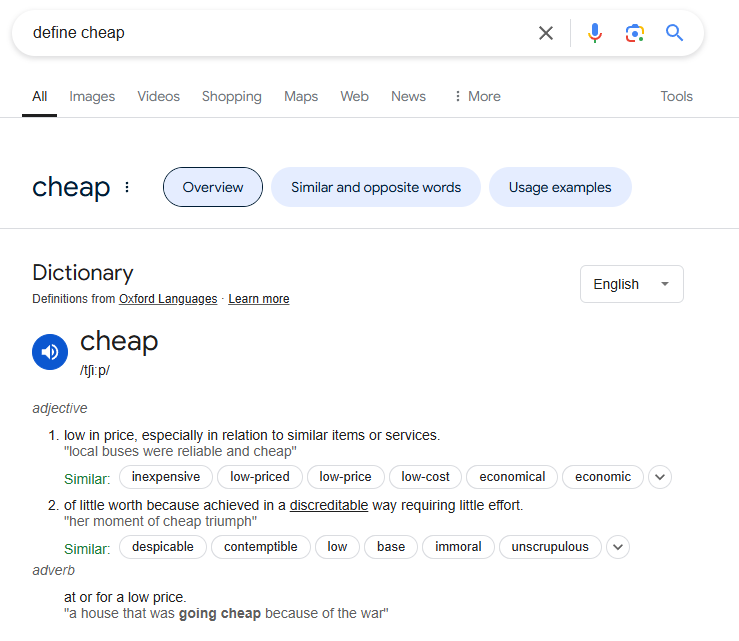
Before we get into what cheap or low price pet insurance is, let’s take a look at the definition of cheap. According to a quick google search (definition from oxford languages^), cheap is defined as:
“Low in price, especially in relation to similar items or services” or “Of little worth because achieved in a discreditable way requiring little effort”
In general, the term “cheap” refers to something that is priced lower than average or of lower cost or value when compared to other products or services available to consumers.
Cheap products
When we talk about products, “cheap” usually refers to items that are inexpensive, affordable, or budget-friendly. These products may be made with less costly, lower-quality materials or may lack some of the features or benefits of more expensive alternatives. In other cases, a similar product may not be priced as high if the brand name is not well known. An example of this may be a cheap knockoff of one of your favourite brands.
Cheap services
If we refer to services, “cheap” typically refers to services that are priced lower than average or considered a bargain. However, it’s important to note that “cheap” services may not always offer the same level of quality, care, attention to detail, expertise, or reliability as more expensive options. That is very much what we found out when it comes to what we have offered in the past compared to our offerings today.
The low-priced pet insurance options we offered before were not of the same level of quality or reliability. That’s why we don’t offer them anymore.
Now, we do understand that some people may have their own concept of what is cheap, so, let us use the term “low in price” or “low priced” in relation to other similar pet insurance offerings, instead of the word “cheap.”
We no longer have very “low in price” pet insurance offerings.
Why? Because to lower the price, we would have to compromise on the coverage or service we deliver. Remember we do not send calls or customers service offshore. You will only ever communicate with an Australia Pet lover, just like you.
Again, we have done that in the past and found that it didn’t work, as our members were thinking they were covered for conditions that they were not covered for, which led to tears.
So we decided to only offer quality pet insurance with no sub limits, serviced by only Australian staff. We allow our members and policy holders to customise the cover to make it more affordable.
An example of low-priced pet insurance in Australia – accident only cover
In the pet insurance world, accident only cover is considered one of the lowest-priced insurance options.
There are still some low-priced pet insurance products available in the market, and they usually fall into the category of “accident only cover” or “accident only pet insurance”. This can start from as low as around $20-$30 a month for dogs and potentially even less for cats.
In the past, when we did offer accident only covers, we found the problem was the shorter list of the conditions it covered. Which was okay at the point of purchasing but when faced with an unexpected incident and you are in the emergency vet, it’s hard to remember exactly what conditions are covered, and what options you did and didn’t choose.
When it comes to pet insurance, what is an accident?
It may sound like an accident to you, but is it? When asked about conditions such as ingestion of a foreign object (if a dog or cat has swallowed something they shouldn’t), some people would think that this is an accident, but it may not be for pet insurance.
In many pet insurance policies, you will find that ingestion of a foreign object is considered to be a cause for an illness and is therefore not claimable under accident only covers. This has proven to be a shock to policyholders who may have purchased an accident only cover, believing they are protected for the “accident when my dog ate something it shouldn’t.”
What’s the difference between Accident only cover and Accident and Illness cover? To the general public, we found accident only cover may sound like it covers vet costs if your pet is in an accident, such as being hit by a car or injuries from dog fights or snake bites. Accident and illness cover may sound like it covers accidents as well as sickness such as diabetes or cancer, provided it isn’t a pre-existing condition.
It’s very important to note that what sounds like an accident to general public and what is actually covered as an accident under a pet insurance policy may be different. The only way to be sure is to contact the insurance provider and confirm.
Accident only covers led to tears, so that is why we no longer offer it. We no longer offer low-priced or, in our eyes, “cheap pet insurance” that limits the coverage too much. Our current pet insurance covers both accidents and illnesses and has one list of conditions covered under the policy. This means, even if you chose an annual benefit limit of $5,000 instead of $25,000, the list of conditions covered is exactly the same. It just means the total amount claimable in the 12-month annual period is $5k, not $25k.
As mentioned before, we do not and probably will never again offer another product that limits the conditions covered under the policy, just to make it an cheaper option compared to other products in the market.
How much can pet insurance cost?
If you were looking for cheap pet insurance (according to the definition of cheap we looked at before), we would agree that there are cheaper options out there for pet insurance in Australia. But cheap pet insurance may not always be the best pet insurance choice for you and your family.
Here are some the ranges of pet insurance prices, for policies in 2026:
- Pet insurance range for a cat: from $15 per month to $200+ a month.
- Pet insurance range for a dog: from $20 per month to over $200+ a month.
But why is there such a difference in pet insurance premiums?
It’s simply because not all pet insurance products are equal. If you were to make the same claim under different pet insurance covers, what you may get back can vary greatly. There are also multiple factors that can influence pet insurance premiums as they are determined based on your pet, as well as your situation,, such as your pet’s breed and where you live. With so many options out there, it can be really confusing and hard to tell the difference between pet insurance offerings. Which makes it even harder to decide which is right for you and your pet.
If you want to know more about pet insurance, please see our ultimate guide on how to compare pet insurance policies.
Make pet insurance cheaper
How can I lower the cost of pet insurance, or reduce the insurance premium?
The amount you pay for pet insurance each month or year, otherwise known as the insurance premium can be reduced by changing the options, such as annual limit, benefit percentage and annual excess. In general, the more coverage you select, the more expensive your premium will be.
We will quickly break down the main mechanisms that affect the pet insurance premiums. When we mention the term “cheap” or “cheaper” below, we refer to the ability to make the premium less than a more expensive alternative.
Look out for tips on how to lower the cost of a pet insurance premium.
Annual Limit
In the market, the total amount you may be reimbursed during a 12 month period can range from $3,000 to over $20,000. The higher the annual limit, the higher the premium, and the lower the annual limit, the cheaper pet insurance premiums will be.
Petsy offers some of the lowest and, conversely, highest annual limits in the market with no sub-limits. Remember, $10k with sub-limits is not the same as $10k without sub-limits.
Our coverage options are entirely up to you to choose from, and we have $5k, $10k, and $25k options available.
Benefit Percentage
Usually, you can choose how much of the vet costs you want to be covered. This is known as the “benefit percentage” in pet insurance.
In the market, the total amount you can select to be reimbursed on vet bills will usually range from 70% to 100% (just check the caveats and fine print on those who claim to offer 100% back).
The higher the benefit percentage, the higher the premium, and the lower the benefit percentage, the cheaper pet insurance premiums will be.
We offer two options, 80% and 90%.
Annual Excess
In the market, the available excess ranges from $0 to over $500.
With Petsy the lower the annual excess, the higher the premium, and the higher the annual excess, the cheaper pet insurance premiums will be.
It is important to note that not all excess available in the market are the same. The three main types are per claim excess, per condition excess and annual excess and they are very different.
A per claim excess would be applied (ie. you need to pay this amount out of your own pocket) for every claim you submit.
A per condition excess would be applied for every different condition that your furry friend develops and you make a claim.
An annual excess is only applied once for the year, regardless of how many claims you made, or how many conditions you furry friend had.
At Petsy we offer a number of annual excess options they are: $0, $150, $200, $300 and $500
Optional Extra Benefits
Many insurance providers offer the opportunity to add-on extra benefits, such as behavioural conditions, physiotherapy or emergency boarding. Each insurance provider will offer different extra benefits, so make sure to consider what extended cover you would like your pet to have.
The more optional extras you choose, the more expensive your pet insurance premium will be, and the less optional extras, the cheaper you can make your pet insurance premium.
Dental Coverage
Adding dental coverage will increase the amount you pay for pet insurance. Choosing to not include dental coverage will reduce the pet insurance premiums.
Not many pet insurance providers have dental coverage as an option. If they do there are usually sub-limits.
Petsy is proud to be one of the few providers that offer dental coverage and as always there are no sub-limits.
Vet Consultations
Not many pet insurance providers will allow you to remove vet consultations from your coverage. In fact, when it comes to vet consultations, many have the caveat of a sub-limit on vet consultations. If you decide to remove vet consultations, this will make your pet insurance cheaper.
There are three main reasons why we allow our policy holders to remove Vet consultations. The first is that we have many Vets, Vet nurses and other staff who work in vet clinics and they usually get a large discount on vet consult charges. The second is that we have a number of elderly, disability and concession card holder who also get a discount on vet consults. The third is that our pet insurance pairs well with a wellness plan that will already pay for vet consults
Still confused about how to get cheap pet insurance in Australia in 2026?
Finding affordable pet insurance doesn’t have to be overwhelming. The key to finding cheap pet insurance in Australia is understanding that prices vary vastly based on your pet insurance provider, breed, pet’s age, coverage level, annual excess, optional add-ons, location, and complexity of treatment. Many pet owners make the mistake of choosing the first quote they see, but comparing quotes from multiple pet insurance providers can save you hundreds of dollars annually.
The most effective way to find cheap pet insurance is to get personalised quotes tailored to your specific pet’s details. Generic pricing guides only tell part of the story; your actual premium depends on your pet’s breed, age, location, and Optional add-ons.
By comparing quotes from multiple pet insurance providers, you can identify the cheapest and best option available for your pet. As mentioned time and time again in this guide, if the premium is too cheap for your pet, then beware of sub-limits, as many pet insurance providers are notorious for having hidden sub-limits on the specific conditions that get you in the time of need. This is one of the reasons why petsy has no sublimits on any conditions. If your pet doesn’t have a pre-existing condition, it will be covered with Petsy.
To make it easier for you, we have made a table for the top 12 most searched dog and cat breeds in Australia, according to recent breed popularity data on Australian Dog Lover.
Cheap Dog Insurance Quotes Australia in 2026 – Compare Prices Instantly
Dog insurance quotes can start from anywhere around $20-25 per month for basic coverage. According to a recent study on Finder, dog insurance costs anywhere around $42-138 monthly, and it can vary vastly depending on your dog’s breed, age, location, and coverage level factors.
But don’t worry, we have prepared a comprehensive table for the top 12 most searched dog breeds in Australia with the monthly quote prices on Petsy.
| Pet Breed ( Dogs ) | 5K Annual Limit ( 80% with 500 annual excess | 10K Annual Limit ( 80% with 500 annual excess ) | 25K Annual Limit ( 80% with 500 annual excess ) | 25K Annual Limit ( 80% with 200 annual excess ) |
|---|---|---|---|---|
| Cavoodle | $27.49 | $32.99 | $40.27 | $60.22 |
| Golden Retriever | $47.25 | $56.60 | $67.98 | $100.33 |
| French Bulldog | $61.27 | $72.54 | $87.44 | $132.55 |
| Miniature Dachshund | $34.36 | $41.24 | $50.33 | $74.03 |
| Border Collie | $34.36 | $41.24 | $50.33 | $74.03 |
| Labrador Retriever | $46.87 | $56.18 | $67.47 | $99.47 |
| German Shepherd | $41.09 | $49.32 | $59.77 | $37.33 |
| Staffordshire Bull Terrier | $37.33 | $54.68 | $79.99 | $79.99 |
| Maltese Cross | $30.99 | $37.20 | $45.40 | $67.26 |
| Australian Cattle Dog | $37.73 | $45.28 | $55.27 | $80.80 |
| African Boerboel | $77.53 | $92.05 | $112.77 | $171.99 |
| Great Dane | $77.53 | $92.05 | $112.77 | $171.99 |
Note: These quoted prices were taken on 13th April 2026 and are subject to change. The quote prices are based on the specific location in Australia, 1 year pet age, pet desexed – yes, optional add-ons – no, vet consultation – no. To get the most accurate data for your pet in less than 15 seconds, please visit our quote tool here.
Cheap Cat Insurance Quotes Australia 2026 – Lowest Prices
Cat insurance quotes can start from anywhere around $15-20 per month for basic coverage. According to a recent study on Finder, cat insurance costs anywhere around $30-80 monthly, and it can vary vastly depending on your cat’s breed, age, location, and coverage level factors.
But don’t worry, we have prepared a comprehensive table for the top 12 most searched cat breeds in Australia with the monthly quote prices on Petsy.
| Pet Breed ( Cats ) | 5K Annual Limit ( 80% with 500 annual excess ) | 10K Annual Limit ( 80% with 500 annual excess ) | 25K Annual Limit ( 80% with 500 annual excess ) | 25K Annual Limit ( 80% with 200 annual excess ) |
|---|---|---|---|---|
| Domestic ShortHair | $21.23 | $22.06 | $26.92 | $39.86 |
| Ragdoll | $23.61 | $28.33 | $34.58 | $51.21 |
| Domestic Medium Hair | $21.23 | $22.06 | $26.92 | $39.86 |
| Domestic Tabby | $21.23 | $22.06 | $26.92 | $39.86 |
| British Shorthair | $23.61 | $28.33 | $34.58 | $51.21 |
| Domestic Longhair | $21.23 | $22.06 | $26.92 | $39.86 |
| Burmese | $23.61 | $28.33 | $34.58 | $51.21 |
| Persian | $23.61 | $28.33 | $34.58 | $51.21 |
| Siamese | $23.61 | $28.33 | $34.58 | $51.21 |
| Maine Coon | $23.61 | $28.33 | $34.58 | $51.21 |
| Abyssinian | $23.61 | $28.33 | $34.58 | $51.21 |
| Australian Mist | $23.61 | $28.33 | $34.58 | $51.21 |
Note: These quoted prices were taken on 13th April 2026 and are subject to change. The quote prices are based on the specific location in Australia, 1 year pet age, pet desexed – yes, optional add-ons – no, vet consultation – no. To get the most accurate data for your pet in less than 15 seconds, please visit our quote tool here.
Summary
So, while Cheap Pet Insurance can be a tempting option, it’s important to understand what it really means. While some may define “cheap” as a lower-priced option, it’s essential to remember that not all pet insurance products are created equal. Before purchasing a pet insurance policy, it’s crucial to evaluate the level of coverage offered and assess whether it meets your individual needs and is right for you and your furry friend
It’s also important to note that certain pet insurance providers may have different definitions of what constitutes an accident or an illness. Thus, it’s essential to contact the insurance provider and confirm what is covered under the policy.
To reduce the cost of pet insurance premiums, pet owners can consider adjusting the options, such as the annual limit, annual excess, and reimbursement percentage. However, it’s vital to remember that lower-priced options may come with limitations or exclusions that could lead to unexpected out-of-pocket costs.
Ultimately, the goal of pet insurance is to provide financial protection for unexpected vet bills. At Petsy, we offer one customisable product with no sub-limits and flexible annual limits that provide coverage at what we see as reasonable price, backed with a high level of customer service (it’s currently one of the highest rated, if not the highest rated!).
We recently introduced a $500 annual excess option that can reduce the premium by more than 40% in some cases.
We hope that by understanding what “cheap” pet insurance really means and evaluating the coverage options available, pet owners can make informed decisions and select a pet insurance policy that is right for them and their furry companions.
If you would like more info on Pet Insurance for Cats or Pet Insurance for Dogs you can call us anytime on 1300 952 790.
What Is Mental Health? How It Works, How We Can Measure It, and Why It Matters

Mental health is a core part of overall wellbeing, shaping how we think, feel, and cope with daily life.
When people hear the word health, they usually think about the body first. They think about exercise, food, sleep, illness, fitness, pain, or going to the doctor when something feels off.
But health is bigger than that.
Our overall wellbeing is not only shaped by what is happening physically. It is also shaped by what is happening mentally and emotionally. That is where mental health comes in.
Mental health affects how we think, how we feel, how we cope with stress, how we connect with other people, and how we move through everyday life. It can influence our energy, motivation, concentration, sleep, relationships, confidence, and sense of balance. In other words, mental health is not some niche topic that only applies to a small group of people. It is part of being human.
Just as everyone has physical health, everyone has mental health too. Sometimes it feels strong and steady. Sometimes it feels stretched, flat, overwhelmed, anxious, or simply off. Understanding mental health helps us recognise that wellbeing is not only about what is happening on the outside. It is also about what is happening within us.
Mental health is part of overall health, not something separate from it.
What is mental health?
The World Health Organization defines mental health as a state of wellbeing in which a person can realise their own abilities, cope with the normal stresses of life, work productively, and contribute to their community. In other words, it is not just about illness. It is a core part of overall health.
A lot of people assume mental health only refers to serious struggles or mental illness, but that is too narrow. Mental health is something every person has. Just as your body can feel strong, tired, sore, run-down, or unwell, your mind and emotions can too.
That is one of the most important things to understand. Mental health is not just about whether someone has a diagnosis. It is about overall wellbeing. It is about how we are doing emotionally, psychologically, and socially. It is about whether we feel able to cope, connect, function, and recover when life gets hard.
It also means mental health is not all-or-nothing. It is not something you either “have” or “don’t have”. It can change over time. It can improve, decline, stabilise, or need extra care, just like any other part of health.
Why mental health matters
Mental health matters because it touches almost every part of life. According to the WHO Global Health Observatory, an estimated 970 million people nearly one in seven were living with a mental disorder in 2019, making it one of the most significant contributors to the global burden of disease.
But even outside of diagnosis, mental health matters because of how much it shapes everyday life.
It affects how we show up at work or school. It affects how patient we are with the people we love. It affects our sleep, our decision-making, our confidence, our energy, our concentration, and our ability to cope with pressure. It can shape how hopeful we feel, how connected we feel, and whether everyday life feels manageable or overwhelming.
When our mental health is in a good place, life often feels steadier. We may still have stressful days, but we can usually move through them in a healthier way. We are more likely to feel like ourselves, stay connected to others, and keep functioning even when life is imperfect.
When our mental health is struggling, even simple things can feel heavier than they should. Small tasks can feel draining. Stress can feel bigger. Relationships can feel harder. Motivation can drop. Sleep can suffer. We may stop enjoying things the way we used to, or feel like we are running on empty.
That is why mental health deserves the same attention and care as physical health. It is not secondary. It is not less real. It is a core part of what it means to be well.
If physical health shapes how our body functions, mental health shapes how we experience life.
Mental health and physical health are more alike than people think
One of the easiest ways to understand mental health is to compare it to physical health.
Most people already understand that physical health exists on a range. Some days you feel energised, strong, and healthy. Other days you might feel run-down, sore, or tired. Sometimes you are not seriously sick, but you still know your body is not quite right. You might feel flat, low on energy, or like you need rest, better food, more movement, or a bit more care.
Mental health works in a very similar way.
There is not one single switch that flips between “healthy” and “not healthy”. It is more like fitness, blood pressure, or general wellbeing. There is a range, and most of us move along it throughout our lives.
You do not need to be in crisis for your mental health to need attention. You do not need a diagnosis to say that you are not coping as well as usual. Just as your body can show signs that something is off, your mind and emotions can too.
That is what makes this analogy so helpful. We already accept that physical health can move up and down over time. We know it can be shaped by sleep, stress, environment, habits, illness, support, and treatment. We also know that paying attention early is usually better than waiting until things get worse.
Mental health works much the same way.
According to research on the social determinants of mental health, mental health can be influenced by stress, grief, loneliness, trauma, relationships, sleep, hormones, physical illness, work, financial pressure, and many other factors. It can improve with support, rest, treatment, better habits, connection, and time.
The key point is simple: health is not only about the body. A fuller understanding of health includes both body and mind.
How can mental health be measured?
People often ask how mental health can be measured, and it is a fair question.
We cannot measure it in exactly the same way we measure a temperature, heart rate, or blood pressure. There is no single machine that can instantly tell us how someone is doing emotionally. But that does not mean it cannot be measured at all.
Clinicians and researchers use validated tools to do exactly this. Instruments such as the PHQ-9 for depression and the GAD-7 for anxiety allow mental health to be tracked with standardised scores, much like how a cholesterol reading helps track cardiovascular risk. These tools are used in GP clinics, hospitals, and research settings around the world.
But measurement does not only happen in a clinic.
In everyday life, we can also look at things like mood, stress, sleep quality, motivation, concentration, emotional regulation, connection with others, sense of enjoyment, and ability to cope. These signs help build a picture of how someone is doing, even if there is no single number that explains it all.
So while mental health may not be measured with a thermometer, it can still be noticed, tracked, understood, and talked about.
We may not measure mental health with a machine, but we can measure it by noticing how we feel, cope, function, and connect.
Can I measure my own mental health?
To a degree, yes.
Most people can get a useful sense of their own mental health by checking in with themselves honestly and regularly. That does not mean diagnosing yourself. It simply means noticing how you have been feeling, functioning, and coping.
You might ask yourself:
- Do I feel like myself lately?
- Am I coping with normal daily stress?
- Am I sleeping reasonably well?
- Do I still enjoy things I usually enjoy?
- Do I feel connected to people, or more withdrawn?
- Am I concentrating okay?
- Does everyday life feel manageable, or harder than usual?
- Do I feel constantly overwhelmed, flat, anxious, or exhausted?
Questions like these can help us spot patterns early. They are not a replacement for professional support, but they are a useful starting point for self-awareness.
In that sense, many of us can measure our own mental health by paying attention to the signals our inner world is giving us, just as we pay attention to signals from the body.
The mental health continuum
One of the most helpful ways to understand mental health is through the idea of a continuum a framework developed by sociologist Corey Keyes, whose research has shaped how many mental health professionals think about wellbeing.
Keyes showed that mental illness and mental health are not opposite ends of the same scale. They are actually two separate dimensions. A person can be free of a diagnosable condition and still be languishing going through life without really thriving, feeling flat, disconnected, or like they are just going through the motions. On the other hand, someone living with a mental health condition can still experience genuine connection, purpose, and wellbeing.
That is a very useful way to think about mental health, because it helps people move away from black-and-white thinking.
Mental health is not simply “good” or “bad”. It can shift. It can improve. It can worsen. It can need support long before things become severe.
This idea gained wider cultural recognition when psychologist Adam Grant wrote about “languishing” in The New York Times in 2021, describing it as the dominant feeling of the pandemic era not depression, not thriving, but that flat and blurry feeling somewhere in between.
That is why the continuum matters. It gives people a more realistic way to understand how mental health actually works in everyday life.
It also helps reduce shame. If mental health exists on a continuum, then struggling does not mean someone is broken. It means they may be going through a period where their mental wellbeing needs more care, support, or help.
Mental health is not fixed. It moves, changes, and responds to life.
What affects mental health?
Mental health is shaped by many things. Like physical health, it is influenced by a mix of internal and external factors.
Sleep plays a major role. So does stress. Relationships matter. So do work pressure, grief, trauma, loneliness, financial stress, hormones, physical illness, routine, exercise, and diet.
Researchers refer to these as the social determinants of mental health the conditions in which people are born, grow, live, work, and age. In simple terms, it means mental health is not just about what is happening inside a person. It is also about what is happening around them.
That matters, because it helps explain why mental health can shift for very understandable reasons.
Sometimes a person is struggling because life has genuinely been heavy. They may be depleted, burnt out, grieving, sleep-deprived, isolated, or under intense pressure. That does not make them weak. It makes them human.
Understanding this can help us respond with more compassion towards ourselves and others.
What does good mental health look like?
Good mental health does not mean feeling happy all the time. It does not mean never feeling sad, stressed, angry, worried, or tired. Those feelings are part of being human.
Psychologist Martin Seligman, one of the founders of positive psychology, developed a framework called PERMA to describe what flourishing can look like: Positive emotion, Engagement, Relationships, Meaning, and Accomplishment. It is a reminder that good mental health is not simply the absence of struggle. It is also the presence of things that help life feel meaningful and steady.
Good mental health usually means being able to cope with life in a reasonably healthy way. It means being able to recover from setbacks, regulate emotions, manage stress, stay connected, and continue functioning day to day.
A person with good mental health may still have hard days, but they are not completely overwhelmed by every difficulty. They may still feel stress, but they can usually work through it. They may still feel sadness, but it does not swallow everything else. They may still need support sometimes, but they are not cut off from hope, enjoyment, purpose, or connection.
Good mental health often looks like sleeping reasonably well, enjoying some parts of life, handling normal responsibilities, maintaining relationships, adapting to change, and feeling at least somewhat steady within yourself.
What does struggling mental health look like?
Struggling mental health can look different from person to person.
For some people, it shows up as constant worry, racing thoughts, irritability, and feeling unable to relax. For others, it may feel like numbness, hopelessness, exhaustion, disconnection, poor sleep, low motivation, or the sense that everyday life suddenly feels much harder than it used to.
Sometimes it looks like withdrawing from people. Sometimes it looks like losing interest in things you once enjoyed. Sometimes it is difficulty concentrating, feeling emotionally flat, or feeling like you are just getting through the day.
What matters is not whether your struggle looks exactly like someone else’s. What matters is noticing when something feels persistently off, heavier than usual, or hard to manage on your own.
Struggling mental health is not a personal failure. It is a sign that something may be out of balance and that care, support, rest, or professional help may be needed.
Mental health and mental illness are not the same thing
This is an important distinction.
Everyone has mental health, just like everyone has physical health. But not everyone has a mental illness.
Mental illness refers to recognised conditions, classified under frameworks such as the DSM-5 or the WHO’s ICD-11, that can significantly affect thoughts, feelings, behaviour, and functioning.
A person can experience stress, sadness, burnout, or anxiety without having a diagnosed mental illness. In the same way, someone living with a diagnosed condition can still have periods of strong wellbeing and stability.
Notably, people with severe mental health conditions die on average 10 to 20 years earlier than the general population, often from preventable physical conditions. That is a powerful reminder that mental and physical health are deeply connected.
This is why it helps to think of mental health as bigger than illness. It is about overall wellbeing, not just diagnosis.
When should someone seek extra support?
It is okay to seek support before things become severe.
If thoughts or feelings are lasting for a long time, becoming more intense, or affecting sleep, work, relationships, or daily functioning, that is a sign it may be time to reach out.
Support might come from a trusted friend, family member, GP, psychologist, counsellor, teacher, or another qualified professional. Asking for help is not a sign of weakness. It is part of taking health seriously.
You do not need to wait until you are at breaking point. It is often easier to get support and make positive changes when concerns are noticed early.
Mental health is part of overall health
At its core, mental health is about how we are doing on the inside. It shapes how we think, feel, cope, connect, and function. It is not separate from everyday life. It is woven through all of it.
Just like physical health, mental health can be strong, stretched, improving, declining, or in need of support. It can change over time. It can be noticed. It can be cared for. And it matters.
The more we understand mental health, the easier it becomes to care for ourselves and the people around us. And the more we accept that health includes both physical and mental wellbeing, the closer we get to a fuller, kinder, and more realistic understanding of what it truly means to be healthy.
References
All sources are publicly accessible. Links open the original source.
1. World Health Organization Mental health: strengthening our response – WHO Fact Sheet, 2022. Defines mental health and its role as an integral component of overall health.
2. World Health Organization Mental health (Global Health Observatory) – WHO, 2023. Reports that 970 million people globally were living with a mental disorder in 2019, and that people with severe mental health conditions die 10–20 years earlier than the general population.
3. U.S. Centers for Disease Control and Prevention About Mental Health – CDC, 2023. Frames mental health as closely linked to physical health and general life satisfaction.
4. Keyes, C. L. M. Mental Illness and Mental Health: The Two Continua Model – Journal of Adult Development, 2002. Establishes that mental illness and positive mental health are two distinct dimensions, including the concepts of languishing and flourishing.
5. Wikipedia Flourishing – Overview of psychological flourishing, including Keyes’ model and Seligman’s PERMA framework.
6. Grant, A. There’s a Name for the Blah You’re Feeling: It’s Called Languishing – The New York Times, 2021. Popularised Keyes’ concept of languishing during the pandemic era.
7. Levis, B. et al. PHQ-9 Reliability and Validity in Resource-Constrained Settings – PubMed Central, 2020. Covers the PHQ-9 and GAD-7 as validated instruments for measuring depression and anxiety symptoms.
8. Spitzer, R. L. et al. A Brief Measure for Assessing Generalised Anxiety Disorder (GAD-7) – Archives of Internal Medicine, 2006. Original validation study for the GAD-7 screening tool.
9. Lund, C. et al. The Social Determinants of Mental Health and Disorder – World Psychiatry, 2024. Examines how housing, income, employment, trauma, and social support shape mental health outcomes.
10. Wikipedia Martin Seligman – Overview of Seligman’s work, including the PERMA model of psychological flourishing.
11. Wikipedia DSM-5 – Overview of the Diagnostic and Statistical Manual of Mental Disorders, Fifth Edition.
12. World Health Organization Mental disorders – WHO Fact Sheet, 2022. Describes the ICD-11 classification system and defines mental disorders as clinically significant disturbances in cognition, emotional regulation, or behaviour.
Sarcoptic Mange in Pets
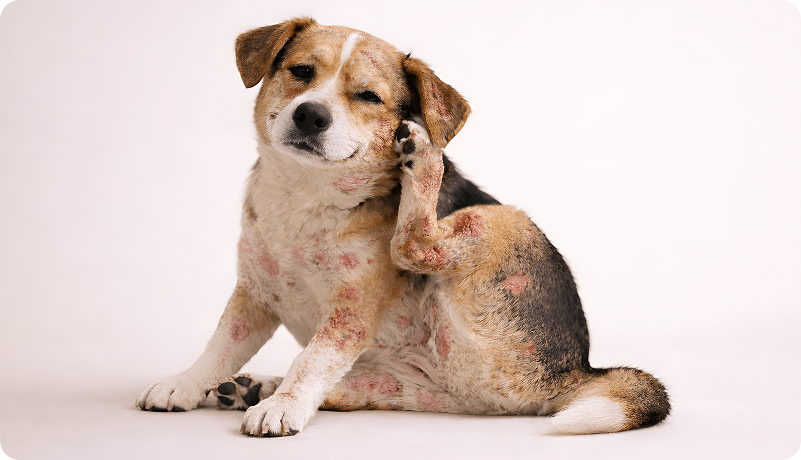
Sarcoptic mange in pets is a highly contagious skin condition that affects both dogs and cats. Also known as scabies, this parasitic infection is caused by microscopic mites that burrow into the outer layers of your pet’s skin. Once there, the mites live, reproduce, and lay eggs, triggering a strong allergic reaction that leads to intense itching, discomfort, and visible skin changes. While sarcoptic mange in pets can look alarming and may spread quickly, the good news is that this condition is treatable and curable when recognized early and managed with appropriate veterinary care.
Key Takeaways
- Sarcoptic mange (scabies) is a highly contagious parasitic skin disease caused by burrowing mites.
- In dogs, it is caused by Sarcoptes scabiei; in cats, a closely related mite (Notoedres cati) causes a similar condition.
- The disease spreads mainly through direct contact with infected animals.
- Sarcoptic mange is zoonotic, meaning people may develop a temporary itchy rash, which usually resolves once the pet is treated.
What is Sarcoptic Mange?
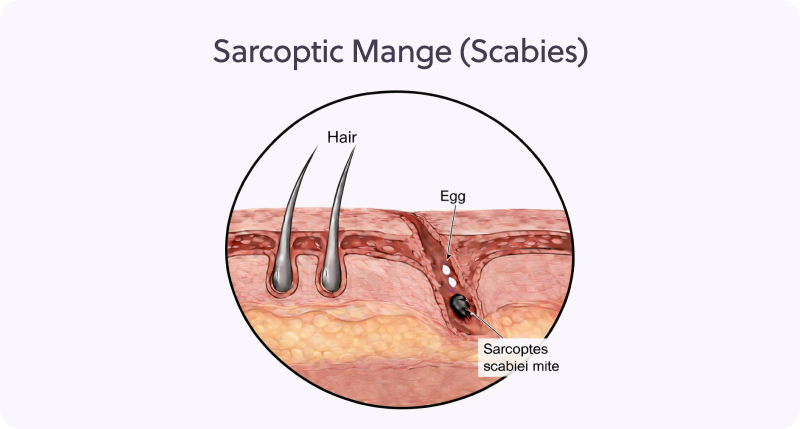
Sarcoptic mange, also known as scabies, is a highly contagious skin condition caused by parasitic mites that burrow into the outer layers of a pet’s skin 1 2. Once there, the mites live, reproduce, and lay eggs. Their presence triggers a strong allergic reaction, leading to intense itching, discomfort, and visible skin changes 3.
- In dogs, sarcoptic mange is caused by Sarcoptes scabiei 4
- In cats, a closely related mite called Notoedres cati causes a similar condition, often referred to as feline scabies 4
While the condition can look alarming and may spread quickly, the good news is that sarcoptic mange is treatable and curable when recognised early and managed appropriately with veterinary care.
How do Pets Catch Sarcoptic Mange?
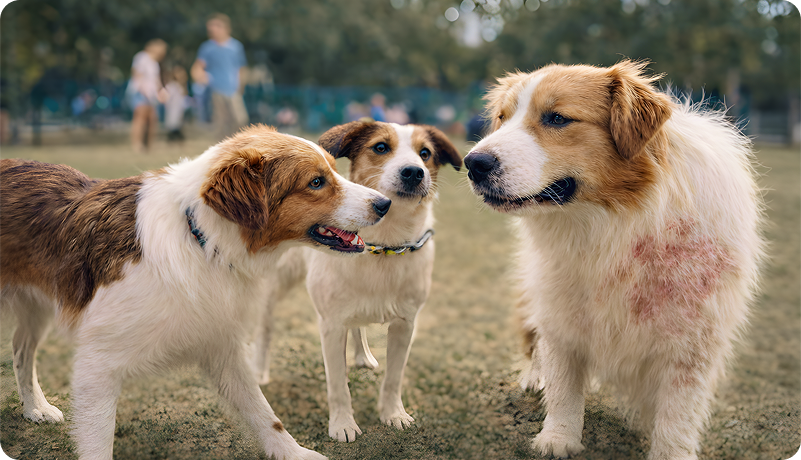
Sarcoptic mange spreads mainly through direct contact with infected animals. Less commonly, short-term contact with contaminated items such as bedding, collars, or grooming tools may also contribute to spread 1 5.
Common Situations That Increase Exposure
Common situations where pets may be exposed include:
- Contact with infected animals at parks, day care, boarding kennels, grooming facilities or shelters 5 6
- Living in multi-pet households 6
- Contact with wildlife, such as foxes (particularly for dogs) 5
However, one of the challenges with sarcoptic mange is that pets can be contagious before showing obvious signs. This allows mites to spread unnoticed if only visibly itchy animals are treated 7.
Who’s More at Risk
It’s important to note that sarcoptic mange is not caused by poor hygiene and can affect pets that are otherwise healthy and well cared for. However, animals with weakened immune systems, underlying medical conditions, or advanced age may be more susceptible or develop more severe symptoms 8. Males and females are affected equally, and there is no breed predisposition 1.
Why Sarcoptic Mange Matters for Pet Owners

Sarcoptic mange is zoonotic, meaning it can affect people who have close contact with an infected pet. In humans, exposure may cause an itchy, red, bumpy rash, with itchiness sometimes worse at night. Affected areas commonly include the arms, wrists, waist, abdomen or where the skin has had close contact with the pet 9 10. Importantly, the animal mite cannot reproduce on human skin. Therefore, symptoms are usually self-limiting and resolve once the pet has been treated and environmental exposure is reduced, however consult your doctor for advice 8 10
Signs of Sarcoptic Mange to Watch for
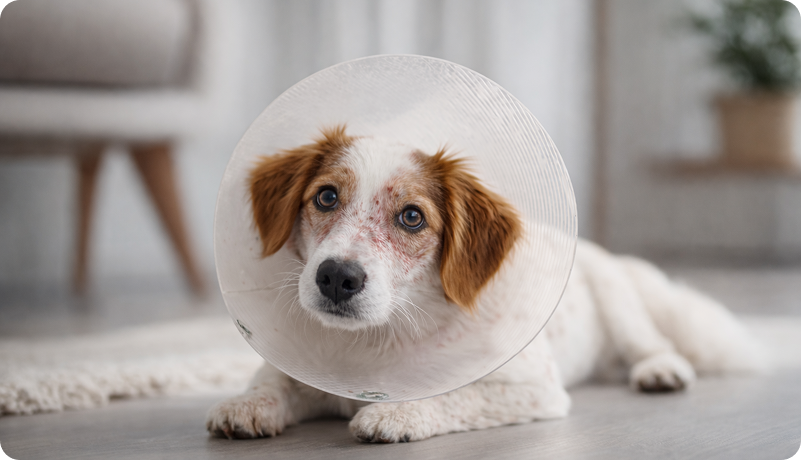
The most noticeable sign of sarcoptic mange is intense itching, which often begins weeks after exposure and tends to worsen over time.
Top 5 signs to look out for include:
- Persistent scratching, chewing, or rubbing 1
- Red, inflamed skin 1 2
- Scaly crusts, scabs, or thickened skin 1 2
- Hair loss 1 2
- Skin sores or secondary infections caused by scratching 1
Lesions tend to follow a characteristic pattern, usually starting on areas with less hair. These include:
Where Lesions Typically Appear
- The edges of the ears
- Elbows and hocks
- Abdomen and chest
- The face and around the eyes
As the condition progresses, larger areas of the body may become affected 11. Without treatment, itching can become severe and widespread, significantly impacting a pet’s comfort and quality of life.
How do Veterinarians Diagnose Sarcoptic Mange?
Diagnosing sarcoptic mange can be challenging, as the mites are difficult to find and no single test that detects every case.
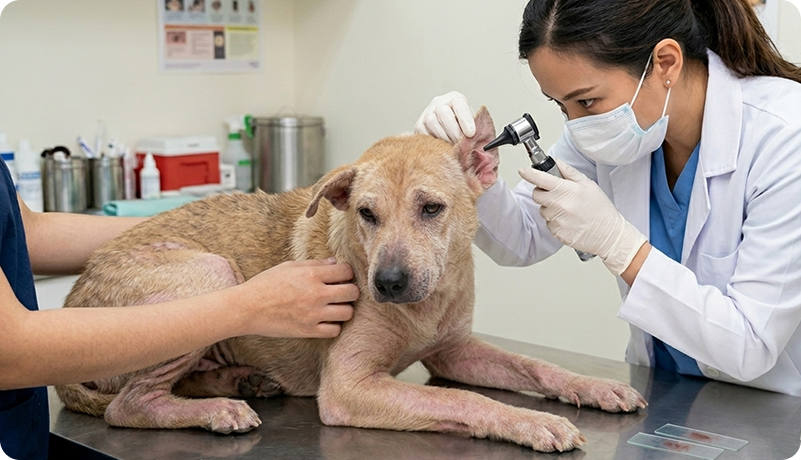
Veterinarians often rely on a combination of:
- Superficial skin scrapings and cytology to demonstrate the presence of mites, their eggs or waste material under a microscope 1 6
- Assessment of clinical signs and the distribution of skin lesions 1
- A treatment trial may be used, where medication is started based on strong suspicion and the pet’s response is monitored. This approach is often used because mites are difficult to detect early and sarcoptic mange can resemble food or environmental allergies, contact reactions to grass, and other parasitic conditions such as ear mites 1 6 7
What Does Treatment of Scabies Typically Involve?
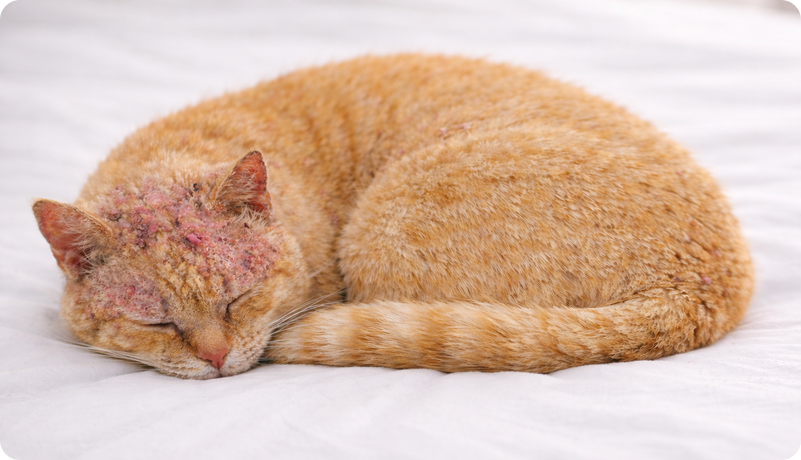
Fortunately, sarcoptic mange is highly treatable with modern veterinary medications. Treatment focuses on:
- Eliminating the mites
- Reducing itching and inflammation
- Treating any secondary skin infections, if present
- Preventing reinfestation
Medical treatment commonly includes:
- Prescription spot-on or oral antiparasitic medications 5 8
- Anti-itch treatments to improve comfort during recovery 6
- Antibiotics or antifungal medications if secondary infections are identified 6
The “Treat-All” Approach
Importantly, a key part of successful treatment is a “treat-all” approach. All pets in the household should be treated at the same time, even if they are not showing symptoms. Treating only the visibly affected pet often leads to reinfestation 6. Consult your veterinarian on the best treatment and approach for your pet.
Initially, some pets may appear itchier during the first week of treatment as the mites die, but this reaction is usually temporary. Most pets show noticeable improvement within 2 weeks, although full skin healing and hair regrowth may take longer 6.
Can Scabies be Prevented?
While exposure to sarcoptic mange cannot always be avoided, pet owners can help reduce the risk by:
- Using routine parasite prevention as recommended by their veterinarian
- Avoiding close contact with animals showing signs of skin disease
- Seeking veterinary advice promptly if a pet develops sudden or intense itching 12
- Keeping bedding, collars, and grooming tools clean 12
At room temperature and moderate humidity, sarcoptic mites usually survive only 24–36 hours away from a host. As a result, extensive cleaning of the home is not usually necessary. In cooler or more humid environments, mites may persist slightly longer. Simple measures, such as washing pet bedding, blankets, and frequently used items, are usually sufficient to reduce the risk of reinfestation, especially in multi-pet households 13.
What Options Can Pet Owners Explore if Their Cat or Dog Has Sarcoptic Mange?

A diagnosis of sarcoptic mange can feel overwhelming, but effective treatment and support are available.
Pet owners can:
- Work closely with their veterinarian to create a treatment and follow-up plan
- Discuss ongoing parasite prevention strategies to reduce future risk
- Ask about short-term medications to help manage itching and discomfort during recovery
- Consider pet insurance coverage to help manage unexpected veterinary costs
Early diagnosis and prompt treatment not only improve your pet’s comfort but also help limit the spread to other animals and people.
References
- Dumitrache MO, Cadiergues MC. The most effective systemic treatment in dogs with sarcoptic mange: a critically appraised topic. BMC Vet Res. 2023 Oct 5;19(1):189.[↩][↩][↩][↩][↩][↩][↩][↩][↩][↩][↩]
- Niedringhaus KD, Brown JD, Sweeley KM, Yabsley MJ. A review of sarcoptic mange in North American wildlife. International Journal for Parasitology: Parasites and Wildlife. 2019 Aug;9:285–97.[↩][↩][↩][↩]
- Colombo M, Morelli S, Sacra M, Trezza G, Paoletti B, Traversa D, et al. An Uncommon and Severe Clinical Case of Sarcoptes scabiei Infestation in a Cat. Pathogens. 2022 Dec 30;12(1):62.[↩]
- Malik R, Stewart KM, Sousa CA, Krockenberger MB, Pope S, Ihrke P, et al. Crusted scabies (sarcoptic mange) in four cats due to Sarcoptes scabiei infestation. Journal of Feline Medicine and Surgery. 2006 Oct;8(5):327–39.[↩][↩]
- Krieger K, Heine J, Dumont P, Hellmann K. Efficacy and safety of imidacloprid 10% plus moxidectin 2.5% spot-on in the treatment of sarcoptic mange and otoacariosis in dogs: results af a European field study. Parasitol Res. 2005 Oct;97(S1):S81–8.[↩][↩][↩][↩]
- Cornell University College of Veterinary Medicine. Sarcoptic mange (scabies) [Internet]. Ithaca (NY): Cornell University; [cited 2026 Jan 16]. Available from: https://www.vet.cornell.edu/departments-centers-and-institutes/riney-canine-health-center/canine-health-topics/sarcoptic-mange-scabies[↩][↩][↩][↩][↩][↩][↩][↩]
- Miller WH, Griffin GE, Campbell KL, Muller G, Kirk RW. Muller & Kirk’s small animal dermatology. 7th edition. St. Louis, Mo: Elsevier/Saunders; 2013. 938 p.[↩][↩]
- Hampel V, Knaus M, Schäfer J, Beugnet F, Rehbein S. Treatment of canine sarcoptic mange with afoxolaner (NexGard® ) and afoxolaner plus milbemycin oxime (NexGard Spectra® ) chewable tablets: efficacy under field conditions in Portugal and Germany. Parasite. 2018;25:63.[↩][↩][↩]
- Mitchell E, Wallace M, Marshall J, Whitfeld M, Romani L. Scabies: current knowledge and future directions. Front Trop Dis. 2024 July 23;5:1429266.[↩]
- Department of Health, Victoria. Scabies control guidelines [Internet]. Melbourne: Health Victoria; Reviewed 10 Jul 2024 [cited 2025 Jan 16]. Available from: https://www.health.vic.gov.au/infectious-diseases/scabies-control-guidelines.[↩][↩]
- Thomson P, O N, Ez A. Main mites associated with dermatopathies present in dogs and other members of the Canidae family. Open Vet J. 2023;13(2):131.[↩]
- Veterinary Partner. An overview of sarcoptic mange (scabies) in dogs [Internet]. Veterinary Information Network (VIN); 2023 Aug 24 [cited 2026 Jan 16]. Available from: https://veterinarypartner.vin.com/doc/?id=4951492&pid=19239[↩][↩]
- Ong CY, Vasanwala FF. Infected with Scabies Again? Focus in Management in Long-Term Care Facilities. Diseases. 2018 Dec 29;7(1):3.[↩]
Spotting the Signs: Why Is There Blood in My Pet’s Urine?

Finding blood in your pet’s urine can be alarming for any pet owner. This condition, known medically as haematuria, occurs when blood is present in a dog or cat’s urine and usually indicates an underlying health issue that needs investigation. You may notice blood as pink, red, or brown discolouration; otherwise, laboratory testing may be the only way to detect it. In particular, common causes include urinary tract infections, bladder stones, injury, prostate disease, and some cancers. Because of this, pet owners should not ignore even subtle changes in toilet habits, as these can be early warning signs.
Key takeaways
- Haematuria is the term used for blood in the urine and is a sign of an underlying issue, most commonly affecting the urinary tract 1.
- Urine may look pink, red, or brown, but changes such as straining, frequent urination, accidents, or genital licking can be just as important 1.
- Overall, a veterinary check is needed to find the cause, using a physical exam, urine tests, blood tests and/or imaging.
- Many causes are treatable, especially when caught early, and following your vet’s treatment plan improves outcomes.
Understanding Blood in Your Pet’s Urine (Haematuria)
Haematuria refers to the presence of blood in a pet’s urine and usually indicates an underlying health issue that needs investigation 2 3 Blood may be visible as discoloured urine or only detected on a urine test 2. Specifically, common causes include infections, urinary stones, injury, prostate disease, and some cancers. 4. Even subtle changes in toilet habits can be an early warning sign and should not be ignored.
Recognizing Symptoms of Blood in Pet’s Urine
Urine discolouration
First, one of the most noticeable signs of haematuria is a change in urine colour 1. Instead of the usual pale yellow, urine may appear pink, red, or brown when blood is present. 1. In particular, vets call this visible, or gross, haematuria and may be associated with conditions such as urinary tract infections, stones, or trauma 1 5 3 6.
If you are unsure, collecting a fresh urine sample in a clear container and holding it against a white background can make colour changes easier to assess. Some owners also find simple urine colour charts from their veterinary clinic or reputable pet health websites helpful.
Additionally, persistent reddish staining on bedding, puppy pads, litter trays, or around the vulva or prepuce can also indicate blood in the urine. Noting when the discolouration first appears, how long it lasts, and whether it occurs at the beginning, middle, or end of urination can help your veterinarian determine where the bleeding is coming from (for example, the bladder, urethra, kidneys, or genital tract) 2.
Subtle signs of haematuria
Not all haematuria is visible. Microscopic haematuria refers to blood in your pet’s urine that cannot be seen with the naked eye and is usually detected only through a urine test 2.
Even when urine looks normal, changes in urination may still occur. For instance, your pet might urinate more frequently, passing smaller amounts, straining in the litter tray or on walks, or hesitating before squatting 2. As a result, some pets may become unhouse-trained and urinate in unusual places, such as on tiles, carpets, or in showers, due to urgency or discomfort.
In addition, more general signs can also be present, including mild lethargy, abdominal discomfort, or a pet that simply seems “not quite itself”. These changes may accompany early kidney infections, urinary stones, or low-grade bladder inflammation 4 6.
Behavioural changes due to haematuria
Notably, behavioural changes can be an early indicator of urinary discomfort. Pets may appear restless, vocalise when urinating, avoid their usual toilet areas, or lick the genital area more frequently 7. Reduced appetite, withdrawal, or reluctance to play may also occur with ongoing urinary tract disease 4.
Haematuria in dogs vs cats

In cats, haematuria is often associated with feline lower urinary tract disease. Affected cats may strain in the litter tray, pass only small amounts of urine, vocalise, lick the genital area frequently, or urinate in unusual places such as sinks, bathtubs, or beds.
In dogs, haematuria can present differently depending on the cause. Male dogs with prostate disease may only see blood at the beginning or end of urination, or as intermittent drips between walks, even when the urine stream otherwise looks normal. In female dogs, vaginal bleeding can sometimes mix with urine, which makes it difficult to tell whether the blood is coming from the urinary or reproductive tract. Either way, a veterinary examination is important to identify the source.
Why is there blood in the urine?
Where does the bleeding come from?
Haematuria occurs when blood in your pet’s urine is present. It most commonly suggests irritation, inflammation, damage to blood vessels, or a problem with the body’s ability to clot blood. The bleeding can originate anywhere along the urinary tract, including the kidneys, ureters, bladder, urethra, and, in male dogs, the prostate.
True haematuria vs. pigment discolouration
Not all red or brown urine is caused by intact blood cells. In true haematuria, red blood cells are visible on urine testing. In other cases, urine discolouration may be caused by blood pigments released into the urine due to red blood cell breakdown or muscle damage. Although these conditions can look similar to the eye, laboratory testing allows veterinarians to distinguish between them and identify whether the cause is local to the urinary tract or related to a systemic condition.
What are the common causes of haematuria?
In most cases, haematuria comes from problems affecting the urinary tract (the kidneys, bladder, or urethra), but it can also be related to genital tract bleeding or whole-body conditions 4.
Urinary tract causes (most common)
- Urinary tract infections (UTIs)
- Bladder or kidney stones and urinary crystals
- Inflammation of the bladder, including idiopathic cystitis (especially in cats)
- Trauma to the kidneys, bladder, or urethra
- Tumours or other growths within the urinary tract
- Polyps in the bladder or urethra
UTIs occur more often in female pets and are more common in dogs than cats, while idiopathic cystitis is the most common cause of haematuria in cats. 5 4, while idiopathic cystitis is the most common cause of haematuria in cats 4.
Genital tract causes (may look like haematuria)
- Prostate disease in male dogs
- Bleeding during heat (oestrus) in entire female dogs
- Inflammation, trauma, or tumours of the vagina or prepuce
Less common systemic causes
- Bleeding or clotting disorders (coagulopathies)
- Blood vessel abnormalities
How is haematuria diagnosed by a veterinarian?
Your vet’s goal is to work out where the blood is coming from and why, so the most appropriate treatment can be started. This is usually done through a step-by-step approach.
Your vet’s diagnostic approach
Discussing your pet’s history
To start, your vet will ask when you first noticed the blood or changes in urination, whether it comes and goes, and if there have been any recent changes at home. This information provides important clues about the source of the problem.
Performing a physical examination
Your vet will carry out a full physical exam, paying close attention to the abdomen, bladder, kidneys, and genital area. In male dogs, the prostate may also be examined.
Testing a urine sample
A urine test (urinalysis) confirms the presence of blood and check for infection, crystals, inflammation, or other abnormalities 1 8. If your vet suspects bacteria, they may run a urine culture to identify the best antibiotic 1.
Running blood tests
Blood tests help assess kidney function, check for infection or inflammation, and identify issues such as major blood loss or clotting problems 2.
Using imaging when needed
Your vet may recommend X-rays or ultrasound to look for stones, tumours, blockages, or structural changes within the urinary tract 4 6.
How does a vet treat haematuria?
Treatment for haematuria depends on what is causing the bleeding. Because haematuria is a symptom, your veterinarian will first identify the underlying cause and then tailor treatment to your pet.
Common treatment options
- Medications
Antibiotics may be used for urinary tract infections, while pain relief or anti-inflammatory medication is often prescribed to reduce discomfort and bladder irritation 1.
- Dietary changes
If crystals or bladder stones are involved, a prescription diet may be recommended to help dissolve crystals, prevent stone formation, and support urinary health 1 6.
- Increased water intake
Encouraging your pet to drink more helps dilute the urine and flush the urinary tract, reducing irritation and supporting recovery 6.
- Stress management (especially in cats)
Since haematuria in cats is often linked to stress-related bladder inflammation, treatment may focus on reducing stress at home or their environment rather than antibiotics.
- Procedures or surgery
Your pet may need surgery or other procedures for bladder stones, tumours, obstructions, or major trauma 4 6.
Can haematuria be prevented?
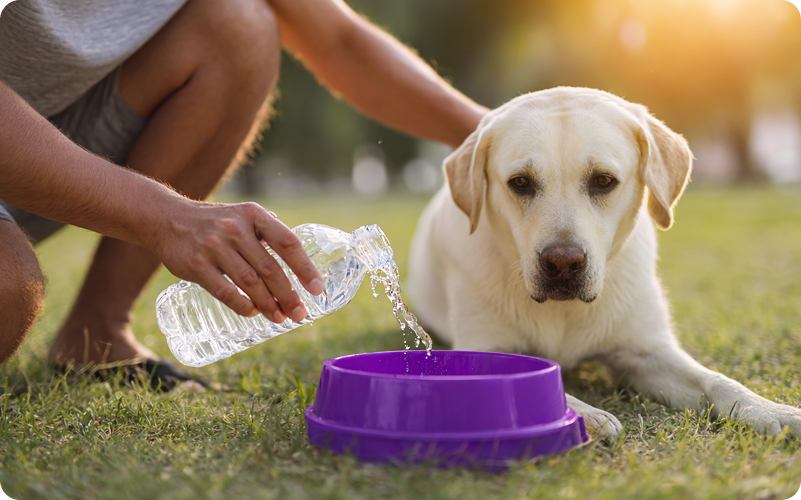
That said, not all causes of haematuria can be prevented, but early detection and good daily care can reduce the risk of urinary problems and help catch issues sooner.
What owners can do
- Monitor urination habits
Keep an eye on urine colour, frequency, and ease of urination. Pink, red, brown urine, straining, frequent small amounts, or accidents should be checked by a vet, even if your pet seems otherwise well.
- Encourage good hydration
Fresh water should always be available. Wet food, multiple water bowls, or water fountains (especially for cats) can help increase water intake and support urinary health.
- Reduce stress (especially for cats)
Stress can trigger bladder inflammation in cats. Maintaining routine, providing enrichment, and keeping litter trays clean and accessible can help reduce flare-ups.
- Provide appropriate diet and toilet access
Feeding a balanced diet suited to your pet’s age and health, and allowing regular opportunities to urinate (walks for dogs, clean litter trays for cats), supports normal bladder function.
- Attend regular veterinary check-ups
Routine exams, urine tests, and bloodwork when recommended can detect urinary or kidney problems early, sometimes before visible blood appears.
Conclusion
Blood in your pet’s urine can be alarming, but many causes of haematuria in dogs and cats are treatable, especially when caught early. With prompt investigation and appropriate treatment, many underlying causes can be effectively managed or resolved. Noticing changes early, following veterinary advice, and having pet insurance in place can make navigating diagnosis and treatment much easier.
Is haematuria covered by pet insurance?
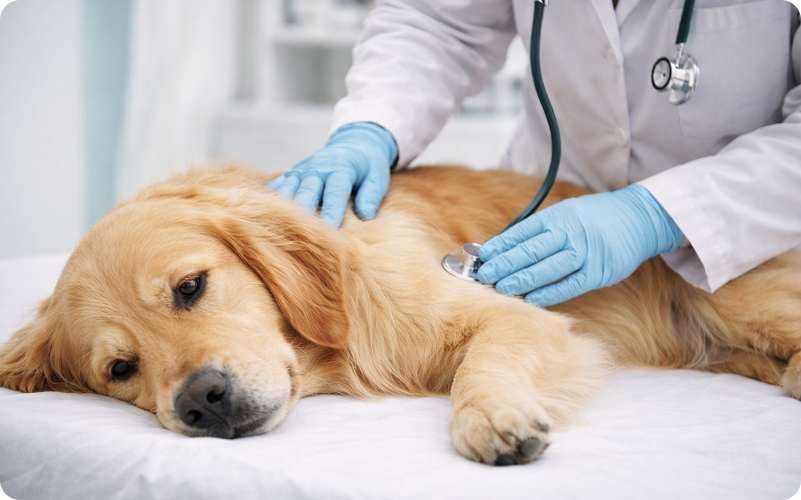
How Petsy Pet Insurance may help
Haematuria links to a range of conditions, from urinary tract infections and bladder stones to more serious illnesses that require ongoing care or surgery. Petsy Pet Insurance may help cover eligible veterinary costs associated with diagnosing and treating haematuria, depending on the underlying cause and your individual policy.
References
- Yadav SN, Ahmed N, Nath AJ, Mahanta D, Kalita MK. Urinalysis in dog and cat: A review. Vet World. 2020;13(10):2133-41.[↩][↩][↩][↩][↩][↩][↩][↩][↩]
- Thompson M, Watson ADJ. Stranguria and haematuria. BSAVA Manual of Canine and Feline Nephrology and Urology: BSAVA Library; 2017. p. 1-7.[↩][↩][↩][↩][↩][↩]
- Ford RB, Mazzaferro EM. Section 3 – Clinical Signs. In: Ford RB, Mazzaferro EM, editors. Kirk and Bistner’s Handbook of Veterinary Procedures and Emergency Treatment (Eighth Edition). Saint Louis: W.B. Saunders; 2006. p. 387-448.[↩][↩]
- Nelson RW, Couto CG. Small Animal Internal Medicine: Small Animal Internal Medicine – E-Book. 6 ed. Chantilly: Elsevier; 2019.[↩][↩][↩][↩][↩][↩][↩][↩]
- Byron JK. Urinary Tract Infection. Veterinary Clinics: Small Animal Practice. 2019;49(2):211-21.[↩][↩]
- Lulich JP, Berent AC, Adams LG, Westropp JL, Bartges JW, Osborne CA. ACVIM Small Animal Consensus Recommendations on the Treatment and Prevention of Uroliths in Dogs and Cats. J Vet Intern Med. 2016;30(5):1564-74.[↩][↩][↩][↩][↩][↩]
- Veterinary Partner. Hematuria (Blood in the Urine) in Dogs and Cats [Internet]. VIN; c2024 [cited 2026 Jan 20]. Available from: https://veterinarypartner.vin.com/default.aspx?pid=19239&catId=254073&id=6465677[↩]
- Ford RB, Mazzaferro EM. Section 3 – Clinical Signs. In: Ford RB, Mazzaferro EM, editors. Kirk and Bistner’s Handbook of Veterinary Procedures and Emergency Treatment (Eighth Edition). Saint Louis: W.B. Saunders; 2006. p. 387-448.[↩]
Periodontal Disease in Pets: What You Need to Know
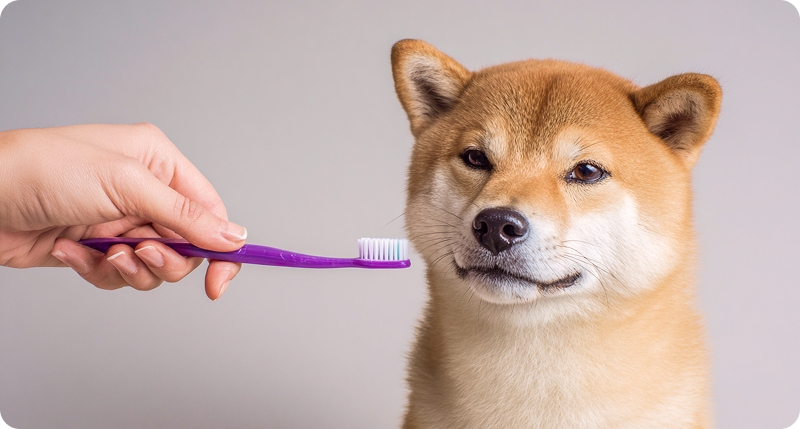
- A progressive condition: Periodontal disease is a progressive inflammatory condition that starts with simple plaque build-up but can lead to permanent damage to your pet’s teeth and gums if not addressed early.
- Subtle early signs: Signs are often subtle, so knowing the early red flags can prevent irreversible oral trauma.
- Prevention is best: Daily tooth brushing remains the “gold standard” (most effective way) method for reducing plaque and lowering the risk of periodontal disease.
What is Periodontal Disease?
Just like humans, dogs and cats are highly susceptible to periodontal disease (also known as dental disease, gum disease or periodontitis), and it’s more common than many pet parents realise. By the age of two, approximately 80% of dogs and 70% of cats already show signs of dental disease 1.
Periodontal disease is a progressive inflammatory condition that gradually damages the teeth, gums, and supporting structures, including the periodontal ligament and surrounding bone. If left untreated, the infection can lead to gum recession, chronic pain, persistent bad breath, loose teeth, and systemic health issues.
How Does Dental Disease Occur?
The process begins with plaque, the fuzzy film you might notice on your teeth surfaces before brushing in the morning 2. It is made up of bacteria, food particles and components of saliva.
- Plaque formation: After every meal, bacteria and food particles cling to the tooth surface and collect along the gum line.
- Mineralisation: If not removed regularly, the plaque combines with minerals in the saliva and hardens into calculus (also known as tartar) within 48 to 72 hours.
- Infection: The bacteria in the plaque will trigger gum inflammation. Calculus provides a rough surface which traps more bacteria and further irritates the gums. Over time, the inflammation will spread below the gum line and permanently damage the tissues and bones that support the teeth.
Note: While regular brushing removes plaque, only a professional veterinary scaling under anaesthesia can remove hardened calculus 1.
Stages of Periodontal Disease
- Gingivitis (Stage 1): The early, reversible stage. Gums appear red, swollen and may bleed slightly. Professional cleaning by a veterinarian and improved home care can return the mouth to a healthy state.
- Periodontitis (Stage 2): An early stage of periodontal disease where plaque and bacteria extend below the gum line, causing inflammation of the tissues supporting the teeth. Gums may appear red, swollen or slightly receded, and bad breath is often present. At this stage, changes are generally mild and, with prompt professional veterinary treatment and improved home dental care, the condition can often be stabilised and in many cases reversed before permanent damage occurs.
- Periodontitis (Stage 3-4): The advanced, irreversible stage. Inflammation spreads deep into the tooth socket, which may causeing permanent bone loss and tissue destruction 3.
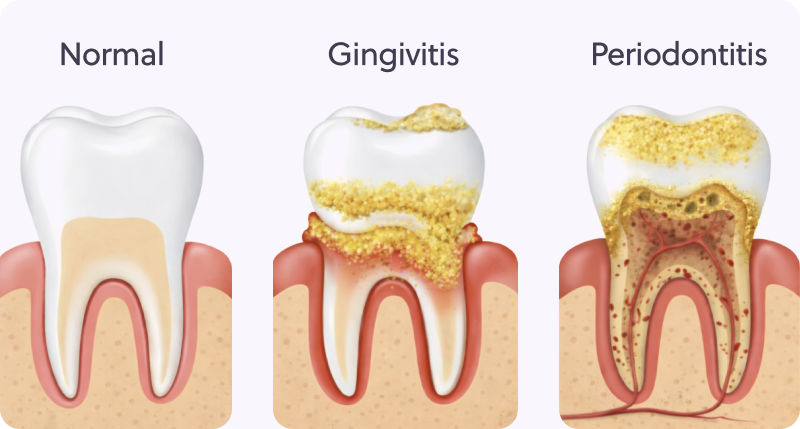
Which pets are most at risk of Periodontal Disease?
While any pet can develop dental issues, certain factors can increase the risk:
Common breeds at risk
- Dogs: Cavalier King Charles Spaniel, Toy Poodle, King Charles Spaniel, Yorkshire Terrier and Greyhounds 4.
- Cats: Siamese, Maine Coon 3.
Other risk factors:
- Size: Small and toy breeds are highly prone due to crowded teeth and short jaws, which create more areas for plaque to hide 5.
- Age: The risk increases significantly as pets get older.
- Dental care: A lack of regular home dental care and professional veterinary cleanings 6.
- Diet: Certain diets may predispose to dental decay.
- Systemic links: Periodontal disease is a systemic concern. Chronic oral inflammation has been associated with heart, kidney, and liver issues 4.
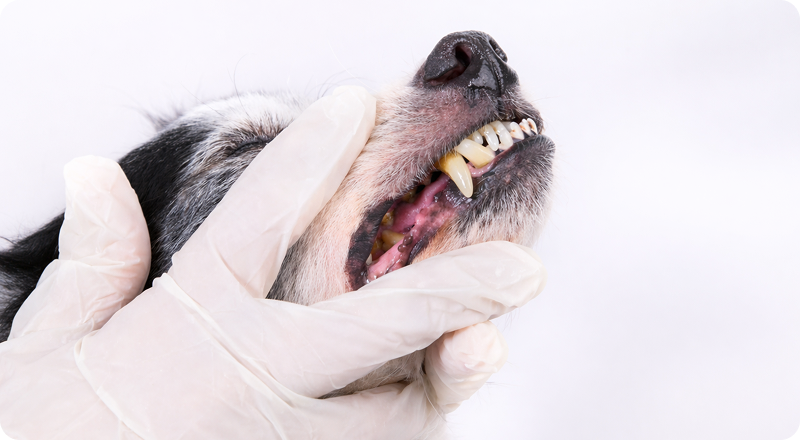
Recognising the Clinical Signs
Periodontal disease can develop quietly. Watch for:
- Persistent bad breath: Often the first noticeable sign.
- Gums: Red, inflamed, bleeding or recessed.
- Eating habits: Sudden reluctance to eat hard food, dropping food or unusual chewing patterns.
- Behavioural changes: Decreased grooming or play, pawing at the face or becoming “head shy”.
- Teeth: loose or missing teeth, visible calculus (yellow or brown) 1.
Dogs vs. Cats
While both dogs and cats are susceptible to periodontal disease, there are slight differences.
- Prevalence: Periodontal disease is generally more common in dogs.
- The “silent feline patient”: Cats are notorious for masking physical discomfort. Instead of obvious dental pain, subtle indicators such as appetite shifts, decreased grooming and a lack of interest in dry food are often the only early warning signs 7.
When to Schedule a Vet Visit?
If you notice signs of dental disease, schedule a veterinary examination as soon as possible. Early detection not only prevents permanent damage and chronic pain, but also makes treatment simpler, less invasive and more affordable.
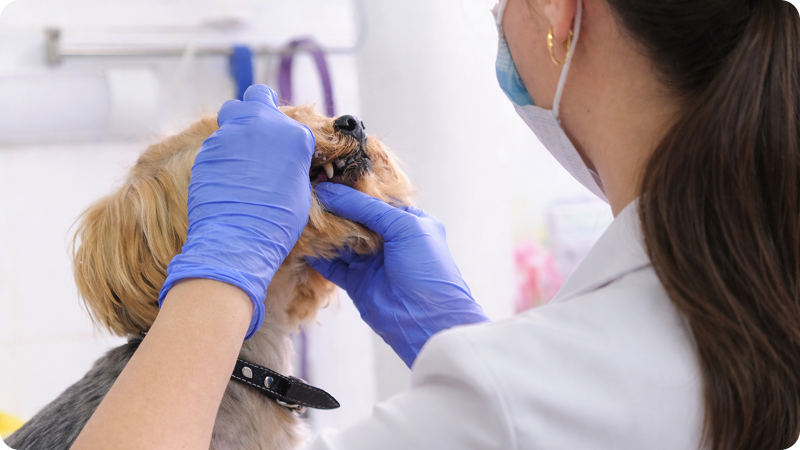
How a Veterinarian Diagnoses Periodontitis
As most of the damage happens beneath the gum line, a definitive diagnosis requires a professional exam under general anaesthesia. This allows the vet to:
- Perform full mouth dental X-rays (essential to assess disease severity).
- Examine each tooth carefully.
- Measure gum pocket depths 8.
Treatment Options
- Early stages: Professional cleaning (scaling and polishing) followed by strict home care.
- Advanced stages: Professional cleaning (scaling and polishing), tooth extractions, periodontal surgery 4.
Prevention and Management
Effective prevention is a combination of home care and professional oversight.
- Monitor for early signs and regular checkups: Ensure you schedule annual dental examinations to catch problems early.
- Daily brushing: The most effective way to manage plaque is daily or regular brushing with pet-safe toothpaste 9. Could you imagine if you never brushed your own teeth? The dental bills would be staggering!
- Supportive dental products: Water additives, dental diets, chews and toys can help slow plaque accumulation 10.
Important: While dental chews, diets and water additives are great support tools, they don’t replace the benefits of regular tooth brushing.
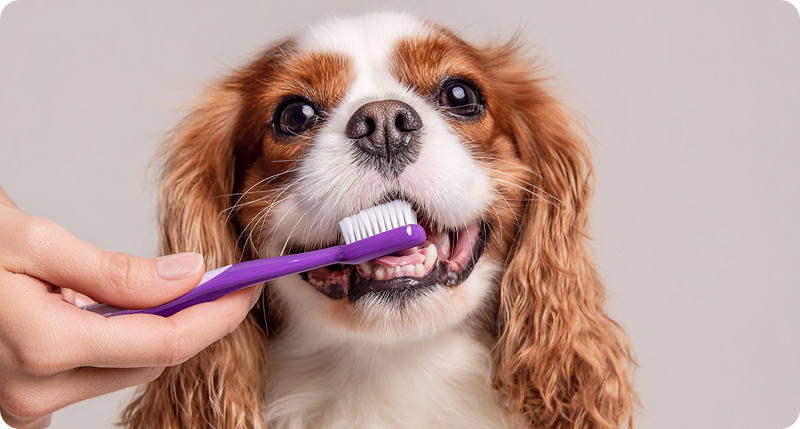
Tips for brushing success
- Brushing action is key: Tooth brushing is effective even without toothpaste, however using flavoured, pet-safe toothpaste can make the experience more enjoyable.
- Introduce the taste: Start by letting your pet lick small amount of flavoured, pet safe toothpaste off your finger.
- Acclimatise to touch: Gently lift your pet’s lips and gums with your finger. Once comfortable, introduce the toothbrush by touching it briefly to their front teeth.
- Master the technique: Once your pet is ready, use a gentle circular motion and angle the bristles at 45° towards the gum line.
- Positive reinforcement: Always follow a brushing session with high value rewards. Whether it’s a favourite toy, extra praise or some yummy treats, ending on a high note creates a positive association.
- Start small, then expand: Keep sessions short and stress free. Begin with the front teeth, then gradually move toward the back molars, increasing the duration as your pet becomes more relaxed 11.
Can Pet Insurance Cover Periodontal Disease?
Petsy Pet Insurance may cover Vet Treatments for dental illnesses such as gingivitis and periodontitis if dental coverage is selected, and provided it is not a Pre-Existing Symptom and Condition. Routine or elective preventive care, like professional teeth cleaning, is not covered unless prescribed for a diagnosed condition. Dental coverage is only available for pets under three years of age at the time of applying for optional extra benefits.
References
- Mulherin BL. Periodontal disease in small animals [Internet]. [cited 2026 Jan 20]. Available from: https://www.msdvetmanual.com/digestive-system/dentistry-in-small-animals/periodontal-disease-in-small-animals[↩][↩][↩]
- Pereira dos Santos JD, Cunha E, Nunes T, Tavares L, Oliveira M. Relation between periodontal disease and systemic diseases in dogs. Research in Veterinary Science. 2019 Aug;125:136–40. doi:10.1016/j.rvsc.2019.06.007[↩]
- O’Neill DG, Blenkarn A, Brodbelt DC, Church DB, Freeman A. Periodontal disease in cats under Primary Veterinary Care in the UK: Frequency and risk factors. Journal of Feline Medicine and Surgery. 2023 Mar;25(3). doi:10.1177/1098612×231158154[↩][↩]
- O’Neill DG, Mitchell CE, Humphrey J, Church DB, Brodbelt DC, Pegram C. Epidemiology of periodontal disease in dogs in theukprimary‐care veterinary setting. Journal of Small Animal Practice. 2021 Aug 9;62(12):1051–61. doi:10.1111/jsap.13405[↩][↩][↩]
- Periodontal Disease in Small Animals [Internet]. [cited 2026 Jan 20]. Available from: https://www.merckvetmanual.com/[↩]
- Santibáñez R, Rodríguez-Salas C, Flores-Yáñez C, Garrido D, Thomson P. Assessment of changes in the oral microbiome that occur in dogs with periodontal disease. Veterinary Sciences. 2021 Nov 27;8(12):291. doi:10.3390/vetsci8120291[↩]
- Bend JE. Educating pet owners beyond the gumline [Internet]. Royal Canin Academy; [cited 2026 Jan 20]. Available from: https://academy.royalcanin.com/en/veterinary/educating-pet-owners-beyond-the-gumline[↩]
- Bellows J, Berg ML, Dennis S, Harvey R, Lobprise HB, Snyder CJ, et al. 2019 Aaha Dental Care Guidelines for dogs and cats*. Journal of the American Animal Hospital Association. 2019;55(2):49–69. doi:10.5326/jaaha-ms-6933[↩]
- Niemiec B, Gawor J, Nemec A, Clarke D, McLeod K, Tutt C, et al. World Small Animal Veterinary Association Global Dental Guidelines. Journal of Small Animal Practice. 2020 Jul;61(7). doi:10.1111/jsap.13132[↩]
- Harvey C, Serfilippi L, Barnvos D. Effect of frequency of brushing teeth on plaque and calculus accumulation, and gingivitis in dogs. Journal of Veterinary Dentistry. 2015 Mar;32(1):16–21. doi:10.1177/089875641503200102[↩]
- Gawor J, Jank M, Harvey CE, Nicolas CS. Effectiveness of dental homecare protocols in unscaled dogs. Journal of Veterinary Dentistry. 2024 Nov 25;42(3):176–81. doi:10.1177/08987564241292769[↩]