
| Key symptoms | Coughing, faster breathing at rest or during sleep, exercise intolerance, lethargy, appetite changes, weight loss, restlessness at night |
| Commonality | High in small and toy breed dogs, rare in cats |
| Transmission | Not contagious |
| Impact on health | Mild to severe (depending on stage) |
| Treatment cost | ~ $1,500 to over $5,000 AUD (depending on disease severity and treatment) |
| Treatment duration | Typically life-long once medication is started |
| Ease of prevention | Not a preventable condition as it is associated with genetics and age |
Most affected dog breeds
If your vet has just told you your dog has a heart murmur and it’s likely Myxomatous Mitral Valve Disease (MMVD), it’s completely normal for your mind to jump to the worst-case scenarios. Hearing “heart disease” can feel overwhelming, and it’s easy to start thinking in short timelines. But in most cases, that’s not how this condition unfolds at all.
Normal valve function
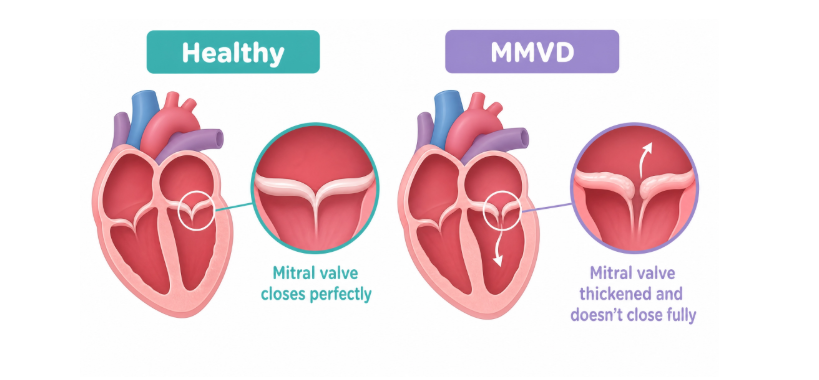
The mitral valve sits between the left atrium and the left ventricle, the two chambers on the left side of the heart. In a healthy heart, the valve leaflets shut like a well-cut door in a good frame, held in place by the chordae tendineae that act as the “strings” that anchor the valve to the ventricle. With every beat, blood moves forward into the aorta, and the body gets its supply.
What does wrong in MMVD
In MMVD, the valve tissue thickens and becomes nodular, and stops closing properly.
Inside the leaflets, waxy substances build up that cause the tissue to stretch and balloon back into the heart chamber above, instead of sealing shut as they should. The delicate strings holding the valve in place (the chordae tendineae) can stretch too, and in rare cases one can snap entirely, which is why an apparently stable dog can deteriorate overnight.
The result of all this is that the valve leaks. With every heartbeat, some blood flows backwards into the left atrium instead of being pushed forward around the body; this is called mitral regurgitation. Over time, the heart has to work harder to compensate: the left atrium stretches, then the left ventricle enlarges to keep pace. For years, and sometimes even many years, the heart manages this remarkably well, and your dog looks completely fine. That’s what makes this disease so deceptive.
Eventually, the pressure on the left side of the heart rises beyond what it can handle. That pressure backs up into the lungs, and fluid begins leaking into the air spaces. This is pulmonary oedema, and it marks the onset of congestive heart failure (CHF).
Breeds
MMVD is responsible for around 70–75% of all heart disease cases in dogs. It’s heavily skewed toward small and toy breeds, and the risk increases with age.
Cavalier King Charles Spaniels are the poster breed for MMVD. They develop the disease younger and far more commonly than other breeds. One prevalence study estimates their risk to be 20 to 30 times higher than that of mixed-breed dogs, and virtually all Cavaliers are expected to develop the disease by 10 years of age. Targeted screening programmes in places like Denmark and the UK have actually delayed the average age of onset in Cavaliers by up to two years, which proves that ethical breeding makes a real difference.
Other commonly affected breeds include Dachshunds, Miniature and Toy Poodles, Chihuahuas, Maltese, Pomeranians, Yorkshire Terriers, Shih Tzus, Miniature Schnauzers, and Cocker Spaniels.
In large breed dogs, MMVD is uncommon compared with small breeds, but it can still occur. When it does, it may be accompanied by other cardiac changes such as abnormal heart rhythms, which can make disease progression and prognosis more variable and less predictable.
Age & Sex
Age is the quiet driver. The older the dog, the more likely the valve has been quietly degenerating. Mild sex patterns appear in some studies, but in real life it’s less “male versus female” and more “how long has this valve been under strain, given the dog’s genetics and build.”
If you have a high-risk breed, this is the key takeaway: documented cardiac screening of breeding dogs is far more meaningful than general claims of “no heart problems in our lines” without supporting test results.
Vets follow a four-stage system by the ACVIM consensus guidelines to describe where a dog is on the MMVD journey. It is used as a guide to whether treatment is needed, when to start it, and which medications are most appropriate.
| Stage | What's happening | What you might notice at home | Typical next move |
|---|---|---|---|
| A | At-risk breed, no murmur | Nothing | Annual check-ups, smart breeding choices |
| B1 | Murmur present, no heart enlargement | Usually nothing | Monitor every 6–12 months |
| B2 | Murmur and measurable enlargement | Often still nothing visible | Start pimobendan, closer follow-up |
| C | Current or past episode of CHF | Cough, fast breathing, fatigue | Diuretics plus core CHF meds |
| D | CHF that no longer responds to standard treatment | Breakthrough symptoms despite therapy | Specialist management, advanced options |
Stage B1 vs B2
Stage B1 is often the “watch and monitor” phase of MMVD. A heart murmur is present, but the heart has not yet changed enough to justify starting certain medications. At this stage, many dogs still feel completely normal and can continue living happy, active lives. Your veterinarian will usually recommend regular rechecks, may suggest an echocardiogram to assess the heart more closely, and will monitor for any signs that the disease is beginning to progress.
Stage B2 is the “don’t ignore this” stage even if your dog looks completely normal. There is evidence of heart enlargement on imaging, and starting pimobendan now buys real time. The EPIC trial, a huge, multi-centre randomised study, showed that pimobendan in B2 dogs delayed the onset of CHF by a median of about 15 months, and extended overall survival by around five months.
Stage C and D
Stage C means CHF has happened, typically with pulmonary oedema. From here, treatment shifts from “delay” to “manage”: getting fluid out of the lungs, easing the workload on the heart, and keeping breathing comfortable.
Stage D is the advanced stage of MMVD, where CHF becomes difficult to control despite standard treatment. Dogs in this stage often need higher medication doses, additional drugs, and much closer monitoring to keep them comfortable. The focus shifts toward maintaining quality of life, managing breathing difficulties, and supporting both the dog and owner through a more fragile phase of the disease.
Typical timelines
Many owners want a clear timeline for how MMVD will progress, but the reality is that every dog follows a different path. Some dogs remain in Stage B1 for years with very little change, while others progress more quickly into Stage B2 or congestive heart failure. Sudden complications such as chordal rupture, tricuspid valve disease, or arrhythmias can also dramatically alter the course of the disease. The most important thing is not predicting exactly how the disease will progress, but monitoring closely enough to recognise changes early and respond before problems become more serious.
The reality with the early stages of MMVD is that many dogs show no obvious symptoms at all. The heart is still compensating effectively, so most dogs continue to run, play, sleep, and behave completely normally. When something does start to show, here’s what you might notice:
Treat as an emergency if you notice:
If you do one thing for a dog with MMVD, do this: track sleeping respiratory rate.
A sleeping dog can’t fake their breathing. While they’re resting or sleeping (not dreaming), count how many breaths they take in 15 seconds (one breath is one rise and fall of the chest), then multiply by four. That’s their breaths per minute. For most dogs, a normal breathing rate during sleep is under 30 breaths per minute (bpm), including dogs with well-controlled heart disease.
Call your vet if:
Sleeping respiratory rate is the most validated, owner-friendly way to catch pulmonary oedema early, often a day or two before the cough and breathlessness arrive. Write the numbers down in a notes app or a simple log. Pattern matters more than any one reading.
A murmur during a routine check-up is usually the first clue. Murmurs are graded 1 to 6 on loudness, and while louder generally means more leak, the relationship isn’t perfect. Staging depends on what’s happening inside the heart, not just what it sounds like.
From there, vets layer in:
Treatment matches the stage. Doing too much too early causes problems and doing too little once CHF arrives causes a faster decline.
| Stage | Typical medication | What it's doing |
|---|---|---|
| A and B1 | None | No drug benefit yet, focus on monitoring |
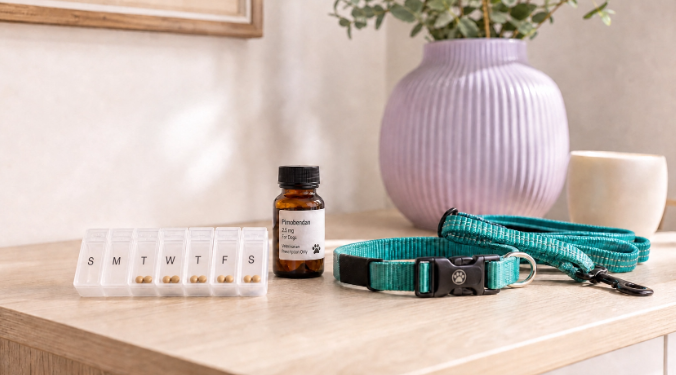
| B2 | Pimobendan (~0.25–0.3 mg/kg every 12 hours) | Delays the onset of CHF, reduces remodelling load |
| C | Pimobendan + diuretic (frusemide/furosemide) + ACE inhibitor + spironolactone | Clears lung fluid, stabilises pressures, supports function |
| D | Switch to or add torsemide, optimise dosing, add sildenafil if pulmonary hypertension is present | Manage refractory CHF, maintain quality of life |
Frusemide (fru-see-mide) is the standard first-line diuretic used to manage fluid overload in MMVD, while torsemide (tor-seh-mide) is a more potent, longer-acting alternative often reserved for more advanced or difficult-to-control cases of heart failure. Both work by helping the body remove excess fluid and ease breathing. Dogs on diuretics need regular bloodwork to check kidney function and electrolytes.
A subset of dogs with advanced MMVD develops secondary pulmonary hypertension (pul-muh-nair-ee hy-per-ten-shun) on top of everything else, which adds further strain on the heart and can make clinical management more complex. Sildenafil (sil-den-uh-fil; yes, the same drug humans take for a different reason) is the go-to treatment.
Diet plays a supportive but not primary role in managing MMVD in dogs. While it cannot stop the progression of the disease, veterinary guidelines recommend maintaining a balanced, high-quality diet that supports lean body condition and avoids excess sodium, particularly as heart disease advances. In later stages, moderate sodium restriction may help reduce fluid retention and ease the workload on the heart, while ensuring adequate protein and calories is important to prevent muscle loss. Omega-3 fatty acids are also commonly recommended for their anti-inflammatory and potential cardiac benefits. Overall, nutrition is used alongside medication to support quality of life rather than as a standalone treatment.
Surgical options for MMVD in dogs do exist, but they are highly specialised and not commonly performed in Australia. There are two main procedures: open-heart mitral valve repair using cardiopulmonary bypass, and minimally invasive transcatheter repair (TEER), which works on the beating heart. Both aim to reduce the leaking through the mitral valve rather than just manage symptoms with medication.
In Australia, these procedures are only available in a small number of specialist referral centres and are typically reserved for carefully selected cases. Availability is limited, and not every dog is a suitable candidate due to the strict assessment criteria, surgical risk, and required cardiac anatomy.
Cost is also a major factor. Surgery is usually considered a very high-cost option, often ranging from tens of thousands of dollars (commonly around $40,000-$70,000 depending on the procedure and case complexity), which places it beyond the scope of standard treatment for most pet owners.
In terms of prognosis, successful surgical repair can significantly extend survival and may offer a near-normal quality and length of life in selected dogs, whereas medical therapy alone focuses on slowing progression and managing symptoms but cannot stop the underlying valve disease from advancing.
For most dogs in Australia, MMVD is therefore managed medically with long-term medication, monitoring, and quality-of-life support, with surgery remaining an uncommon but emerging option in select cases.
For most dogs on medical management, life looks pretty normal between vet visits. Your role becomes part-monitor, part-medicator, part-record-keeper.
A simple home routine that works:
What you might pay and where insurance fits in
Heart disease management isn’t cheap, and the costs add up over years rather than hitting you all at once.
The medical management of MMVD is usually a long-term, ongoing cost rather than a single treatment expense. For dogs in the earlier stages, medication and routine monitoring typically cost a few hundred dollars per month, depending on the dog’s size and treatment plan. As the disease progresses, costs increase due to the need for multiple heart medications, more frequent vet visits, imaging such as x-rays or echocardiograms, and occasional emergency care if heart failure develops. Overall, the financial commitment tends to rise steadily with disease severity, particularly once clinical heart failure is present.
For surgery in Australia, the upfront cost is substantial and generally not covered unless your dog has comprehensive pet insurance with high annual limits. The commonly quoted $40,000-$70,000 AUD range typically includes the procedure and immediate specialist hospital care, but does not usually account for referral travel, pre- and post-operative diagnostics, or the cost of managing any complications that may arise afterwards.
This is where having pet insurance in place before a heart murmur is detected matters. Once MMVD is diagnosed, it becomes a pre-existing condition, meaning any policy taken out after that point won’t cover it. There is also a 14-day waiting period from when your policy starts, so any signs or symptoms that appear in that window will be excluded too.
Petsy covers heart conditions and heart disease like any other illness, with no sub-limits on what we’ll pay toward eligible vet costs, but only when the policy is in place before any clinical signs appear. If you’ve got a high-risk breed such as a Cavalier, Dachshund, Cavoodle, Maltese, or small mixed-breed, getting cover sorted while your dog is young and healthy is the single most useful financial move you can make.
Owners always want a timeline. Vets rarely give one because the variation is genuinely huge.
What we know:
These numbers are not a fixed outcome or a prediction of what will happen, but a general guide to help understand the disease.
Polite vagueness doesn’t help your dog. These are fair, useful questions:
Yes. Many do, especially when caught early and managed properly by stage. The dogs that struggle are usually those whose disease isn’t detected until well into CHF, or whose owners can’t keep up with monitoring and medications.
No, and that’s a common misdiagnosis trap. Cough has many causes in older small-breed dogs (collapsing trachea, chronic bronchitis, kennel cough), and “cardiac cough” is genuinely overdiagnosed. Chest X-rays and an echocardiograph are how vets separate the two.
Sometimes, not always. Murmur intensity is a clue, but staging depends on heart enlargement and regurgitation severity, not just sound.
In Stage B1 and most of B2, normal sensible activity is fine and probably helpful. Once a dog is in CHF, exercise should be adjusted to what they can comfortably handle, and your vet can help you draw that line.
Yes, in a small number of carefully selected dogs with open-heart valve repair or newer transcatheter procedures. However, it’s not a routine treatment and it comes with significant cost and strict eligibility criteria.
The genetic contribution is strong, especially in Cavaliers. It’s polygenic (pol-ee-jen-ik), meaning multiple genes are involved and heritability estimates for murmur severity are high. If you’ve got a related dog and they are a predisposed breed, it is recommended to get them checked.
MMVD is common, slow-moving for most dogs, and very manageable when you’re paying attention. The take-home messages are:
If your dog has just been diagnosed, take a breath. The work ahead is monitoring, medicating, and showing up for rechecks. Not glamorous work, but it’s the work that buys time and quality of life. Your vet is your team-mate in this, and with the right plan in place, most dogs do far better than that first scary diagnosis suggests.
Marcella is a final year Doctor of Veterinary Medicine student at The University of Sydney with a strong passion for small animal medicine and animal welfare. She enjoys helping pet owners better understand their pets’ health and wellbeing, with particular interests in preventative healthcare and dentistry. In her free time, Marcella likes to explore new food spots and binge Netflix shows.
Specified Conditions includes:
Lumps means the protuberance or localised area of swelling or unusual growth that can occur anywhere on or in the body including tumours, warts, cysts, growths, mucoceles, haematomas and abscesses.
You can apply to reduce the 6-month exclusion period for Specified Conditions by using our request for Waiver Form. Simply take this form to your next vet visit and submit the completed form back to [email protected] within 14 days of the visit.
During the application process You will be provided with the option to include Optional Extra Benefits that cover certain conditions and Treatments which are not otherwise covered under the Policy.
The Optional Extra Benefits are:
Alternative Therapies, Behavioural Problems, and Dental Illness.
Examples of Alternative Therapies: Acupuncture, physiotherapy, hydrotherapy.
Examples of Behavioural Problems: Excessive licking, fur pulling, pacing and destructive chewing.
Examples of Dental Illnesses: Dental diseases, gingivitis, periodontal disease.