
| Key symptoms | Limping, stiffness, swelling around the knee, reluctance to bear weight, reduced mobility |
| Commonality | Very common in dogs, rare in cats |
| Transmission | Not contagious |
| Impact on health | Moderate to Severe depending on severity |
| Treatment cost | ~$1,500 to $7,000 AUD (depending on surgery type and recovery) |
| Treatment duration | Â 6 weeks to 6 months (depending on treatment) |
| Ease of prevention | Difficult |
Most affected dog breeds
Most affected cat breeds
The cruciate ligament is like a strong rope inside your pet’s knee joint that keeps the bones stable when they walk or run. When this ligament stretches or tears, it causes pain and makes the leg unstable. You might notice your pet limping or holding their leg up.
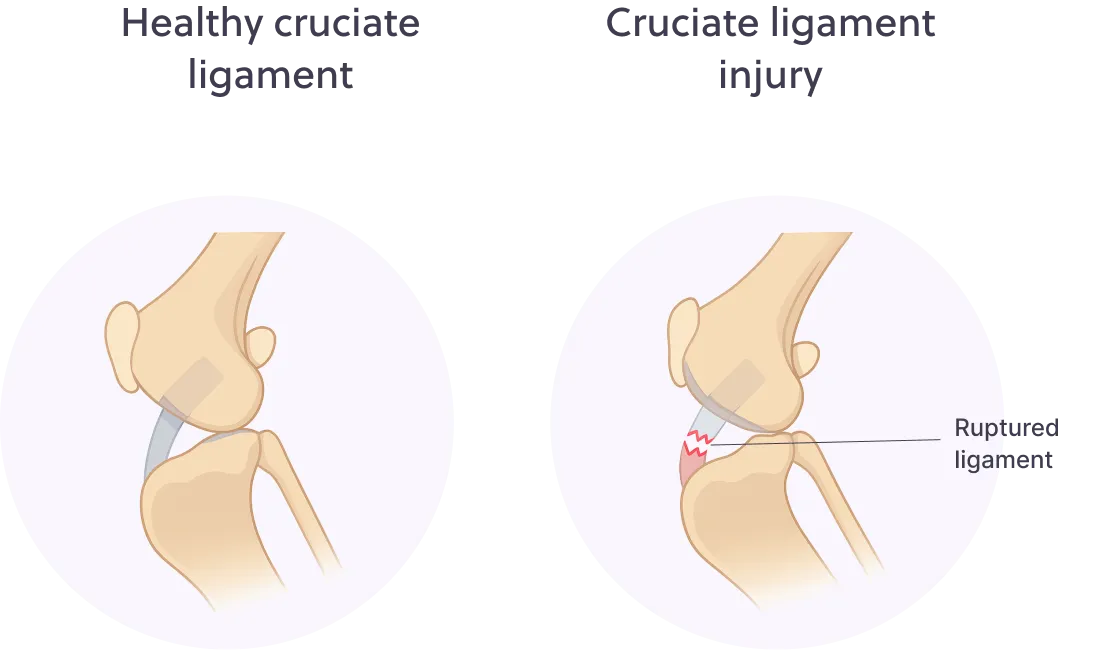
Cruciate ligament damage involves partial or complete rupture of the cranial cruciate ligament (CCL) in dogs or the cranial cruciate ligament (CrCL) in cats. This ligament stabilises the stifle (knee) joint, preventing the tibia from sliding forward under the femur. Rupture leads to joint instability, inflammation, and progressive osteoarthritis.
Cruciate ligament injuries are painful and can greatly affect mobility. Without treatment, pets may develop chronic arthritis or permanent lameness. Early diagnosis and appropriate management, including surgery or physiotherapy, can restore function and quality of life.
The cruciate ligament connects the femur (thigh bone) to the tibia (shin bone) inside the knee. When this ligament tears, the bones move abnormally, causing pain and swelling.
There are two cruciate ligaments in each knee:
Damage can range from a mild sprain to a full rupture. In most dogs, the injury develops gradually due to degeneration, not just trauma.
Degenerative changes
Over time, the ligament weakens and becomes more likely to tear, especially in middle-aged or large-breed dogs.
Obesity
Excess weight puts strain on the knees, increasing the risk of tearing the ligament.
Sudden movement or trauma
A sudden twist or jump can cause the ligament to rupture, especially during play or exercise.
Genetics and breed predisposition
Some breeds are more prone to ligament injuries due to their anatomy or rapid growth patterns.
Poor conditioning
Weak muscles and limited exercise increase the risk of ligament injury by reducing joint stability.
Early signs:
Advanced signs:
Tip:
If your dog suddenly limps or can’t put weight on a hind leg, book a vet visit immediately. Early intervention helps prevent further joint damage.
Physical examination
Your vet will test for instability in the knee using the cranial drawer test or tibial thrust test.
Imaging
Sedation
In some cases, sedation may be required for accurate assessment, as muscle tension can mask instability.
Treatment depends on the size, age, and activity level of your pet, as well as the severity of the tear.
For small dogs, cats, or partial tears:
Surgery is usually recommended for larger dogs or complete ruptures. Common techniques include:
Your vet will recommend the most suitable option based on your pet’s size, age, and activity level.

Recovery
Most pets stay at the vet for one to two nights after surgery. Full recovery typically takes 8 to 12 weeks. Controlled rest, gradual exercise, and physiotherapy are essential.

Rehabilitation
Hydrotherapy, stretching, and muscle strengthening exercises help restore movement and prevent stiffness.

Long-term care
Weight control, regular vet checks, and joint supplements such as glucosamine can help prevent arthritis and support long-term health.
Costs vary based on surgery type, pet size, and recovery requirements.
Prices vary by clinic and location. Pet insurance can help manage the high cost of surgery and rehabilitation.
Maintain a healthy weight
Keeping your pet at a healthy weight reduces pressure on their joints.
Regular exercise
Moderate, consistent exercise helps strengthen muscles and ligaments. Avoid sudden high-impact play or rough surfaces.
Joint supplements
Provide supplements containing glucosamine, chondroitin, and omega-3 fatty acids to support joint health.
Warm-Up before activity
Gentle warm-ups before exercise can reduce the risk of sudden strain.
Early intervention
If your pet shows any signs of limping or stiffness, seek veterinary attention before the condition worsens.
What is Petsy Pet Insurance?
Petsy reimburses 80% or 90% of eligible vet costs for unexpected illnesses or injuries once exclusion periods have passed. You can customise your cover, and your vet can often submit claims directly for faster processing.
Petsy also offers a complimentary Pre-Existing Condition Assessment to help clarify what is covered based on your pet’s medical history.
What is a pre-existing symptom or condition?
Petsy covers eligible costs for cruciate ligament damage as long as it’s not pre-existing and no signs or symptoms of cruciate ligament damage appeared during the exclusion period. Starting your policy early ensures your pet is protected before any symptoms arise.
Cruciate ligament damage is a Specified Condition that has a 6 month exclusion period. Once this period has passed without symptoms, it may be covered if it is not pre-existing.
Does Petsy cover Cruciate Ligament Damage?
Petsy covers eligible costs for cruciate ligament damage as long as it’s not pre-existing and no signs or symptoms of cruciate ligament damage appeared during the exclusion period. Starting your policy early ensures your pet is protected before any symptoms arise.
How Petsy pet insurance can help
Surgical repair and rehabilitation for cruciate ligament damage can be expensive. Petsy Pet Insurance can help to cover eligible costs for surgery, medication and rehabilitation related to cruciate ligament damage. Optional Extra Benefits including coverage for rehabilitation and specialised therapies is available for pets younger than 3 years old at the time of adding it onto the policy.
You can apply to reduce the 6 month exclusion period for Specified Conditions including cruciate ligament damage.
How to apply:
You can find the form under Policy Documents on our website or contact us directly to request a copy.
Cruciate ligament damage is a painful but treatable condition that commonly affects dogs. With early diagnosis, the right surgery, and careful rehabilitation, most pets regain full mobility and return to their normal activities. Maintaining a healthy weight, monitoring for early signs, and having pet insurance in place can make managing this condition much easier
It is an injury to the ligament in the knee joint that stabilises movement. A tear or rupture causes pain and instability.
Large and active breeds such as Labradors, Rottweilers, and Boxers.
Yes, but it is rare. It usually occurs in overweight or older cats after trauma.
Treatment can include rest, physiotherapy, or surgery depending on severity.
You can reduce risk by maintaining a healthy weight, providing regular exercise, and avoiding excessive jumping.
Specified Conditions includes:
Lumps means the protuberance or localised area of swelling or unusual growth that can occur anywhere on or in the body including tumours, warts, cysts, growths, mucoceles, haematomas and abscesses.
You can apply to reduce the 6-month exclusion period for Specified Conditions by using our request for Waiver Form. Simply take this form to your next vet visit and submit the completed form back to [email protected] within 14 days of the visit.
During the application process You will be provided with the option to include Optional Extra Benefits that cover certain conditions and Treatments which are not otherwise covered under the Policy.
The Optional Extra Benefits are:
Alternative Therapies, Behavioural Problems, and Dental Illness.
Examples of Alternative Therapies: Acupuncture, physiotherapy, hydrotherapy.
Examples of Behavioural Problems: Excessive licking, fur pulling, pacing and destructive chewing.
Examples of Dental Illnesses: Dental diseases, gingivitis, periodontal disease.